
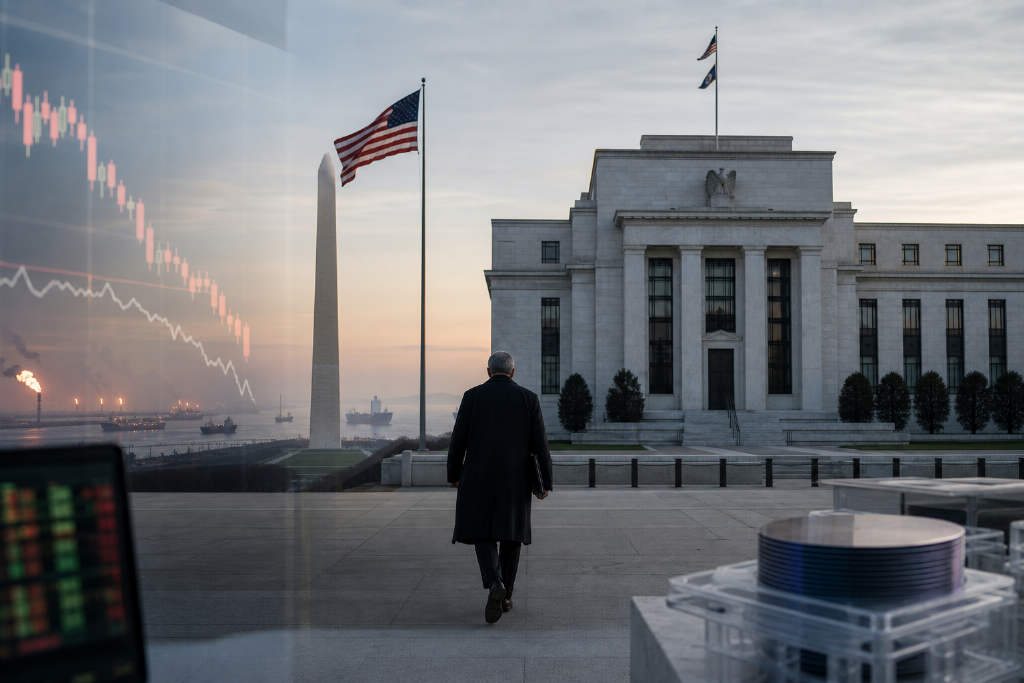
ABMedia said the latest selloff is being driven by more than the usual list of market headwinds. In its view, the pressure comes from two forces hitting at once: inflation risk linked to the Strait of Hormuz and a Federal Reserve that is no longer willing to tell markets where policy is headed in advance.

The report opened with the immediate market damage. The Philadelphia Semiconductor Index dropped 4.98% overnight, TSMC ADR fell 4.07%, and AI-related shares closed broadly lower. In Taiwan, the benchmark index finished at 44,719.35, down 1.30%, after sliding as low as 44,308.71 during the session.
Why the selling has been so concentrated
ABMedia wrote that investors have no shortage of visible negatives to point to: weaker valuations in AI and semiconductors, oil-driven inflation risk, the 10-year U.S. Treasury yield back at 4.71%, softer economic and consumer momentum, and a Fed that is in no position to cut rates under that mix. Still, the article argued that those factors alone do not explain why the selling has been so sharp and so concentrated.
Its main argument is that markets are still anchored to an older Fed era, one in which the central bank would step in quickly and offer clear direction. According to the report, that era ended. During the pandemic, the Fed had to dominate markets with every tool available. What the U.S. faces now, however, is a capital-expenditure cycle driven by AI, and the Fed’s role in that setting is different.
Markets are testing Chair Warsh’s Fed
According to the article, Warsh took office as Fed chair on May 22, 2026, and held his first press conference on June 17. He said the central bank was entering a “new chapter” and created five working groups to review policy communication, the balance sheet, data use, productivity and employment, and the inflation framework.
ABMedia highlighted what it called his most important line from his confirmation hearing: “Unlike many of my colleagues, I do not believe in forward guidance… I should not tell you in advance what future decisions will be.” The article also said he indicated he could end the release of quarterly economic projections and the dot plot.
That, the report said, is not ambiguity. It is a direct statement that he does not intend to spell out the Fed’s stance ahead of time. For more than a decade, markets have been used to extracting the next policy step from the dot plot, statement language, and the chair’s press conference. Warsh, in ABMedia’s telling, is trying to remove exactly those signposts.
The article pointed to another line as equally important: “Focus on the left side of the decimal point, not the right.” It interpreted that to mean Warsh cares more about whether inflation is 3% or 4% than whether it is 3.4% or 3.3%. For a market accustomed to parsing tiny month-to-month CPI changes, that suggests the reaction function has changed.

At the same time, ABMedia said Warsh’s own signals are not fully consistent. He has blamed post-pandemic inflation on excessive Fed stimulus and supports shrinking the current balance sheet of about $7 trillion, which the article described as hawkish. But when he was nominated last year, he was also widely read as aligned with the White House on rate cuts, pointing in a dovish direction.
A chair who wants balance-sheet reduction, is seen as leaning toward rate cuts, and refuses to provide forward guidance leaves markets unable to infer behavior from rhetoric alone, the report said. In an earlier guidance-heavy regime, those contradictions would have been pressed in a post-meeting news conference. In a no-guidance regime, the article argued, markets can only test the answer through price action.
ABMedia added an important caveat: Warsh’s institutional review does not mean he has already decided not to support markets. The present decline, it said, may be the test through which investors learn whether he will respond the way prior Fed chairs did.
Hormuz and oil are at the start of the chain
The article traced the source of the current pullback not to U.S. equities but to the Middle East. It said the Strait of Hormuz has been effectively closed since fighting broke out in late February 2026. The International Energy Agency estimates that global oil demand will decline by an average of 1.6 million barrels per day this year as a result.
ABMedia also said a memorandum of understanding signed in June expired on Monday this week, leaving little sign of progress toward peace as of publication. For the U.S., the report argued, higher oil prices feed the kind of inflation that is hardest for the Fed to deal with. July headline CPI rose 3.4% year over year, while the energy component climbed 14.7% and gasoline rose 24.6%.
That leaves the Fed stuck, in the article’s framing. Rate cuts cannot bring down oil-led inflation, while rate hikes cannot reopen the strait. On July 29, the Fed kept its policy rate in a 3.50% to 3.75% range, and three officials favored a 25-basis-point increase.
With rates not falling, long-dated Treasury yields remain elevated. The 10-year yield has returned to 4.71%. For equities, ABMedia wrote, that yield functions as the discount rate that determines what future earnings are worth today. Companies whose profits are pushed further into the future suffer the biggest valuation hit, and AI names fit that profile. In that sense, the article said, the market is not declaring AI over. It is repricing the same future earnings stream at a far higher discount rate than when yields were near 3%.
Correction, not crash
On the question of whether the decline is over, ABMedia first tried to set the scale of the move. This is a correction, it said, not a crash. The S&P 500 only set a fresh record closing high on Aug. 13 and has been pulling back since then. On Aug. 18, the VIX closed at 15.84, showing higher anxiety but still some distance from disorder. In Taiwan, the market has fallen 6.33% from its June 22 peak of 47,741.51 through the Aug. 19 close.
The report laid out three things to watch next:
- Whether the 10-year Treasury yield stops rising. ABMedia described this as the direct driver of valuation compression.
- Whether negotiations around Hormuz show progress. Oil sits at the start of the chain, and if the strait stays shut, inflation pressure will be harder to ease.
- Whether markets can identify the Fed’s reaction pattern. The article called this the hardest variable to quantify, but also one that determines when volatility stops expanding.
It added that a real bottom may arrive only when the VIX spikes, panic becomes widespread, and bad headlines no longer push prices to new lows.
What may hold up after the washout
ABMedia said the screening criteria for companies change once rates are back above 4%. Firms that remain standing after this drawdown, in its view, will likely need to pass four tests:
- Free cash flow must be strong enough to fund capital spending without relying on fresh financing.
- Debt structures cannot depend on a low-rate environment.
- The business needs pricing power.
- AI investment must translate into revenue, orders, or productivity, not just a larger capital-expenditure line on the income statement.
For Taiwan, the article made a point of separating valuation pressure from the underlying economy. It cited export data showing July exports at $75.30 billion, up 32.9% year over year, with exports for January through July up 44.7%. In the report’s reading, the basic picture has not deteriorated. The current decline is more about a global AI position and valuation reset feeding into Taiwan than about a demand problem in Taiwan itself.
Still, the supply chain is split in two, according to ABMedia. One group consists of companies with real orders and revenue already coming through. The other is made up of companies whose price-to-earnings multiples were inflated mainly by the AI theme. In a rising discount-rate environment, the latter group is likely to come under pressure first and may struggle to regain momentum even after a bottoming phase.
The article ended by framing the market in terms of two distinct bets. One is a bet that the AI earnings cycle is not over. The other is a bet that the Fed will eventually return to market support. The first can be checked against company earnings. On the second, the report said, nobody knows the answer yet.