

MarsBit has published its Weekly Editor’s Picks for Oct. 17-23, bringing together a broad set of stories on macro markets, regulation, crypto trading, AI infrastructure and security. The outlet said the column is meant to surface analysis with decision-making value at a time when fast-moving headlines can bury deeper reporting.

Macro themes: U.S. elections, gold’s drop and a stronger yen
In the macro section, MarsBit reviewed three possible outcomes for the U.S. midterm election and what each could mean for President Donald Trump. The piece said Trump’s approval rating has fallen to the lowest level of his presidency, while polling shows Democrats in a favorable position in the election race. Even so, a Democratic win in one or both chambers would not hand the party control of the White House’s executive power. Trump would still retain veto authority and broad executive powers in areas including tariffs, immigration and foreign policy.
The roundup said that no matter which party ends up controlling Congress, a 2027 fight over raising the debt ceiling and funding the federal government is still likely. Two economists cited in the piece expect markets and investors to face a volatile year.
Another macro story focused on the unusual divergence between the U.S. dollar, Treasuries and gold. Bond yields have been moving lower, but that has not supported precious metals. Gold has traded weakly while the yen has strengthened sharply. According to the summary, that combination may suggest intervention designed to push the yen higher, a development that would usually weigh on the dollar. Gold has now given back its gains since August, erasing almost the entire rally. At the same time, global risk assets have come under pressure, and the effect of forced unwinds may still be spreading.
MarsBit also highlighted Goldman Sachs’ suggestion to watch short USD/JPY as a low-cost hedge against an AI bubble. The argument is that Japan’s savings have continued to flow overseas, especially into U.S. bonds and equities, helping fund the boom in American asset markets. If investors start marking down expectations for U.S. growth, that capital flow could reverse, increasing pressure for Japanese money to return home and lifting the yen. The piece added that the yen has extended its rise to the strongest level in more than a month, while a sell-off in technology shares has pushed investors toward traditional havens including the Japanese currency, Japanese government bonds and U.S. Treasuries.
Investing and startups: BTC, Hyperliquid, perpetual DEXs and Papertrade
In the investing and startup section, MarsBit revisited how BTC performed after four past midterm elections. The takeaway was that BTC is now much more integrated into traditional financial channels and increasingly trades like a high-beta risk asset, with stronger links to U.S. equities, dollar liquidity and global risk appetite. That means shifts in policy expectations around the midterms are likely to feed into BTC price action. The article also stressed that this should not be read as BTC being directly tied to election results. The point is that, in the current cycle, BTC’s sensitivity to macro risk appetite has become unusually high.
On Hyperliquid’s expansion on the retail side, MarsBit cited research by Hyperdash co-founder Hanson Birringer. Across six major applications connected to Hyperliquid, retail users have lost a combined $280 million, involving about 400,000 traders. Those losses came from two sources: trading P&L and fees. Fees made up the larger share, accounting for more than half of the loss figure slightly above $126 million. BTC was the most traded market and also the one where users suffered the heaviest losses.
The article said these applications did achieve the original goal of Builder Code by bringing Hyperliquid new traders, volume and fees. But many of the users they attracted lost most of their capital through overtrading, fee drag and liquidations. Most stopped trading after the third month.
MarsBit also covered who really benefits from perpetual DEX fee generation. Citing PerpsAtlas, it said 38 perpetual DEXs generated about $125 million in user fees over the past 30 days. Hyperliquid alone contributed $84.55 million, and the top five platforms accounted for 85.6% of the total. The piece argued that traders bear the cost and generate the fees, yet platforms often use that revenue to buy back tokens and reward tokenholders first, not necessarily the users creating the income. In that framing, tokenomics can support token value, but it cannot replace trader economics. Users farming airdrops pay a certain cost up front, while any chance of breaking even depends on token valuations they do not control, and even that assumes the project eventually launches a token.
The roundup added that PopDEX’s idea of being trader-first means technical investment has to show up in lower all-in trading costs, more stable execution and more efficient capital use.
IOSG’s analysis of Papertrade supplied another set of figures. Of the $63.2 million in net trader losses, $54.1 million, or 86%, went to PAPER stakers. Another $4.7 million sat with LPs, while developers received about $4.5 million, or 7%. The top 1,000 wallets held 88% of PAPER, absorbed 81% of all losses and took 91% of the distributions. MarsBit summed that up as a casino that returns the house take to gamblers. The article also said revenue came in waves tied to volume washing, PAPER had a market price but thin depth, and solvency had remained intact.
AI and storage: Nvidia, CoreWeave and crypto AI revenue
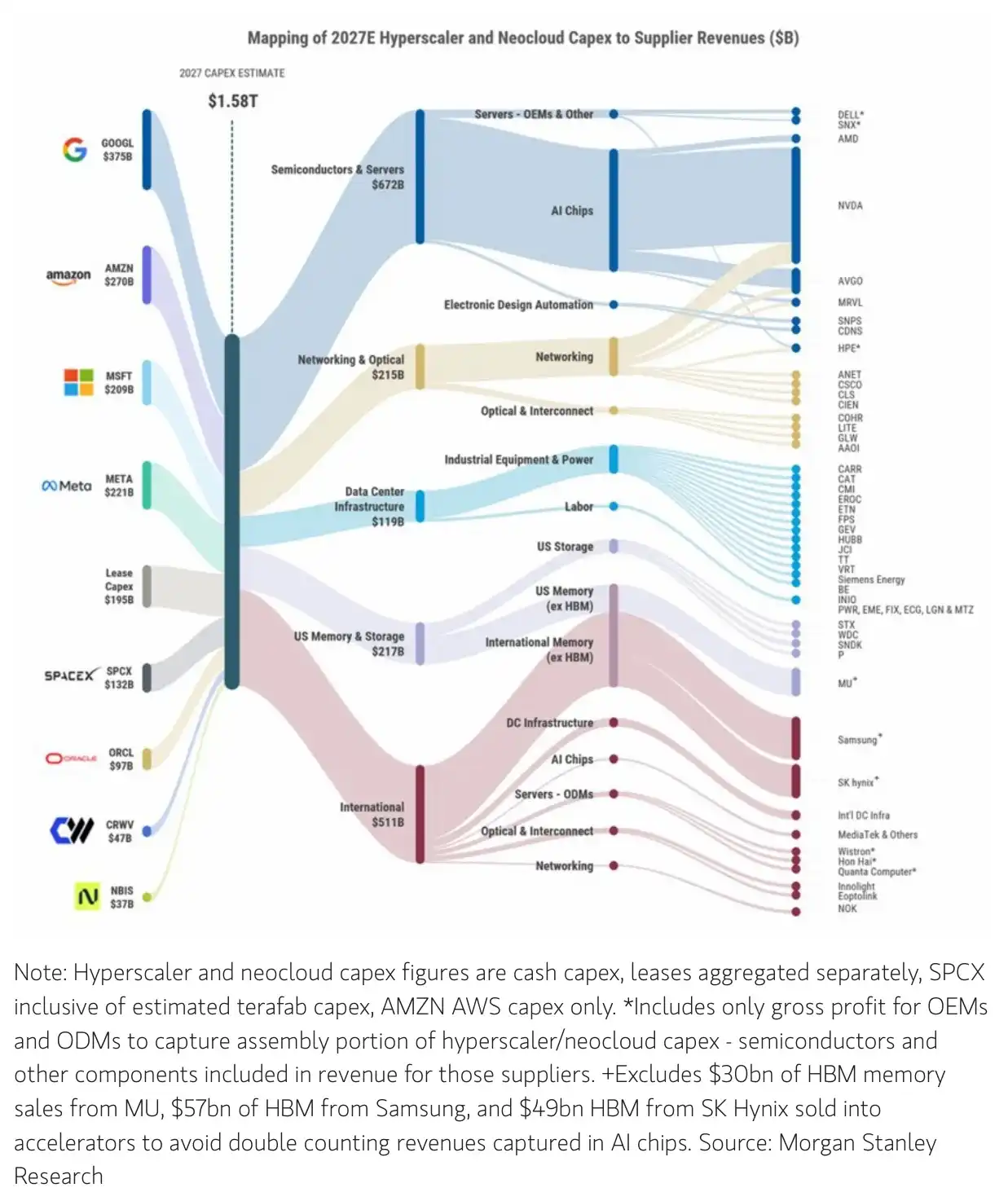
In AI and storage, MarsBit said capital flows remain highly concentrated. Out of $1.58 trillion in spending by hyperscale cloud providers, roughly two-thirds of the S&P 500’s benefit went to Nvidia alone, while the other 499 index members shared about $339 billion. The article said AI capital expenditure is set to directly drive about 25% of S&P 500 sales growth, and AI-related companies are expected to contribute 78% of the index’s earnings growth in 2027.
It also pointed to more than $1.1 trillion in disclosed lease commitments that hyperscalers have not yet started. MarsBit described this as synthetic capex: it does not appear under capital expenditure on cash flow statements, but in economic terms it functions like debt financing. The piece said 2027 is likely to be the year when hyperscalers face their largest free cash flow gap, with debt financing pressure rising sharply.
On CoreWeave, MarsBit noted that yields on the company’s unsecured bonds have climbed to about 15%, while CDS spreads have moved above 1,000 basis points, prompting questions about systemic risk across the AI capex cycle. Still, the article argued that CoreWeave looks more like the episode of panic triggered by Silicon Valley Bank in 2023 than the subprime crisis of 2008. In that view, the market is using a very small and structurally fragile instrument as a barometer for a trillion-dollar AI spending cycle. It added that the market may be looking at the wrong reference point, because the unsecured bond market does not reflect CoreWeave’s true marginal financing cost.
MarsBit also examined the crypto AI sector, saying that a market framed around “trillion-token” narratives is generating only $8.7 million in monthly revenue. Most of that revenue is concentrated in platforms that control model supply or user access. Many gateways simply wrap APIs from OpenRouter or Venice into crypto-paid products and add markups of 4% to 30%, leaving them exposed to replacement by upstream providers once usage scales. Users who pay the premium are doing so mainly for privacy and censorship resistance. The article added that turnover among projects in this segment is fast, and verifiable monthly paid usage remains below $9 million, far below the token scales promoted by project teams.
Policy and stablecoins: GENIUS Act rules, White House turnover, MSCI and Circle
In policy and stablecoins, MarsBit highlighted the Office of the Comptroller of the Currency’s final rule implementing the GENIUS Act. The rule sets requirements for the issuance, reserves, redemption, custody and risk management of payment stablecoins under the OCC’s jurisdiction, and it will take effect on Jan. 18, 2027. Under the final framework, issuers will need to show not only that reserves are sufficient, but also who holds them, how users can redeem into dollars and how concentrated redemption events would be handled.
Compared with the draft, the most closely watched change was a looser approach to some third-party reward arrangements. Trading platforms still have room to offer stablecoin rewards, though the practice was not fully cleared without limits. MarsBit said the earliest beneficiaries may be issuers and distribution platforms such as Circle and Coinbase. Stablecoin payments were identified as another likely winner. Funds moving on-chain could also flow into DeFi and real-world assets, or RWA. For public blockchains that carry stablecoins, more transfers, payments and financial activity could translate into higher transaction volume, fee generation and application demand. The article added that for the broader crypto market, the more important point may be the potential buying power that comes with wider stablecoin adoption.
Another story focused on turnover at the White House crypto committee. MarsBit said that on Sept. 15, the Senate voted on a motion to proceed to debate on the CLARITY Act. The result was 49 in favor and 50 against, short of the 60-vote threshold. All Democratic senators voted no, and several Republicans also opposed the motion. The dispute centered on ethics provisions tied to crypto assets linked to the Trump family and on whether stablecoins should be allowed to pay interest. Based on DLA Piper’s assessment, the chance of reviving the bill during the remainder of the current session is low, with the next opening possibly not arriving until January 2027.
The article said that on the executive side, the White House crypto committee that was supposed to coordinate negotiations no longer has a single staff member in post. From Bo Hines to Patrick Witt, all four core members left over a span of 14 months, and any follow-up arrangement may have to wait until after the midterm election.
MSCI’s new screening framework was another major topic. MarsBit said MSCI announced on Oct. 15 that it would adopt a new framework for “non-operating companies,” using metrics such as operating assets, operating expenses and cash flow to determine whether some listed firms look more like investment vehicles than operating businesses. The changes will be applied in the November index review, with the final list of affected companies due on Nov. 11 and the changes taking effect after the close on Nov. 30.
According to the article, the new MSCI rule is designed to remove listed companies that look more like investment tools than businesses with real operations from global indexes. Strategy, Metaplanet and Upexi, all crypto treasury companies, appeared on the potential deletion list. Index eligibility matters directly for passive fund allocation. If a company is removed, funds tracking the relevant indexes would need to adjust holdings, which could create concentrated selling pressure. For treasury companies, the longer-term question is whether index exclusion would compress valuation premiums and reduce the efficiency of raising capital to buy more crypto.
MarsBit also asked why Circle keeps only 7 cents of every dollar it earns. As of June, USDC accounted for about 77% of global stablecoin transaction volume, up from 60% a year earlier. In the first half of 2026, Circle generated about $1.4 billion in revenue, of which roughly $819 million went to USDC distribution partners and transaction costs. Circle also spent about $473 million, or around 34 cents of every revenue dollar, on regulatory licenses, bank partnerships, settlement liquidity, compliance systems, new product development and blockchain infrastructure integration. That left the company with net profit of just 7 cents per dollar of revenue.
The article said Circle has for years shared most of USDC’s economics with partners that drive adoption, and that reinvestment should not be viewed simply as overhead. Every additional dollar invested widens the company’s moat. It also noted that all Circle customers have long been able to redeem through standard banking rails for free, with settlement usually completed within two business days.
MarsBit summarized Circle’s redemption terms around three principles:
- all Circle customers can redeem USDC for free;
- payment activity on the Circle Payments Network, or CPN, now has access to free near-real-time settlement;
- Circle platform customers can qualify for free near-real-time redemption through multiple routes.
The article described USDC’s operating model as a self-reinforcing flywheel in which most economic value is passed to partners that expand adoption, customers retain access to free redemption, and Circle reinvests its retained earnings into the infrastructure base.
Airdrop opportunities and interaction guides
In the airdrop section, MarsBit said HYPE was the most successful bet made by an0n2498.hl over the past two years, while Variational may be the opportunity he is most focused on now. The wallet grouped its preferred directions into three buckets: Hyperliquid and its surrounding ecosystem, including Entropy and Kinetiq; Variational and the ecosystem that may form around it; and ecosystems tied to Ink, Nado, Quotrons and Kraken.
The article said smaller retail users may want to study not only what he is farming, but also why those projects were chosen and whether the risk-reward profile fits their own situation. MarsBit also recommended another piece titled “Popular interaction roundup | Binance launches the Prophet event; NoahAI Season 0 is now live (Oct. 21).”
Security and the week’s other headlines
In security, MarsBit pointed to a story titled “10 million tokens minted out of thin air: did the Cysic cross-chain bridge become a hacker cash machine?”
The weekly headline recap also listed a series of policy, market and project developments:
- the OCC released the final GENIUS Act rule and removed the presumption that third-party stablecoin rewards are unlawful;
- the U.S. Securities and Exchange Commission published its fiscal 2027 examination priorities, including tokenization, cybersecurity and risks tied to emerging technologies;
- Trump spent heavily, with $8 billion deployed in an effort to reverse midterm-election weakness;
- Meta became the “last straw,” the Nasdaq fell sharply and Treasuries rallied;
- Elon Musk said he wants every one of 70 million American children to receive one share of SpaceX;
- Musk also said usage on X is at an all-time high;
- Tesla released its third-quarter earnings;
- a16z Crypto rebranded to a16z Frontier and expanded its investment scope from crypto to frontier technology startups;
- Zcash’s NU7 upgrade is approaching, with 22,000 ZEC facing a soft freeze;
- Solana activated Alpenglow, described as its largest consensus upgrade to date;
- Pump.fun launched pre-IPO token trading;
- PaperTrade saw a sharp data decline after not opening PAPER transfers;
- Sophon will shut down its mainnet;
- 1inch Card will be wound down gradually;
- the team behind TRUMP made between $779 million and $1.16 billion in profit from token buyers, while buyers lost 97%;
- a serious PHP security flaw led to large-scale outages across government websites in multiple countries;
- the crypto industry lost $1.18 billion to attacks in the third quarter, with about 77% linked to issues including insufficient audit coverage.
The roundup ended by linking to the broader Weekly Editor’s Picks series and signing off until the next edition.



