

MarsBit has published its Weekly Editor’s Picks for Aug. 29 to Sept. 4, bringing together the outlet’s selected reads across macro policy, crypto markets, on-chain narratives and project developments.

Macro backdrop
Warsh’s first Jackson Hole speech centered on moving beyond forward guidance
At 22:00 Beijing time on Aug. 28, Federal Reserve Chair Kevin Warsh delivered a speech at the Jackson Hole central banking symposium. It was his first appearance at the event since taking office as Fed chair.
In the speech, Warsh said the tool of “forward guidance,” widely used in extraordinary periods, had completed its mission under normal economic conditions and should give way to a policy framework rooted in data dependence and decision-making discipline. He also addressed artificial intelligence, saying its effects on productivity, labor markets and the structure of returns on capital remain unclear, which leaves the Fed in a position where caution is required.
Warsh laid out seven principles to guide policy implementation, including anchoring inflation at 2%, balancing the employment mandate, using short-term rates as the main tool, monitoring money quantities, and keeping communication restrained and purposeful.
On the economy, he said the labor market is broadly consistent with full employment, while inflation remains well above target. PCE inflation stood at 3.7% year over year, and more than half of its components were rising above 3%. He said the Fed would not pre-commit to a policy path, but added that unless officials were convinced inflation was moving toward target at a clear pace, the central bank still had “work to do.”
Debt and supply pressures still hang over the long end
One of the selected pieces argued that although Warsh insisted he was not offering forward guidance, the sheer density of his signals triggered a sharp market response. By the close, however, long-dated yields had erased their earlier decline as the bond market refocused on supply.
The roundup framed the current volatility as two separate issues: a “rate problem,” tied to how markets respond to the Fed, and a “supply problem,” which is the longer-running challenge and one that will not disappear because of a few remarks from policymakers. It pointed readers to the September Fed meeting, the Bank of Japan decision and the Treasury buyback window as the next developments to watch.
Oil back at $90 revives stagflation trades
MarsBit’s weekly package said the energy shock is changing how markets think about inflation and the path of rates. Softer job openings, construction spending and manufacturing data had pointed to cooling growth, but rising oil, diesel and natural gas prices may lift headline inflation again.
That leaves the Fed facing a more difficult mix: weaker growth with price pressure that may not fade at the same speed. Energy prices, the rates market and risk assets are increasingly being priced together rather than separately. If refined fuel prices stay elevated, the Fed’s policy room could narrow further, while long-dated Treasuries would also face pressure from inflation, fiscal deficits and AI-related financing demand.
The options market has seen more positioning for tail-rate risk, but the article said that reflects hedging against extreme scenarios rather than a confirmed shift into an accelerated upward move in yields.
Japan’s 10-year yield moves above 3%
Japan’s 10-year government bond yield rose above 3% this week, the highest level in nearly 30 years. The selection said the break above that threshold, together with persistent yen weakness and growing expectations for further Bank of Japan tightening, has intensified concern over a large-scale unwind of yen carry trades.
U.S. Treasury Secretary Bessent has already warned publicly that disorderly moves in the yen market could trigger forced liquidations, hit global markets and eventually raise borrowing costs for U.S. households and businesses.
Markets are now fully pricing a 25-basis-point Bank of Japan hike in September, a pace the roundup described as much more aggressive than what the central bank had signaled earlier this year.
This section also pointed readers to another piece: “The Fed’s quiet balance-sheet expansion: You think it’s doing QT, but is it actually buying Treasury bills aggressively?”
Investing and startups
Robinhood Chain has no token, but related assets are already benefiting
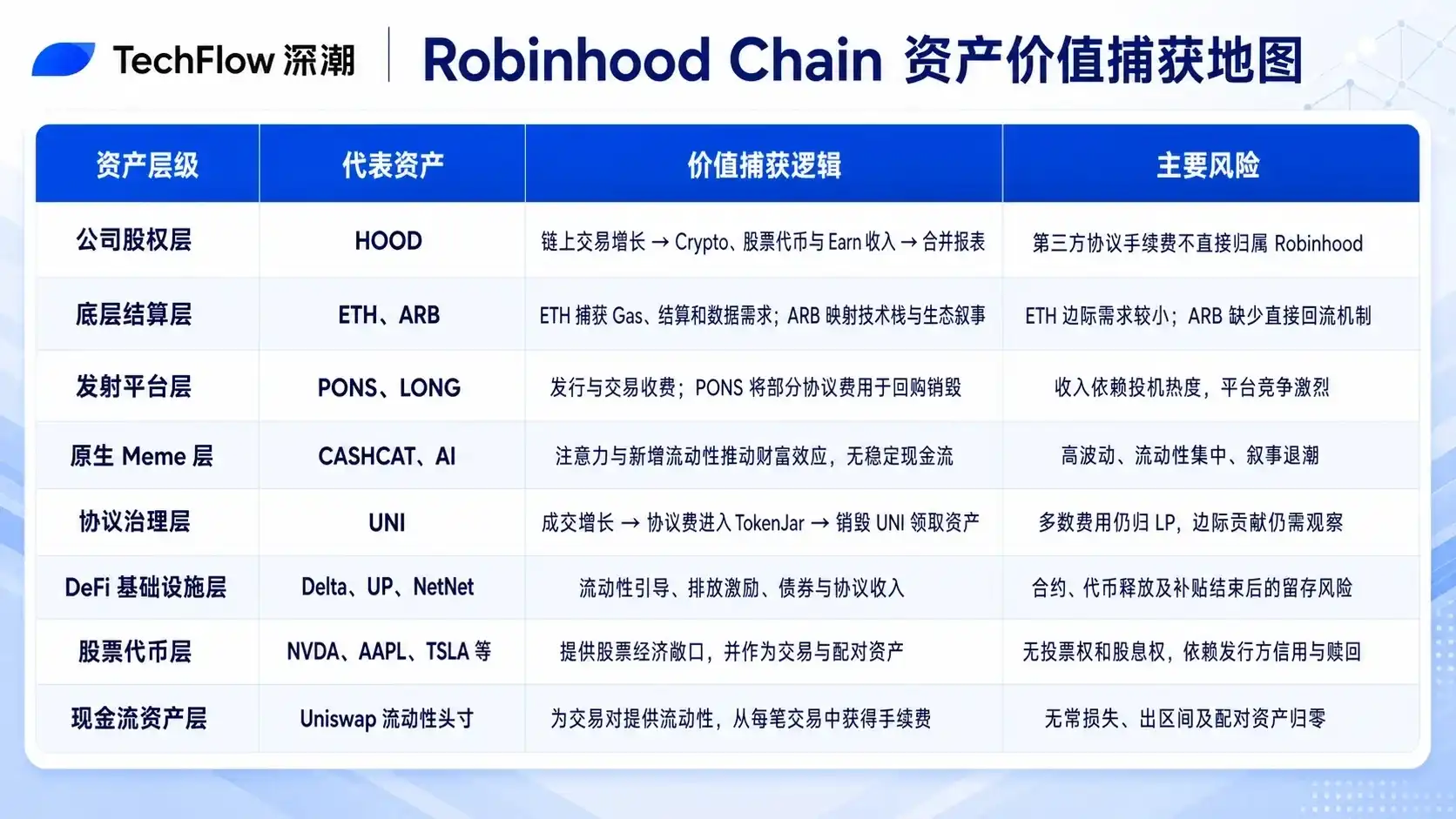
In its Robinhood Chain coverage, MarsBit mapped out who may be capturing the upside from the chain’s growth. Uniswap accounts for a major share of trading on Robinhood Chain, with protocol fees feeding token burns. Lighter has become the perpetuals entry point inside Robinhood Wallet. Morpho sits behind Robinhood Earn as lending infrastructure. Ten percent of Robinhood Chain revenue flows into the Arbitrum ecosystem.
Based on that framework, UNI was presented as the biggest beneficiary, followed by LIT, while MORPHO and ARB were described as weaker beneficiaries in comparison.
Additional reads in this area included “Eight layers of assets, two ways to think about them: a full breakdown of the Robinhood Chain wealth effect,” “How an arbitrage trader extracted $10 million in 10 months and shared a new strategy,” and “Machi Big Brother’s token launch flopped as veteran callers lost traction in a new trench.”
CeFi & DeFi
A major overhang for Bitcoin has eased for now
MarsBit said a recent series of transactions by Strategy looked like “selling low and buying high,” but in the near term they relieved the STRC depeg and the cash-reserve issue that had come into focus because of it. In the article’s framing, the market’s biggest hidden concern has eased at least for this stage.
Airdrop opportunities and user guides
Two notable interaction updates
The roundup’s interaction digest said GTE has opened early pre-registration tasks, while BitRobot launched its points system on Sept. 1.
Meme
Another nine-figure meme appears on Robinhood Chain as stock-paired trades feed the RWA story
The selection said Robinhood Chain has again produced a meme token with a market value above $100 million, with the stock-paired meme format feeding back into the real-world asset narrative.
AI was singled out as the leading meme token in the stock-paired segment. It is paired with NVDA, the Nvidia stock token on Robinhood Chain. Over the past month, its community has formed an AI treasury that uses creator fees and 50% of trading fees to buy back and burn circulating tokens. So far, 0.82% of the token supply has been burned.
The article also tied AI’s rise to LONG, the token-launch platform behind it. LONG is a meme issuance platform in the Robinhood Chain ecosystem and, in its early stage, even airdropped NVDA stock tokens to AI holders. With its “coin-stock pairing” issuance model, LONG has become one of the chain’s leading meme launch platforms.
The analysis also included a clear warning: buying stock-paired meme coins amounts to making two bets at once. Traders are betting that the meme token will outperform the stock on a relative basis, and also betting on the stock’s dollar price movement itself. There is no 1:1 redemption relationship between the meme token and the stock token it references. The stock token is only the quote asset inside a liquidity pool, not collateral backing the meme coin. In that sense, the pairing does not create a valuation floor.
The article argued that another key role of this format is expanding the use case for stock tokens. Meme trading that drives volume in stock tokens is a development Robinhood wants to see.
Three ways to approach meme-stock structures on Robinhood Chain
The roundup divided Robinhood Chain’s “alternative assets” into three broad categories:
- stock tokens, stock meme coins, launchpad platform tokens and lending assets;
- LP-based products, including meme liquidity pools, stock-token liquidity pools and leveraged stock liquidity pools;
- coin-stock linkage trades, including reverse squeezes in meme coins and stock moves lifting meme tokens.
Why the squeeze story for stock-paired meme coins breaks down
On the much-discussed squeeze narrative, MarsBit’s selected analysis said the central problem is scale. Controlling stock tokens does not mean controlling the real shares.
If scarcity pushed the on-chain price of HIMS far above the real-world stock price, Robinhood’s authorized participants could mint new stock tokens and arbitrage the spread. Minting fresh tokens would require buying additional underlying shares for backing, so issuance could create some incremental demand for the stock. But hoarding already-issued tokens does not itself force equivalent buying in HIMS shares.
Instead, the article said, the main result would be more stock-token issuance, a larger token float and a pullback in the on-chain price toward the real-world share price. To achieve the kind of squeeze story traders imagine, the market would need a more developed TEQ structure, or tokenized equities.
The piece added that there is still something genuinely interesting in watching a new narrative emerge. Speculative opportunities exist, but the bigger point is that new forms of financial mechanism design may follow. It also recommended another related read: “JINQIAN crashed from 80 million to zero in two hours as coin-stock pairing became a customized trap.”
Five emerging AMMs for stock-token LPs
For users looking at where to deploy stock-token LP capital on Robinhood Chain, the roundup listed five emerging AMMs:
- up.: 100% of protocol revenue goes back to token holders;
- Fables: a points program is live and TGE is scheduled for October;
- RAMSES: the well-known Arbitrum AMM has arrived;
- Delta: protocol fees are automatically converted into liquidity;
- Ekubo: the old Starknet project failed to gain renewed traction.
What the chain’s new breakout memes have in common
MarsBit also summarized the common thread behind eight meme coins that reached valuations in the tens of millions of dollars on Robinhood Chain: a new narrative formed where tech themes, celebrity developments, corporate in-jokes and market sentiment overlapped.
For traders who have not been sitting on-chain all day, the roundup highlighted several names it said may still offer a second entry point:
- PONS, with platform daily revenue nearing $1 million;
- HMM, which turns trader hesitation into a “thinking cat” token;
- DELTA, a liquidity-management tool for Robinhood Chain;
- microduck, tying an open-source machine duck concept to the Nvidia stock narrative;
- YOLO, transplanting the WallStreetBets all-in culture onto Robinhood Chain;
- AI, the coin-stock meme paired with Nvidia;
- BONER, a direct adult-style joke built around a men’s health stock;
- SPACEHOOD, a coin-stock meme tied to SpaceX attention.
PONS jumps fivefold in a week
The roundup said PONS, the platform token of Pons, entered another sharp rally as issuance volume and trading share on Robinhood Chain expanded quickly. According to the article, Pons has developed a positive flywheel: more token launches bring higher revenue, which supports stronger buybacks.
It said the next questions for PONS are straightforward. How long can this latest meme surge on Robinhood Chain last? Can Pons keep its lead among issuance platforms? And if the token is to move toward a $500 million or even $1 billion valuation, a meme coin with broader breakout appeal may be needed.
Buying a Nasdaq company for $1.8 million, then using memes to force a squeeze
Another recommended article pushed the thought experiment even further. If on-chain demand can truly be turned into buying pressure in the underlying stock through the minting and collateral mechanism of stock tokens, then Robinhood Chain may be producing more than a new batch of meme coins. It may be sketching out a new capital machine that connects crypto attention with Nasdaq small-cap equities.
This section also recommended “A practical guide to FOMO: from finding people to finding tokens, how social trading works.”
Ethereum and scaling
ETF inflows and staking are tightening ETH supply at the same time
One of the selected Ethereum pieces said U.S. spot Ether ETFs recorded nearly $700 million in net inflows for the week, about 42 million ETH have moved into staking, exchange balances are down about 15% from early June, and corporate treasuries are still adding to holdings. Together, those forces are shrinking the amount of ETH available for immediate sale.
The article said Ethereum’s circulating float has tightened notably since June. If new money enters a thinner market, price elasticity could increase. What the market still needs to confirm, it added, is whether institutional inflows can continue, whether ETH/BTC can hold its rebound, and whether staking and corporate buying will keep absorbing fresh supply.
New ecosystems
HIP-4 competition begins as Hyperliquid prediction markets move into a builder phase
In the new-ecosystem section, MarsBit focused on the launch of Outcome, a prediction-market project in the Hyperliquid ecosystem. The article said this marks the first real shot in HIP-4 permissionless deployment and shows Hyperliquid’s expansion into prediction markets entering a builder phase.
Teams including Unit, Skew and trade.xyz have also signaled plans or already started building around HIP-4. The contest over traffic, liquidity and users at the Hyperliquid prediction-market entry point is now underway.
This part also recommended another piece: “A new era for Solana on-chain governance: stronger deflation, while a burn proposal unexpectedly stalls.”
A quick catch-up on the week’s major stories
Policy and macro markets
- the restart of conflict between the U.S. and Iran, with discussion of causes and impact;
- Donald Trump again calling on the Fed to cut rates and saying U.S. GDP could rise 20%;
- a former Fed vice chair saying the default option is now a rate hike, and that Warsh’s speech changed the Fed’s earlier logic.
Views and public comments
- Nvidia CEO Jensen Huang said AI is driving manufacturing back to the U.S., and that AI startups raised $400 billion in the past six months;
- investor Serenity, referred to in the roundup as the “white-haired stock god,” said Nvidia’s bet on MediaTek may be a move to choose the next ASIC leader;
- Elon Musk said Google and Anthropic are renting AI compute from SpaceX;
- Arthur Hayes said a collapse in EUR/JPY is close and would be the final missing piece for a restart in the crypto bull market;
- Jiang Zhuoer said Bitcoin will face its first real test since Aug. 19, that he has sold 50% of his spot ETH position, and that he sold all BTC holdings at $82,050 while watching the $70,000 to $72,000 range next;
- one view cited in the roundup said Bitcoin could fall to $50,000 in autumn, with rate-hike expectations and stalled progress on the CLARITY Act forming a double pressure point;
- crypto trader Rune again clarified that a post about acquiring a U.S.-listed company was generated by Claude, and that the figures in it were fabricated and exaggerated.
Institutions, large companies and major projects
- OpenAI released GPT-6 Astra and said it may be close to AGI;
- Moonshot AI, parent of Kimi, has started a Hong Kong IPO process and plans to raise funds at a $50 billion valuation;
- in South Korea’s five biggest exchanges, nearly 30% of assets are tradable on only one venue, raising concerns over exit difficulty;
- the Bitcoin kimchi premium in South Korea has turned positive again and stayed that way for a full week, the longest stretch since May;
- meme trading has overtaken expectations, with Robinhood Chain’s single-day revenue surpassing Ethereum’s;
- Pons plans to expand stock tokens, and cumulative creator trading-fee income has exceeded $25 million.
Security
- abnormal password reset emails affected thousands of X users, with multiple crypto-industry accounts receiving requests;
- after the biggest lending protocol in the Cronos ecosystem, Tectonic, was hacked, Cronos faced renewed criticism over centralization because of its rollback action;
- Sui-based DeFi protocol Full Sail decided to wind down gradually after a loss of about $455,000.
The roundup closes by linking to the wider Weekly Editor’s Picks series and signs off until the next edition.