

MarsBit has published its Weekly Editor’s Picks for Aug. 22 through Aug. 28, pulling together the stories it viewed as most worth reading across macro, investing, AI and storage, CeFi and DeFi, airdrop interaction guides, meme tokens, Ethereum scaling and broader ecosystem developments.

Macro: Treasury funding expectations and precious metals positioning
In the macro section, MarsBit said mainstream Wall Street institutions currently expect the U.S. Treasury to signal in November that future increases in borrowing may be handled through Treasury bills and shorter-dated notes, while also expanding buybacks to ease pressure on long-end yields. Some investment banks have even suggested that a more aggressive option — directly reducing long-term bond issuance — is becoming more plausible.
With long-dated Treasury yields hovering near multi-year highs, the report said any move away from the long-standing “regular and predictable” approach is injecting new volatility into markets. Investors, it said, are being pushed to reassess portfolio risk under what it described as a new era in U.S. debt management.
On gold, MarsBit cited Goldman Sachs as saying that fundamental buying is now moving in tandem with options flows, and that dealer hedging could act as a short-term amplifier after a breakout. The same positioning can magnify upside, but it can also deepen pullbacks if inflation heats up again and rate-hike expectations rise, because dealer unwinds would add selling pressure.
Goldman kept its end-2026 gold target at $4,900 per ounce, while saying that forecast still does not include a surge in hedging demand tied to macro policy risks. MarsBit also said Goldman’s trading desk has seen Chinese and Western macro funds adding exposure at the same time, with clients using options and spot trades to bet on gold reaching $4,800 to $5,500. In silver, there has been demand for three-month digital options with a $90 strike, though MarsBit stressed that this reflects client positioning rather than an official Goldman target.
This section also pointed readers to another recommended piece: “Bessent’s real calculation: squeezing Treasury CTA shorts and pushing the 10-year yield to 4.3%?”
Investing and startups: Arthur Hayes, crypto proxy stocks and the altcoin rebound
In the investing and entrepreneurship section, MarsBit highlighted a lengthy interview with Arthur Hayes. Hayes argued that crypto is the purest “release valve” for central bank money printing and said 2026 is replaying a path that leads back toward 2008, the same road that ultimately gave birth to Bitcoin. He also said the Clarity Act is “a very bad thing” for the U.S. domestic crypto ecosystem, for real innovation, and for useful projects with market demand, because in his view the government only gives crypto occasional surface-level attention while putting real weight behind AI.
Hayes said he does not rely much on technical analysis himself, but pays attention to equity technical analyst Milton Berg and watches Bitcoin and U.S. stocks through that lens. He said ETH should outperform all other large-cap crypto assets during this liquidity-driven rebound because Ethereum has the largest developer community. For BTC to break above its previous high this year, he said the trigger would be the Federal Reserve removing the counterparty cap on the Foreign and International Monetary Authorities repo facility.
He also said war remains the biggest risk for the crypto market and that investors need patience and focus. The interview included comments on Flop Network, a project he currently leads that MarsBit described as a spot market for computing power with a native currency.
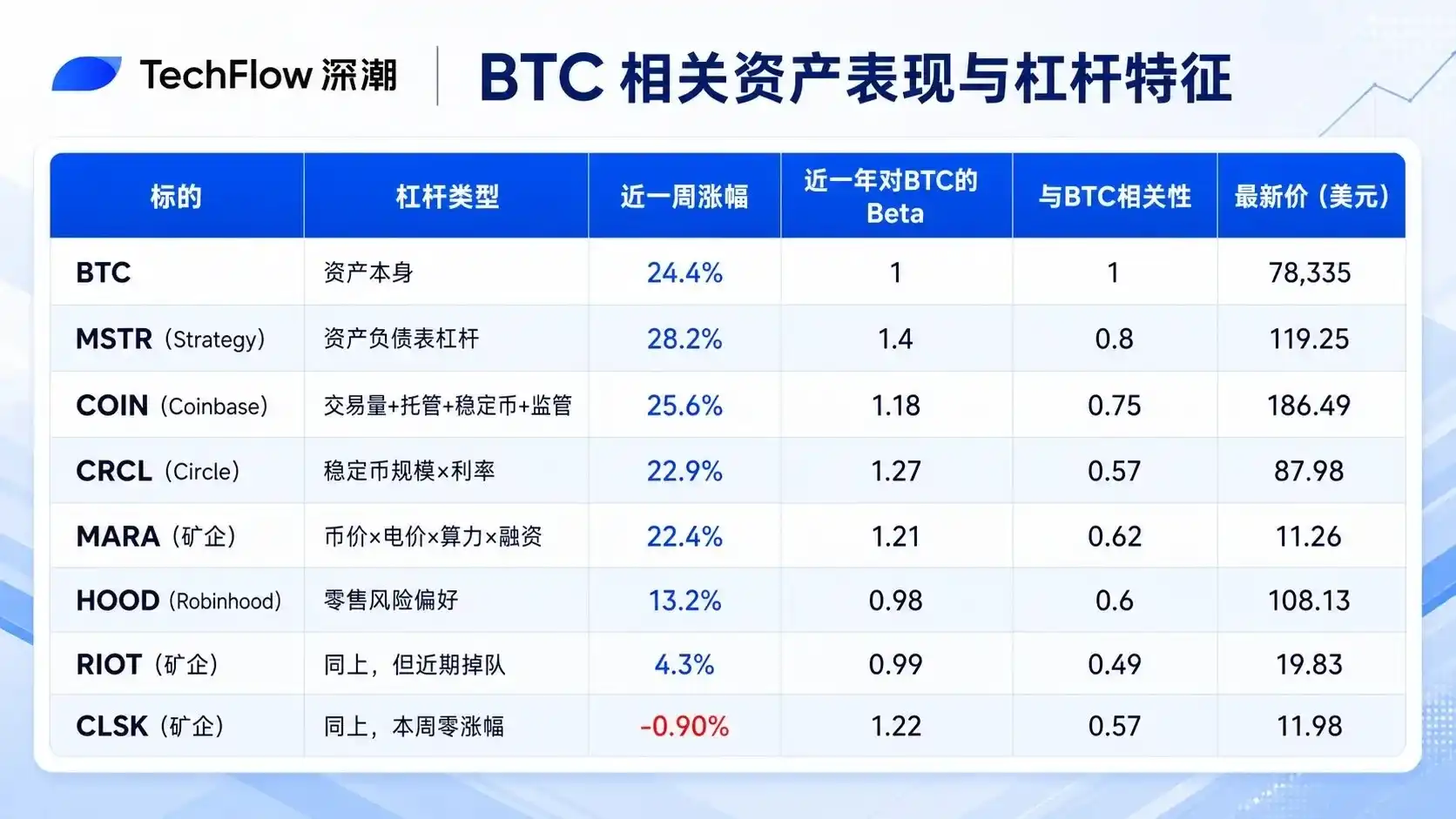
MarsBit also ran through the question of which listed stock offers the strongest leveraged exposure to crypto after BTC surged 24% in a week. It described MicroStrategy, or MSTR, as a leveraged Bitcoin bond with the highest upside elasticity; COIN as more dependent on operating leverage and better suited to investors looking for a balance of industry growth and regulatory upside; CRCL as having revenue with almost no direct link to BTC’s price; HOOD as the smallest mover but potentially the most resilient on the downside; and mining firms as the highest-beta and most fragile group.

On Circle, MarsBit examined what the market is really pricing in after the stock gained 17% in two days, using daily close data through Aug. 21, 2026. It highlighted two core fundamental issues. First, while USDC circulation and on-chain transaction volume both continued to grow in the second quarter, revenue growth had already slowed, and more than 85% of revenue still came from interest generated by reserve assets. As rates decline, the near-term earnings question is whether USDC scale can expand fast enough to offset lower reserve yields. Second, the longer-term variable lies with Arc blockchain and Circle Payments Network, or CPN. MarsBit said the valuation framework Circle ultimately earns — a neutral 2030 scenario of $101 or $259 — depends on whether Arc can generate real assets, trading activity and recurring revenue after launch.
On altcoins, MarsBit said the “alt season” may only be beginning, citing gains in 92% of tokens and a return of total altcoin market capitalization to $1 trillion. It said a broad recovery has become the market consensus, but capital is likely to keep concentrating in leading projects, with top-tier altcoins accounting for an ever larger share of total altcoin trading volume. In this cycle, it added, future gains may rely more heavily on project fundamentals, use cases and independent capital inflows.
At the token level, MarsBit said ZEC climbed to an eight-year high of about $836 to $855 while Bitcoin rose more than 24% over the week. The immediate catalyst, it argued, was not simply a return of the privacy-coin narrative, but Grayscale’s latest amended filing to convert the Zcash Trust into a spot ETF, along with disclosure that a subsidiary of parent company DCG is discussing an injection of about 200,000 ZEC into the fund.
At nearly the same time, Grayscale was following a similar trust-to-ETF path for Bittensor, or TAO, though at a much earlier stage. MarsBit said the market still appears to be underestimating this conversion playbook.
On HYPE, MarsBit said Hyperliquid’s Aligned Quote Assets v2, or AQAv2, would begin accruing yield that day. That adds a revenue line linked to stablecoin reserve income on top of trading fees, with the proceeds ultimately set aside for HYPE buybacks. According to the article, AQAv2 could bring in an additional $150 million to $200 million a year for buybacks.
ENA’s rally, meanwhile, was tied to two supply-side measures announced by the Ethena Foundation: repurchasing locked tokens held by seed investors, and canceling all future monthly VC unlocks. MarsBit said those moves largely remove ENA’s biggest supply overhang and spare the market from trading around a monthly unlock calendar.
This section also recommended several related reads, including interviews with the Robinhood CEO and Cobo co-founder Shenyu, as well as a founder reflection piece on why “fomo” pulled ahead from the same starting line.
AI and storage: Nvidia demand broadens, SK Hynix faces a split market view
In AI and storage, MarsBit first reviewed Nvidia’s earnings picture. It said spending by major cloud providers is still the main engine behind demand for AI compute, and that the company’s core business is not showing a clear slowdown. If anything, it is still accelerating. On products, Nvidia is gradually moving from the Blackwell cycle into the Rubin cycle.
The piece said that over the past year, AI compute demand was driven mostly by a small number of leading model companies. That is now changing. Demand is spreading across more frontier models, open-source models, enterprise AI, agents and robotics. Demand remains strong, but supply has become the main constraint on further growth. To push through that bottleneck, MarsBit said Nvidia is extending its role toward becoming a capital organizer for AI infrastructure.
The SK Hynix analysis focused on where support may emerge after a sharp decline. MarsBit argued that for high-beta names, the fact of a pullback is not the signal — where the pullback stops is. It said the market remains deeply divided on the memory cycle, and pointed to the company’s Aug. 19 announcement of a KRW 40 trillion share buyback plan as one of the most important fundamental variables in the current correction.

MarsBit also flagged three layers of risk. First, on competition, Samsung Electronics has already launched a new generation of high-bandwidth memory products, and if a second supplier gains certification at scale, the industry pricing center could come under pressure. Second, on labor negotiations, if a revised wage proposal raises the cash component, the company’s expense base will increase. Third, on volatility, the stock’s volatility is about 3.31% and its beta about 1.77, with intraday swings often above 8%, making conventional percentage stop-loss rules much less effective. Position size matters more than stop placement in that kind of name.
CeFi and DeFi: protocol revenue, crypto-backed credit and interaction opportunities
In CeFi and DeFi, MarsBit said DeFi has led the rebound and argued that revenue is the clearest fundamental metric in the sector. Prices and narratives may swing back and forth, it wrote, but if a protocol can keep making money over time, that at least shows real demand is still there.
The article named a group of high-revenue projects that may be worth watching for entry opportunities: UNI, JUP, MET, RAY, CAKE, AERO, WLFI, AAVE, ETHFI and LDO. It added one cautionary note: net income for WLFI holders is still zero.
Another piece in this section looked at Galaxy Digital’s launch of a Crypto Portfolio Line of Credit on its retail platform GalaxyOne. MarsBit said users can borrow dollars or USDC against a mixed collateral pool of BTC, ETH and SOL, including staked SOL, at an annual interest rate of 8.99%. The product carries no origination fee, charges interest monthly, can be reused on a revolving basis and offers instant funding. The initial loan-to-value ratio is 50%, meaning a user with $100,000 in crypto assets can borrow up to $50,000. The product is currently available in 40 U.S. states.
MarsBit described the core user profile as someone who holds a large amount of crypto, does not want to sell — either because of long-term conviction or because they want to avoid triggering capital gains tax — but still needs short-term liquidity. It added that crypto-backed lending is best used as a liquidity tool rather than a long-term leverage strategy.
In the airdrop and interaction guide section, MarsBit listed a set of PerpDEX points plays that may still be worth tracking under a still-supportive HYPE backdrop: Variational, Extended, RISEx, Lighter & Robinhood Wallet, Entropy, Arcus, Trasia, GTE, Perpl and HelloTrade.
That part of the weekly digest also pointed readers to several recommended reads, including pieces on Axis Robotics, Flop Labs validator applications, TermiX’s points system and EASY Residency’s fourth-season list.
Meme tokens, Ethereum and broader ecosystem themes
In the meme category, MarsBit included an article tracing the rumor that Trump would launch a new token on the Robinhood chain, summarizing the episode as one of rumor-driven pumping, heavy dumping and a denial from his son. It also linked to a separate weekend meme-token roundup focused on BSC, Robinhood and Base.
In Ethereum and scaling, MarsBit examined the implications of BitMine approaching ownership of 5% of ETH. The article said that holding 5% of ETH would not give BitMine any direct control over the Ethereum network, because Ethereum protocol changes are decided through the EIP process and rough consensus among core developers, not by token ownership. Ethereum also does not have on-chain governance.
Still, MarsBit said a 12% share of total network staking is not trivial. Excessive concentration in a single entity could create systemic risk, and because BitMine is a listed company subject to U.S. securities law, its staking activity may also draw attention from the SEC, the CFTC or other regulators. The article went on to argue that BitMine has no material source of revenue outside ETH, making it a leveraged bet on a single asset rather than an operating company with diversified cash flows.
In a separate interview with Tom Lee, MarsBit said BitMine’s buying of nearly 5% of the total ETH supply is unlikely to be the endpoint. Lee said the entire strategy has been funded through equity, with no debt and no convertible bonds, which he described as keeping the capital structure clean.
According to Lee, the company probably will not stop at 5% if institutions begin to hold ETH as a long-term asset, and the real year to evaluate is 2027. The article added that BitMine does not need to sell ETH to cover expenses, because annualized staking income of about $300 million is enough to cover the roughly $30 million to $35 million in yearly dividends on its 9.5% preferred shares, BMNP. Lee also compared ETH to “stocks/land,” saying its core attribute is store of value rather than bond-like cash flow.
In the broader ecosystem section, MarsBit noted that one governance vote could lift SOL’s daily burn by 14 times. In security coverage, it also included a story about internet personality Dishi discovering after eight years that he had allegedly been cheated out of tens of millions by people from the crypto circle.
Weekly catch-up: BTC, policy signals and institutional calls
In its fast recap section, MarsBit listed a number of shorter headlines, including Bitcoin returning to $80,000 after 100 days and public attention around “Sun Yuchen suing Jing Tian.”
On policy and macro markets, it said the U.S. plans to redeploy diplomats to embassies in the Middle East and that the conflict involving Iran is not expected to return to full-scale escalation. It also cited Trump as saying that if he loses the midterm elections, he will be impeached. On the Treasury side, MarsBit said the U.S. Treasury may tap a nearly trillion-dollar government account balance, while Bessent stressed another bond buyback on Sept. 9.
Under views and commentary, MarsBit cited Standard Chartered as saying Bitcoin could rise to $126,000 on ETF inflows and short liquidations. It also noted that Vitalik had published research on “local mixing” cryptography, exploring next-generation obfuscation techniques that could become a new cryptographic primitive.
In institutions, large companies and major projects, the digest included a claim from a former X product lead that X is preparing to support some cryptocurrency trading functions. It also said total altcoin market capitalization rose by $215 billion in three days from Aug. 19 to Aug. 22, with Trump policy signals seen as a catalyst for returning capital. Glassnode, according to MarsBit, said 85% of altcoins had funding rates above average, a sign the market has entered an optimistic phase. The roundup also mentioned trader Machi Big Brother turning $150,000 into $12.72 million in three days after being liquidated nearly 500 times.
On security-related items, MarsBit said Trump’s second son denied that Trump would launch a new token and called the message fraudulent. It also said Zhou Guren, described as the largest buyer of the Trump family’s WLFI, had been listed as a dishonest judgment debtor in six cases involving debts totaling tens of millions of yuan.
The weekly post closed with links to previous installments of the Editor’s Picks series and a note that the next edition will follow.