
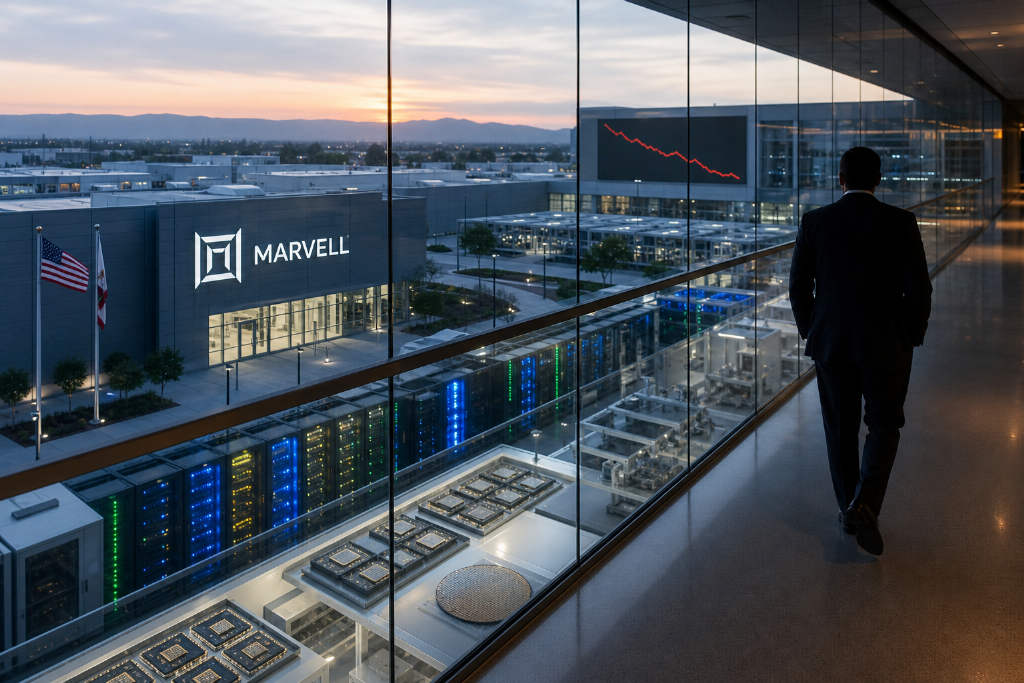
Marvell Technology posted earnings and guidance that came in above expectations and raised its revenue outlook for fiscal 2027 and fiscal 2028 for a second straight quarter. The stock still dropped, falling as much as 7% intraday on Thursday, as investors focused on when a major Google order will begin to contribute in size.
Record revenue led by data center demand
The U.S. data center chipmaker reported fiscal 2027 second-quarter revenue of $2.739 billion, a record high and up 37% from a year earlier. Data center remained the company’s main earnings driver. Revenue from that segment rose 46% year over year and made up 79% of total revenue, up from 74.4% in fiscal 2026.
The numbers were strong, but the market reaction quickly shifted to the timing of future growth.
Google order is included in part, but the bigger ramp comes later
According to Reuters, Chief Executive Officer Matt Murphy said part of the revenue tied to the Google order is already included in the company’s custom revenue target through fiscal 2028. The larger volume increase, he said, will not arrive until fiscal 2029.
Murphy also said custom chip revenue will more than double next year. He added that Marvell’s previously stated target of more than $10 billion in fiscal 2029 custom revenue has room to move higher, but he declined to provide a revised target.
Because the company did not sharply lift its long-term goal, and because the Google order is not expected to scale meaningfully until fiscal 2029, investors who had been looking for faster acceleration appeared disappointed.
Expectations have already moved up sharply
Driven by the AI trade, Marvell shares have risen nearly 189% this year. The stock was also added to the S&P 500 in June, drawing passive fund demand and other buying interest.
Bob O Donnell, chief analyst at TECHnalysis Research, said expectations for custom AI chips have been pushed very high. In his view, market expectations are generally running ahead of reality.
Custom chips gain ground as AI workloads shift
One reason large technology companies are designing their own chips is cost. Compared with Nvidia processors, which are expensive and face tight supply, in-house alternatives can be cheaper. That trend has made Marvell’s custom silicon intellectual property and ASIC business one of the beneficiaries of the data center buildout cycle.
Another tailwind comes from changing workloads. As AI applications shift from model training to inference, custom chips often deliver better performance and power efficiency for specific tasks than general-purpose processors, lifting demand at the same time.