
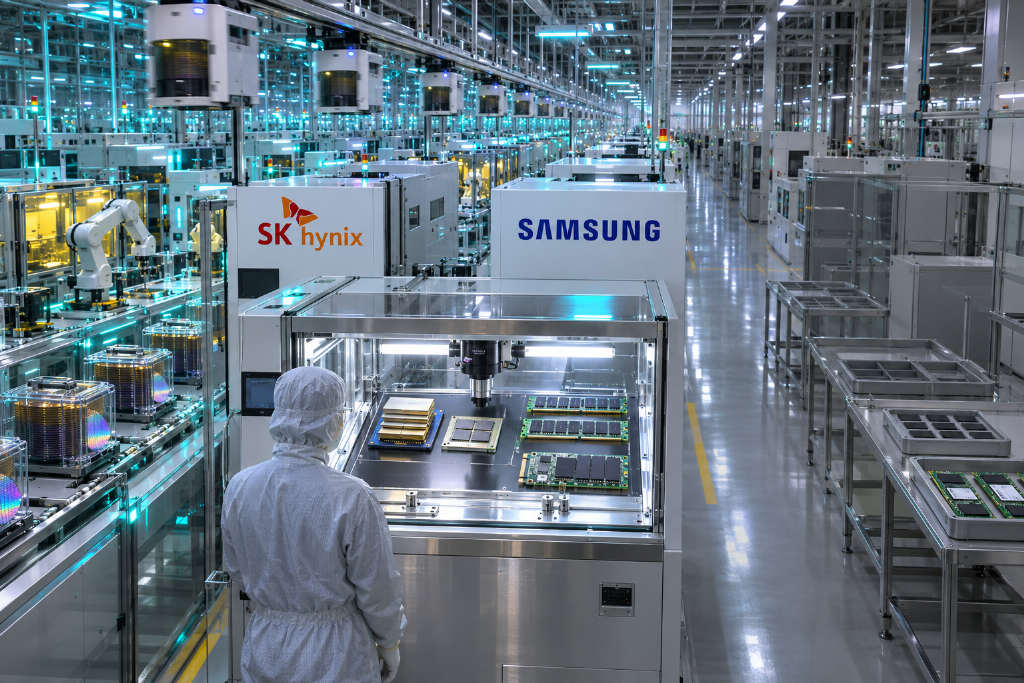
The memory market is entering a structurally uneven price cycle. SK hynix said DRAM and high-bandwidth memory, or HBM, capacity is nearly sold out, while customer purchase requests are more than twice the company’s available supply. Samsung has completed negotiations for its 2027 HBM supply, and that capacity has also been sold out. Production schedules at major global suppliers have already extended to 2029.
Consumer memory is moving at a different pace. Generic MLC NAND contract prices were flat in October, and Kioxia said the upward trend in NAND prices could stop in its fiscal 2027. The result is a split market: orders for AI-related memory are being booked years ahead, while demand from end markets is weakening on a quarterly basis. The current increase is not a uniform rise across every memory product. It is a shortage concentrated in products with higher computing density.
Enterprise memory stays strong while consumer demand softens
Cloud providers and server customers continue to increase purchases on the enterprise side. Locking capacity and signing long-term supply contracts have become standard steps. Smartphone, PC and retail-channel demand is more subdued, leaving downstream buyers cautious about inventory.
Data from DRAMeXchange, a unit of TrendForce, showed that the average contract price for DDR 8Gb (1Gx8) reached $27.5 in October 2026, up 5.77% from $26 in September. For the fourth quarter, institutions still expect contract prices to rise by double digits. Enterprise SSDs are the main product category behind the wider increase.
Consumer NAND is showing less upward momentum. DRAMeXchange’s October data showed that the average price of generic 128Gb MLC NAND was unchanged from the previous month, ending a 21-month run of gains. SLC NAND prices still posted a structural increase of 5% to 10%. Kioxia said its average NAND selling price rose about 70% quarter on quarter in the second quarter of 2026, but the increase slowed to about 20% in the third quarter. It expects the upward price trend could stop in fiscal 2027.
Market views cited by The Securities Times’ Star Market Daily describe a cycle that is rising in height but narrowing in breadth. Price increases are concentrated in products tied to computing demand rather than spreading across the full supply chain. Samsung, SK hynix and Micron are directing advanced capacity toward HBM, server DDR5 and enterprise QLC SSDs. That allocation indirectly reduces supply available for traditional consumer DRAM and some NAND products.
People cited by Star Market Daily said suppliers are reserving limited capacity for long-term contract customers and higher-value products, keeping general-purpose supply under pressure. Overseas suppliers expect the supply-demand balance to tighten in later years and are extending some cloud-provider contracts into more distant periods. The contracts lock in capacity, smooth capital-spending risk and turn expected price increases into enforceable commercial terms.
Long-term contracts extend the shortage into later years
Samsung expects HBM’s share of industry DRAM capacity to rise from about 20% now to nearly 30% in 2027. That would leave less wafer capacity for general-purpose DRAM over the next two years. General-purpose DRAM supplies servers, PCs, smartphones and a range of smaller markets, so the allocation decision reaches well beyond a single product category.
At a third-quarter 2026 earnings meeting on Oct. 28, SK hynix President and CEO Kwak Noh-jung said the company had signed long-term supply agreements with 14 core customers, including leading global cloud-service providers. The contracts generally run for five years. The quantities already locked in represent more than 50% of the company’s combined capacity for 2027 and 2028, and SK hynix plans to keep a similar ratio over the medium and long term.
Kwak said the agreements already completed, together with demand still under negotiation, mean that “DRAM and HBM capacity is effectively almost sold out for the next three years through 2029.” Customer purchase intentions are more than twice the company’s current supply capability. SK hynix expects tight memory supply and demand conditions to continue through 2030.
Other suppliers are following a similar path. Samsung has signed long-term agreements with 10 major customers and is negotiating with another 10. The company expects the chance of locking 60% to 70% of total capacity through long-term agreements by 2030 to increase. Its 2027 HBM volume and price negotiations are complete.
Micron said in its fourth-quarter fiscal 2026 results that most of its HBM bit supply for calendar 2027 had been contracted. Contract prices were higher year on year, while the gross-margin gap between HBM and traditional DRAM was narrowing. Micron, Western Digital and Seagate have offered similar assessments: supply-demand conditions in 2027 and 2028 will be materially tighter than in 2026, and some cloud-provider agreements already run through 2030.
Chinese memory suppliers are being drawn into the same contracting structure. ChangXin Memory Technologies said at its third-quarter earnings briefing on Oct. 30 that customers had reserved capacity for key products in 2027. Server DDR5 is currently in short supply, and discussions over long-term supply arrangements with several major customers are moving forward.
Demand growth is giving both sides a reason to accept multi-year contracts. SK hynix, citing institutional estimates, said global cloud-service-provider capital spending could grow by more than 60% in 2027. Realizable DRAM demand growth is expected to exceed 20% that year, while NAND demand growth is expected to approach 20%.
AI architectures are opening new layers of storage demand
The spread of agentic AI and very long context windows is expanding the role of memory in system architecture. KV-cache volumes are growing rapidly, and enterprise SSDs are beginning to handle KV-cache offloading. Suppliers are developing tiered scheduling software for KV caches and hybrid-memory solutions based on CXL. They are also planning HBM products that balance bandwidth and capacity.
TrendForce expects the average blended selling price of HBM to rise 121% year on year in 2027. Its forecast reflects supply constraints, a higher share of expensive HBM4 and the ramp-up of HBM4E in the second half of 2027.
The customer base is also becoming more diverse. People cited by Star Market Daily said traditional enterprise-built systems, sovereign AI projects and local deployments are growing alongside major cloud providers. A multi-layered investment structure reduces the effect of any one company changing its capital-spending schedule. That is also supporting supplier confidence in signing five-year agreements.
Gao Chengyuan, president of the Tiaoyuan Institute of Influence Research, told Star Market Daily that “overall tightness” does not mean every product is tight at the same time. New capacity is expected to translate into actual growth gradually from the second half of 2027, but it will still be concentrated mainly in data centers. Supply improvement for consumer-electronics memory depends on whether end markets can demonstrate renewed growth potential.
Gao said suppliers currently have strong profits and ample cash. They would rather adjust shipment volumes than cut prices first and disrupt market pricing. Consumer memory supply could loosen before enterprise supply, but a sharp price decline is unlikely.
Suppliers reach record profits as module makers and device brands feel the pressure
With both prices and shipments rising, major global suppliers have reached record profitability. SK hynix’s third-quarter 2026 revenue exceeded 100 trillion won for the first time, while operating profit rose 632% year on year. Samsung Electronics reported third-quarter operating profit of 107.4 trillion won, up 783% year on year and a record for the fourth consecutive quarter. Micron’s data-center revenue reached $18 billion in its fourth fiscal quarter of 2026, an increase of about 1,042% from a year earlier.
Investment banks disagree on how long South Korea’s AI-driven memory-chip cycle can last. Morgan Stanley cut its target price for SK hynix by 38% on Nov. 9 to 1.6 million won and reduced its Samsung Electronics target by 19% to 309,000 won. It cited the risk of higher chip supply and delays to data-center construction in 2028. Nomura kept its previous target prices in a report released last Thursday. Those targets were 2.9 times and 2.2 times the levels set by Morgan Stanley after its cuts, respectively.
Chinese listed memory companies are also showing a split in sequential performance. ChangXin Memory Technologies reported third-quarter net profit of about 54.4 billion yuan, with sequential growth slowing. GigaDevice’s attributable net profit for the first three quarters rose 921.55% year on year, but its third-quarter net profit fell about 22% from the previous quarter. Longsys reported third-quarter net profit of 3.745 billion yuan, down 44.23% sequentially.
Biwin Storage posted third-quarter net profit of 1.602 billion yuan, up 525.34% year on year. Demingli reported third-quarter net profit of 2.729 billion yuan, a modest 2% sequential increase, making it one of the few companies still reporting sequential profit growth. Shannon Semiconductor, whose business is mainly distribution and trading, reported revenue of 106.426 billion yuan for the first three quarters, up 303.14% year on year, and attributable net profit of 5.340 billion yuan, up 1,386.13%.
People cited by Star Market Daily said a module maker that only buys memory dies, performs basic packaging and resells the products has little influence over upstream supply and no strong technical barrier downstream. For such companies, a price cycle creates pressure from both directions: procurement costs rise, finished-product prices may not keep up, and inventory gains can reverse repeatedly as prices move quickly.
Gao said module makers face both margin compression and difficulty obtaining supply. Supplier price increases reach module makers first, while finished-product prices adjust more slowly. Suppliers also prioritize high-margin customers and large original-equipment manufacturers, leaving small and medium-sized module makers without stable enterprise-grade supply. Some have to replenish inventory at high prices in the spot market, and certain channels have already seen inverted pricing. The benefit from low-cost inventory was largely exhausted in the third quarter of 2026, so module makers’ margins are expected to fall toward normal levels quarter by quarter.
Higher memory prices are reaching device manufacturers. Counterpoint estimates that DRAM and NAND together accounted for 49% of smartphone bill-of-materials costs in the second quarter of 2026, up from 13% in the first quarter of 2025. Xiaomi’s smartphone gross margin fell to 10.1% in the first quarter of 2026. IDC data showed global PC shipments of 62.7 million units in the third quarter of 2026, down 20.1% year on year. Shipments by HP, Dell and Lenovo each fell by more than 22%.
Yuan Shuai, deputy secretary-general of the Zhongguancun Internet of Things Industry Alliance, said memory is taking a larger share of complete-device material costs, allowing price swings to reach manufacturers’ margins quickly. Customers that signed long-term agreements in advance face relatively less pressure. Customers dependent on spot purchases or short-term orders face delivery uncertainty and frequent quotation changes.
Yuan said that if prices rise too quickly while end demand fails to keep pace, channel inventories and complete-device sales could be restrained. That would in turn weaken suppliers’ bargaining position.
This article was originally published by the WeChat account The Securities Times’ Star Market Daily and written by Chen Junqing. The original title was “Memory Prices Rise Again? The Real Reason Has Been Found.”



