
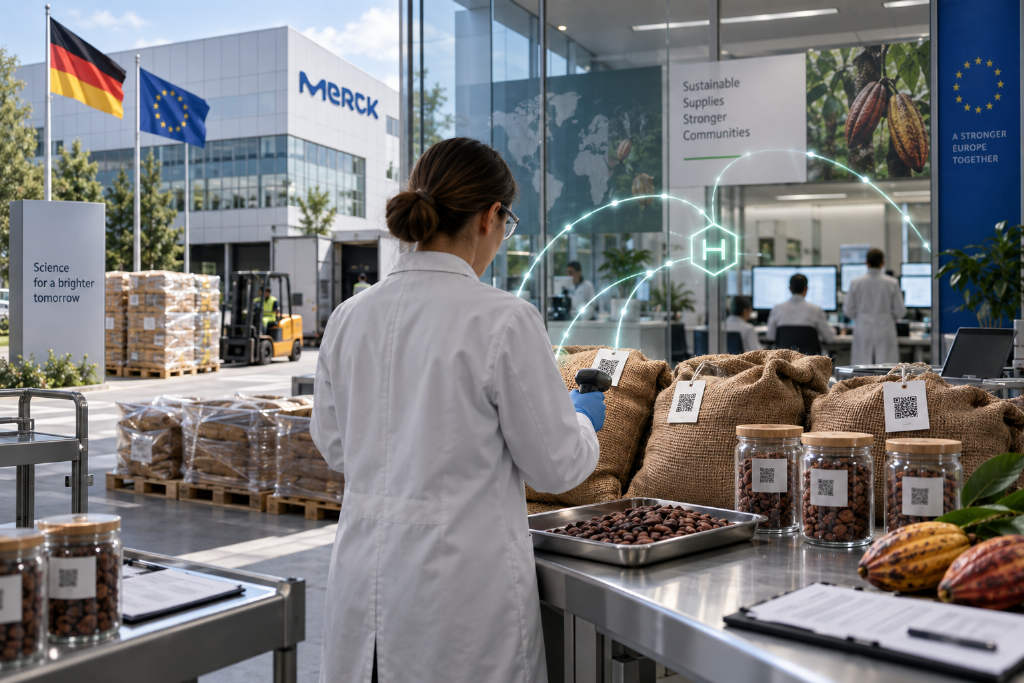
The Hashgraph Group, Merck KGaA and PwC Germany said Tuesday they are piloting a cocoa traceability system that links physical authentication scans to records written on the Hedera network, less than four months before the European Union’s deforestation regulation starts applying to large and medium operators.
No cocoa company is named in the announcement. The three partners also disclose no tonnage, no farm count, no cost and no date for moving beyond the pilot stage. The release carries quotes only from the three technology vendors behind the system.
This is the third announcement tied to the passport platform since February without a named customer, and the second involving Merck KGaA. The Darmstadt-based science and technology company operates as EMD in the United States and Canada and is unrelated to Merck & Co.
What the EU rule actually requires
According to the European Commission, large and medium operators must comply with Regulation (EU) 2023/1115 from Dec. 30, 2026. Micro and small operators follow on June 30, 2027. Cocoa is one of seven commodities covered by the rule, along with cattle, coffee, oil palm, rubber, soya and wood.
The report says the regulation’s central requirement is geolocation. Article 9 requires operators to collect and retain for five years “the geolocation of all plots of land” where the commodity was produced, along with the date or time range of production. The regulation defines geolocation as latitude and longitude to at least six decimal places, and for plots larger than four hectares, a polygon tracing the perimeter. Any deforestation on a listed plot disqualifies everything grown on it.
Authentication is not the same as farm mapping
Merck’s M-Trust technology addresses a different problem. It embeds security markers in products or packaging and confirms, when scanned, that the item matches the record describing it. The Hashgraph Group’s TrackTrace platform then writes that scan to Hedera with a timestamp. Neither step creates the farm polygon. That still has to be surveyed at the first mile and entered by whoever buys the beans.
Thomas Endress, Executive Director and Head of M-Trust at Merck, said in the release: “M-Trust verifies that the product being scanned is genuine, while TrackTrace records that authentication event as part of the product’s digital history.”
Husen Kapasi, Enterprise Blockchain Lead at PwC Germany, pointed to recalls as a use case. The system, he said, maintains “a verifiable trail not only of the finished product, but also of its raw materials, including their quality and compliance history.” He added that this becomes useful “in the event of a food recall or a compliance investigation.”
Fines start with a 4% ceiling requirement
Article 25 of the regulation requires member states to set fines whose maximum is “at least 4 % of the operator’s or trader’s total annual Union-wide turnover in the financial year preceding the fining decision,” and to raise that figure “where necessary, to exceed the potential economic benefit gained.” In other words, 4% is the minimum ceiling member states must set, calculated on EU-wide revenue.
Non-compliant operators can also face confiscation of the products and any revenue from them, exclusion from public procurement for up to 12 months, and a ban on placing goods on the market in cases of serious or repeated breaches.
Food is outside the Digital Product Passport regime
The release also presents the pilot as part of “the broader shift toward Digital Product Passports under ESPR.” But the Ecodesign for Sustainable Products Regulation, which created the digital product passport and entered into force on July 18, 2024, does not apply to cocoa. Article 1(2)(a) excludes food as defined in Regulation (EC) No 178/2002, along with feed, medicines, live plants and animals.
When The Hashgraph Group launched TrackTrace in February, it listed textiles, construction materials, batteries and electronics as the product groups the passport regime would cover. Food was not among them.
Why cocoa traceability is hard
The traceability challenge described by the partners is documented. According to the International Cocoa Organization, cocoa is grown by an estimated 5 million to 6 million farmers, most of them smallholders. West Africa produced 77.3% of the world crop in the 2020/21 season. Côte d’Ivoire alone accounted for 43.3%, while Ghana represented 20.2%.
Beans from thousands of plots move through village buyers and intermediaries before reaching a processor. That is what makes plot-level geolocation expensive to produce.
Built on the June integration announcement
The cocoa pilot extends an integration the same two companies announced on June 9, when The Hashgraph Group said it would connect M-Trust scanning to TrackTrace passports and said a first working supply-chain pilot would be announced soon.
PwC Germany is the new addition here. The release credits the firm with mapping business processes, defining workflows and running training for enterprise deployment.
The Hashgraph Group is a Swiss venture-building company that builds on Hedera. Hedera has hosted enterprise and tokenization pilots for years. The network launched an asset tokenization studio in September 2024, and The Hashgraph Association, the Swiss non-profit alongside the group, set up a $250 million venture studio with Saudi Arabia’s investment ministry in February 2024.
Stefan Deiss, CEO and co-founder of The Hashgraph Group, described the cocoa project as a template. “By integrating TrackTrace with Merck’s M-Trust technology and PwC’s process expertise, we can link any physical product, not limited to cocoa, to a trusted digital record,” he said.
HBAR market data and Hedera network activity
HBAR traded at $0.077, down 2.5% over 24 hours and up 5.9% over seven days, with a market value of $3.5 billion, according to CoinGecko. The token remains 86% below its September 2021 high of $0.5692.
Hedera’s DeFi footprint remains small compared with its enterprise pipeline. DefiLlama data showed $27.3 million in total value locked and $1.4 million in 24-hour DEX volume. Over the same 24-hour period, the chain processed about 593,500 transactions and recorded 3,831 active addresses.