
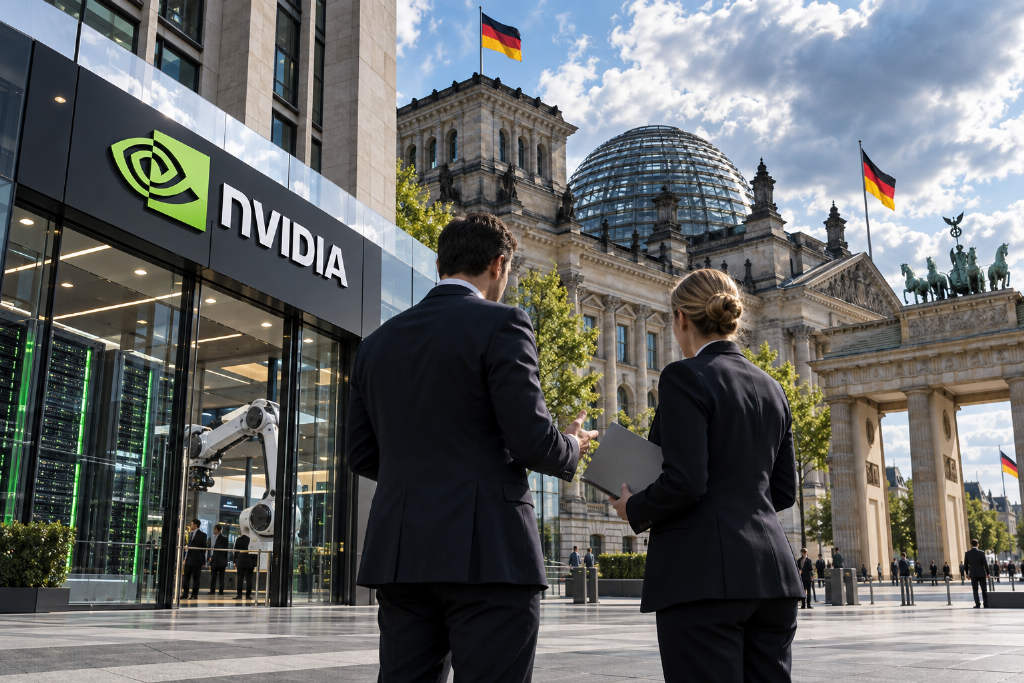
German Chancellor Friedrich Merz asked Nvidia CEO Jensen Huang for advice on AI regulation during the opening conversation at the Invest in Germany summit in Berlin on the evening of Oct. 19, local time. Huang answered with three pillars and said, 「If the industry has not developed, there is nothing to regulate.」 The full exchange was published on YouTube by Germany’s Federal Ministry for Economic Affairs and Energy.
Merz says neither no regulation nor overregulation is the right answer
Near the end of the conversation, Merz raised the question himself. He said Brussels is having very intense debates over regulation and that the European approach differs from the one in the United States. 「I think we all agree that no regulation is not the right answer, and regulating too tightly is not either,」 he said.
Merz asked Huang how regulation should be handled given that AI can cause harm and that harm has already occurred. He also asked what Germany or Europe could do better than others.
Huang lays out three pillars, starting with safety technology
Huang began with what he called a safety-first approach. Using autonomous driving as an example, he said an unsafe product leaves the industry with no future. In his words, safety and capability are not a tradeoff; they belong together.
He then set out three pillars. First, regulation is not possible without technology. The tech industry, he said, has to invent the tools that make systems safe. He pointed to work with Mercedes-Benz CEO Ola Källenius on functional safety technology for self-driving vehicles and said, 「Safety is not hope and dreams. Safety is technology and engineering.」
Second, companies need to follow best practices. Huang said younger companies are still growing and may make more mistakes than they should.
Only the third pillar involves regulation by industry and government. Huang compared AI with the internet, saying it is difficult to regulate the internet itself but not difficult to regulate applications built on top of it. AI, he said, should be regulated through its applications. If AI is used in a new product that falls outside the reach of existing regulators, authorities should move quickly to assess it and bring AI into the current rule set.
At that point, Huang turned to Merz and said he had also heard him talk about finding a balance between innovation and regulation. 「If the industry has not developed, there is nothing to regulate. You would want Germany’s AI industry to flourish, while doing so safely and responsibly.」 He closed that part of the answer by saying safety technology can be invented, best practices can be followed, and 「when necessary, we make sure regulation is done properly.」
Merz says AI rules should be at least European, ideally global
Merz replied that Huang’s comments were 「very helpful.」 He said his personal view is that AI regulation and safety standards should exist at least at the European Union level and ideally at the global level. Still, he added that the United States and Europe are taking different approaches and 「we are still far from that point.」
Merz also said he had succeeded in ensuring that Germany’s machinery industry would not have to follow the EU’s general AI rules and would instead be covered by sector-specific rules, calling that 「a major achievement.」 Huang immediately responded: 「Give Germany a chance, give this industry a chance.」
Huang says Nvidia invested nearly $1 billion in Germany over the past year
Investment came up during the same conversation. Huang said Nvidia has invested nearly $1 billion in Germany over the past year and made investments in four new companies this week. 「In some ways, we are one of the largest venture investors in Germany,」 he said, before joking that other venture capital firms 「better hurry up, otherwise I’ll take all the good deals.」
According to CNBC, the four startups are robotics company Agile Robots, hospital management software company Avelios Medical, sound-generation-for-video startup Mirelo, and satellite manufacturer Reflex Aerospace. Nvidia did not disclose the size of the investments.
Germany’s government and Nvidia also signed a joint declaration of intent the same day to promote AI models for industrial use.
Merz urges small and midsize businesses to open the door to AI
Merz also called on Germany’s small and midsize businesses to 「open the door to AI and make good use of your data.」
Huang agreed and said Germany’s data is a natural national resource. He said the country should bring in the technology needed to turn that data into its own intelligence, rather than sending the data away and then buying back 「Germany’s intelligence.」



