


AI-linked trades faced another round of selling over the past week, with pressure hitting both U.S. stocks and bonds. The Nasdaq logged its worst single-day drop in months, U.S. high-yield bond risk premiums climbed to a 17-month high, and yields on CCC-rated junk bonds rose to their highest level since 2020. Index-level moves looked limited on the surface. Underneath, risk is being repriced more aggressively.
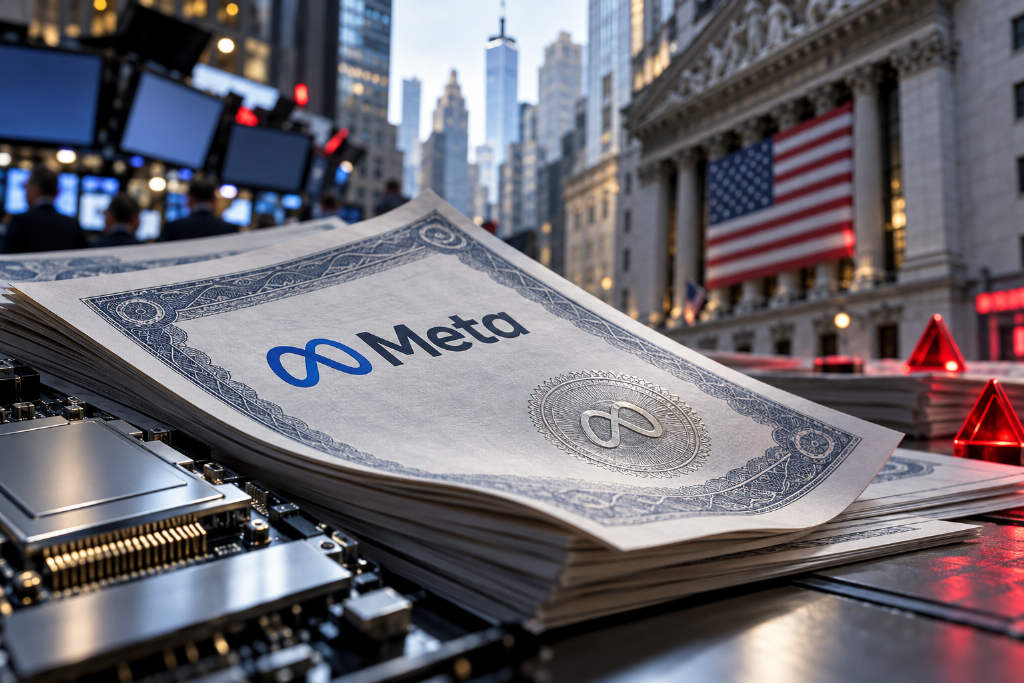
One of the market’s main concerns is Meta’s large financing plan released after its third-quarter earnings. In an Oct. 23 research note, Barclays said Meta chose to raise funds early in part because other companies in the AI ecosystem had already started, or were planning, their own financing programs, leaving capital markets with less room to absorb new supply.
That points to a prisoner’s dilemma facing AI giants. Each company has an incentive to move first, but if major issuers all accelerate debt sales at the same time, the added supply can push funding costs higher and squeeze financing capacity across the group. Hedge funds are also continuing to cut leverage, while spread dispersion across AI-related credit assets is widening.
That means the question of when the AI trade bottoms is no longer tied only to earnings from large technology companies. It also depends on whether the market can absorb dense bond supply and whether rising funding costs will keep weighing on the AI supply chain.
Indexes looked calm while AI positions were cleared out
Over the past week, index performance masked sharp divergence beneath the surface. Goldman Sachs data showed its long-short basket of AI beneficiaries versus AI risk names had fallen about 55% from its June peak, erasing all of this year’s gains. Momentum strategies also saw a steep drawdown, reaching levels last seen during the 2008 financial crisis.
On Thursday, the S&P 500 fell 1.2%, yet 335 of its constituents still advanced. The equal-weight S&P 500 gained 0.7%, while the market-cap-weighted SPY closed lower. Goldman Sachs said hedge funds deleveraged in seven of the previous eight trading sessions, and Thursday’s selling was driven entirely by long liquidation.
The move suggests the recent pullback is not only a reassessment of AI valuations. It also reflects a concentrated unwind of crowded positions. Whether that reset can support a lasting rebound still depends on whether pressure in credit markets eases.
Credit stress is concentrating in lower-rated borrowers
According to Bloomberg, average risk premiums on U.S. high-yield bonds rose to a 17-month high, while the primary market saw its biggest wave of withdrawn deals this year. Yields on CCC-rated junk bonds climbed to 15.85%, the highest since 2020, and the spread over BB-rated bonds moved close to peak levels seen in 2016 and 2020.
The leveraged loan market is under pressure as well. The amount of deeply distressed loans trading below 60 cents on the dollar rose to its highest level since March 2020. JPMorgan data showed that over the past 12 months, the volume of loans priced at 80 cents on the dollar or below jumped nearly 90%.
Even as CCC spreads widened sharply, the broader credit market did not deteriorate in tandem, suggesting risk is concentrating among weaker issuers. Robert Cohen, head of corporate credit at DoubleLine Capital, said some CCC borrowers may head toward debt restructuring, but that does not mean the entire credit cycle has turned.
Goldman Sachs data showed spreads across multiple rating buckets, from investment-grade and high-yield credit derivatives to lower-rated cash bonds, have reached cycle highs. R. Lakshmanan, head of Asia-Pacific corporate credit at CreditSights in Singapore, said credit risk repricing is gradually becoming a sustained trend after a series of global shocks hit markets.
Meta debt plans expose an AI funding prisoner’s dilemma
Meta’s financing plan has brought the tension between AI capital spending and credit-market supply into clearer view. The company narrowed its 2026 capital expenditure outlook to $135 billion to $145 billion and expects fourth-quarter spending of $49 billion to $59 billion. Free cash flow after dividends has turned negative, and management also expects to raise hundreds of billions of dollars starting this fall.
Barclays said revenue growth at hyperscale technology companies is materializing, but capital spending is still climbing. The financing question has shifted from whether funding is available to when to raise it, how much to raise, and what form it should take.
In its filing, Meta said that because other companies in the AI ecosystem have already launched or are planning financing activity, the market’s capacity to absorb issuance is becoming increasingly limited, making early financing a practical necessity.
But if every company tries to move first, individually rational decisions can become a market-wide problem. A concentrated wave of new bond supply can lift issuance costs and limit the room for credit spreads to tighten. To avoid damaging credit ratings through excessive borrowing, companies are also considering equity financing, convertible bonds, asset-backed securities, and off-balance-sheet funding.
Barclays said AI-related financing supply is likely to keep limiting spread tightening in the near term.
AI credit is fragmenting as investors price issuers one by one
Barclays estimates AI-related credit assets total about $680 billion, spanning hyperscale technology companies, semiconductor firms, data centers, and hardware companies. That equals roughly 7.5% of the market value of the investment-grade bond index, yet accounts for about 13% of the index’s duration-times-spread, or DTS, risk exposure.
On the whole, AI credit assets trade at a spread premium of about 35 basis points to the investment-grade index, while bonds with maturities longer than 10 years carry a premium of about 55 basis points. At the same time, spread dispersion among AI issuers rose from 24 basis points to 65 basis points over the past year. Even excluding Oracle and the data-center segment, that measure still increased by about 60% to 37 basis points.
Since mid-September, credit spreads for Oracle, Meta, SpaceX, and several data-center operators have widened more than the index, while shorter-dated bonds from Microsoft, Google, and Amazon have held up better. Investors are no longer treating AI as a single credit theme. They are separating issuers by funding needs, balance-sheet strength, and long-term risk.
The yield curve is also showing pressure at the long end. Barclays data showed that over the past year, the average curves for hyperscale technology companies steepened by 137% in the 2-year to 5-year segment, 140% in the 5-year to 10-year segment, and 68% in the 10-year to 30-year segment. Meta’s 10-year to 30-year curve spread reached 68 basis points, the steepest among comparable issuers.
A steeper long-end curve shows investors are demanding more compensation for holding long-dated debt. As AI companies keep expanding capital spending, the market is weighing not just whether those investments can turn into revenue, but also the size of future financing, the timing of cash-flow improvement, and the effect of new bond supply on borrowing costs.
For that reason, a bottom in the AI trade will depend on whether the market can absorb large financing plans, whether credit spreads can stabilize, and whether risk dispersion among AI issuers keeps widening. Until those pressures ease, any rebound may still be constrained by higher funding costs.