


Meta said in its third-quarter earnings release on Oct. 21 that its board has approved the creation of a publicly listed, non-voting Class C common stock. The company also plans a one-time stock dividend that would give holders of each existing Class A and Class B common share one Class C share. Meta said the market price of its Class A stock is expected to reflect an effect similar to a 2-for-1 split after the distribution is completed.
The date issue needs to be handled carefully. Under the earnings release, Meta plans to file an amended and restated certificate of incorporation in Delaware, with an effective date of Jan. 19, 2027. The stock dividend depends on that charter becoming effective and would be distributed only after that point. The record date and distribution date have not been announced and will be determined later by the board. That means Jan. 19, 2027 should not be described as the completion date of the split or the first trading date of the new shares.
What Meta has confirmed and what remains undecided
The clearest way to read the announcement is to separate confirmed items from open ones.
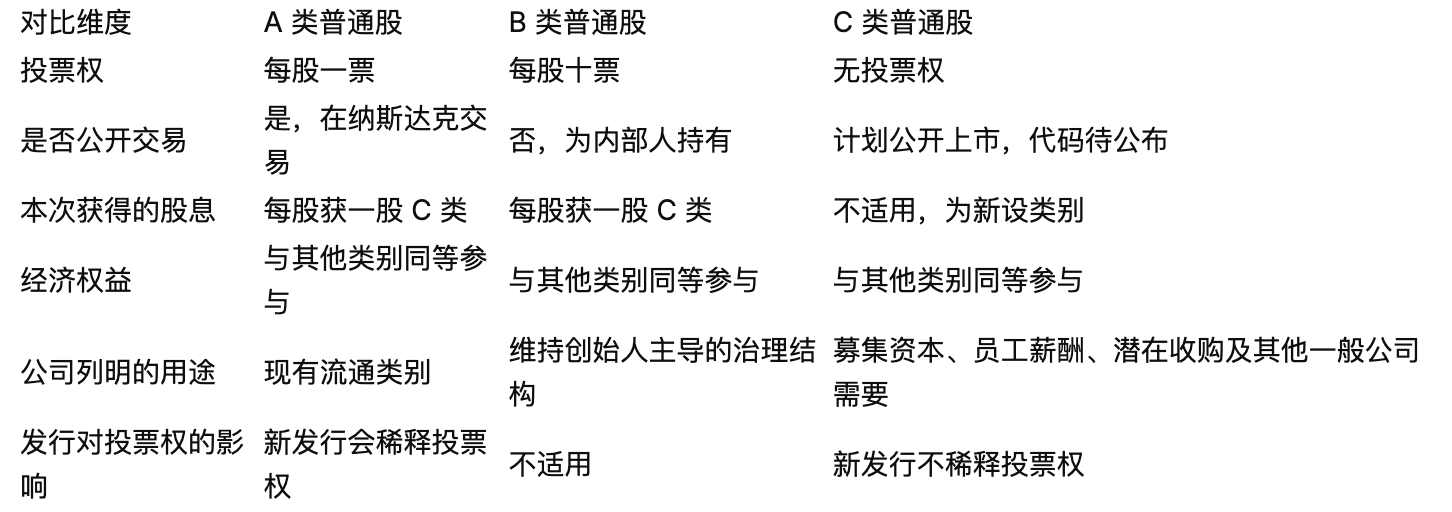
Meta has confirmed six points. The board approved the creation of a publicly listed, non-voting Class C common stock, effective in January 2027. A special committee made up of independent and disinterested directors unanimously recommended the plan after reviewing the company’s capital structure. Meta plans to file an amended and restated certificate of incorporation in Delaware, effective Jan. 19, 2027. That charter amendment has already been approved by written shareholder consent, so no separate vote is required. The one-time stock dividend ratio is one Class C share for each outstanding Class A or Class B share. And the company said the stock dividend will not change the voting power of any shareholder.
Four other points remain open. Meta has not announced the record date or the distribution date for the stock dividend. It has not disclosed a ticker symbol for the Class C shares. It said only that it intends to list the Class C stock on Nasdaq after issuance, without giving a listing date. It also has no specific plan to announce for raising capital through future Class C issuance. Chief Financial Officer Susan Li said the company has no specific financing plan to announce, but wants to preserve access to diversified funding sources.
Meta said it will file a Form 8-K and an information statement with the U.S. Securities and Exchange Commission, and those filings will be the source for later dates. In the transaction, Moelis & Company is serving as independent adviser to the special committee, while Morgan Stanley is advising the company.
How Class A, Class B, and Class C differ
The main differences among the three share classes are voting rights and intended use, not economic rights.
The key purpose of the new Class C stock is to give Meta a way to issue equity in the future without diluting voting control. In its announcement, the company listed capital raising, employee compensation, potential acquisitions, and other general corporate purposes as possible uses. It also directly referred to the costs of AI competition and infrastructure. Meta further said the structure supports maintaining Mark Zuckerberg as a founder-led chief executive.
Control metrics need to be read with care because the figures vary by source and timing. According to Benzinga, entities associated with Zuckerberg and his spouse Priscilla Chan hold 56.1% of Meta’s voting power, which is why the charter amendment could be approved by written consent without a shareholder meeting. According to Yahoo Finance, after the distribution those related entities would retain about 60.6% of the voting power while representing about 13.4% of the economic interest. Meta’s own statement is narrower: the stock dividend itself does not change any shareholder’s voting power.
Meta also entered into a founder alignment agreement with Zuckerberg covering the sale of the Class C shares he receives in the dividend, his service obligations to the company, and conditions for future Class C distributions. TradingKey described the arrangement as allowing him to sell up to 20% of the newly received non-voting shares. That percentage is TradingKey’s characterization.
What happens if an investor owns 100 Class A shares
A simple example helps show why the stock dividend should not be mistaken for extra value.
If an investor holds 100 Class A shares on the record date, that investor would receive 100 non-voting Class C shares under the 1-for-1 distribution. After the dividend, the position would become 100 Class A shares plus 100 Class C shares, taking the total share count from 100 to 200.
On price, Meta said the market price of Class A stock is expected to reflect an effect similar to a 2-for-1 split once the distribution is complete. Using the Oct. 21 Class A closing price of $697.52 as a simple illustration, 100 shares were worth about $69,752 before the distribution. If the Class A price then adjusted mechanically to roughly half, or about $348.76, the 100 Class A shares would be worth about $34,876, while the 100 Class C shares would theoretically account for the other half. The combined value would still be about $69,752.
That example comes with three limits. First, it is only an illustration based on the company’s description of the price effect, not a price forecast. Actual trading prices will be set by the market. Second, Class A and Class C shares may trade at different prices because their voting rights differ. Non-voting shares often trade at a discount to voting shares, so the two classes are not guaranteed to split value evenly. Third, the record date has not been announced, so the phrase “held on the record date” cannot yet be tied to a calendar date.
Meta also drew a line between the stock dividend and future financing. The dividend itself does not bring cash into the company and does not create wealth for investors. It changes the class mix of the shares and the per-share price. What could affect the economic interest of existing shareholders is a future issuance of additional Class C stock, which is a separate matter.
The financial backdrop behind the capital structure change
Meta’s earnings figures provide the context for why the company is making this move now.
Third-quarter revenue was $64.60 billion, up 26% year over year and above market expectations of about $63.3 billion. Net income was $9.86 billion, up 264% year over year. Diluted earnings per share came in at $3.83, above expectations of about $3.56, and would have been about $7.40 excluding legal-related expenses.
At the same time, operating income fell 37% year over year to $12.99 billion, and the operating margin dropped from 40% to 20%. Costs and expenses rose 68% year over year to $51.61 billion, including a $9.89 billion charge tied to an August 2026 agreement with 52 state attorneys general over litigation involving youth mental health and social media.
Cash flow is the central point. Third-quarter capital expenditures, including principal payments on finance leases, reached $34.91 billion, above operating cash flow of $32.79 billion. Free cash flow was negative $2.12 billion. Yahoo Finance said long-term debt increased by $22.2 billion over nine months to $80.9 billion, while Meta did not repurchase stock in 2026. By comparison, it repurchased $26.2 billion in the first nine months of 2025. Cash and marketable securities at quarter-end stood at $82.45 billion.
Guidance adds to that picture. Meta put 2026 full-year capital expenditure guidance at $135 billion to $145 billion, narrowed from the prior $130 billion to $145 billion range. Yahoo Finance calculated that this implies fourth-quarter capital spending alone of $49 billion to $59 billion. Fourth-quarter revenue guidance was $73 billion to $76 billion. Full-year 2026 expense guidance was $175 billion to $179 billion, raised to include legal costs. Reality Labs is expected to post a 2026 loss of $18 billion to $19 billion, narrowing to about $15 billion in 2027. Meta did not provide 2027 revenue or capital expenditure guidance, saying only that it will continue to invest aggressively.
Taken together, the logic of the capital structure change is straightforward. With free cash flow turning negative, debt rising sharply, and buybacks paused, Meta is preserving an equity financing channel that does not dilute voting control. Yahoo Finance estimated that at a market capitalization of about $1.78 trillion, issuing shares equal to 1% of the company could raise about $17.8 billion. The same outlet estimated a possible fourth-quarter funding gap of $16 billion to $26 billion, roughly equal to 1% to 1.5% of the company.
Three separate issues investors should not mix together
The first is the stock dividend itself. It is a 1-for-1 distribution, involves no cash, creates no value, and does not change voting power. For existing shareholders, its direct effect is a change in share-class composition and a mechanical adjustment in per-share price, while total position value is theoretically unchanged.
The second is any future issuance of new Class C shares. That is the part that would affect economic ownership. If Meta later issues additional Class C stock to raise capital, the economic interest of existing shareholders would be diluted, while the voting structure would remain unchanged. Benzinga quoted a market participant as saying shareholders bear all of the economic dilution from future issuance while Zuckerberg bears none of the control dilution. At the same time, Susan Li said the company has no specific financing plan to announce, so the timing and size of any issuance remain open. Yahoo Finance said that decision will likely depend on 2027 capital expenditure guidance, which it expects to be discussed on the fourth-quarter earnings call.
The third is voting power. Meta’s position is that voting power does not change in the current distribution and would not be diluted by future Class C issuance either. That means the voting percentage of existing Class A holders would not fall because of new Class C issuance, but it does not alter the existing control structure created by Class B shares carrying 10 votes each. Benzinga reported that related entities currently hold 56.1% of the voting power.
Once those three issues are separated, the takeaway becomes clearer. The current distribution is economically neutral. A future issuance could be economically dilutive, but its size and timing are unknown. Voting power remains unchanged in both cases, which is both the purpose of the design and the source of the criticism around it.
Common stock holders are not the same as derivatives holders
Meta’s stock dividend belongs to shareholders who actually hold the relevant class of common stock on the record date. Derivatives positions are not common stock holdings. That means stock-based perpetual contracts and similar derivatives do not carry the right to receive the Class C stock dividend. Any treatment of corporate actions should follow the contract rules and adjustment notices issued by the relevant platform.
The source article also noted that META stock perpetual contract quotes and contract details can be viewed on MEXC. It added that stock perpetual contracts are derivatives, not common stock holdings, and therefore do not entitle holders to receive this Class C stock dividend.
James Mitchell: the split effect is only a byproduct
James Mitchell said the announcement has been widely framed as a stock split, but in his view the split-like effect is only a byproduct. The 1-for-1 stock dividend may make the Class A price look like a 2-for-1 split, and that effect is economically neutral. The substantive change is the creation of a share class that can be issued without diluting voting control, with Meta explicitly listing capital raising, employee compensation, and potential acquisitions among its uses.
He also singled out the timing point most likely to be misstated. Jan. 19, 2027 is the effective date of the amended and restated charter, not the completion date of the split and not the first trading date of the new shares. The stock dividend comes only after the charter takes effect, and the record date and distribution date have not been announced. Until the Form 8-K and information statement are filed, he said, investors should not make plans based on any assumed distribution date.
From a financial perspective, he argued that the timing is not hard to understand. Third-quarter capital expenditures of $34.91 billion exceeded operating cash flow of $32.79 billion, free cash flow was negative $2.12 billion, long-term debt rose by $22.2 billion to $80.9 billion over nine months, and Meta did not repurchase stock in 2026 after buying back $26.2 billion in the first nine months of 2025. With free cash flow negative, debt rising, buybacks paused, and full-year capital expenditure guidance still at $135 billion to $145 billion, the appearance of a new equity financing channel is not surprising. What stands out is that the structure was designed not to touch control.
He also pointed to the criticism aimed at the structure itself. Benzinga cited the view that shareholders bear all of the economic dilution from future issuance while the founder bears none of the control dilution. Yahoo Finance, by contrast, framed the post-distribution structure as about 60.6% of voting power against about 13.4% of economic interest. For investors, Mitchell’s practical approach is to split the analysis in two. The first layer is the current distribution, which is economically neutral. The second is the timing and size of the first actual Class C issuance, which is the variable worth tracking and is closely tied to 2027 capital expenditure guidance.
Key questions
Did Meta announce a stock split or a new share class?
Both elements are present, but the substance is the latter. Meta approved a publicly listed, non-voting Class C common stock and plans a one-time stock dividend of one Class C share for each existing Class A or Class B share. The expected split-like price effect does not change the fact that the core function is to create a future financing instrument that does not dilute voting power.
Has the record date been announced?
No. Meta said the record date and distribution date will be determined later by the board. The only fixed date disclosed so far is Jan. 19, 2027, the effective date of the amended and restated charter.
What happens on Jan. 19, 2027?
That is the effective date of the amended and restated certificate of incorporation that Meta plans to file in Delaware. It is not the completion date of the split-like event and not the first trading date of the Class C shares. The stock dividend comes after that date, subject to the board setting the record date and distribution date.
Has the Class C ticker been disclosed?
No. Class A shares will continue to trade on Nasdaq. Meta said it intends to list the Class C shares on Nasdaq after issuance, but it has not disclosed the ticker or the listing date.
What happens if I hold 100 shares?
If you hold 100 Class A shares on the record date, you would receive 100 non-voting Class C shares and end up with 100 Class A shares plus 100 Class C shares. The total share count doubles, while total position value is theoretically unchanged. The two classes may still trade at different prices because their voting rights differ.
Will my voting power be diluted?
Not by this distribution. Meta said the stock dividend does not change any shareholder’s voting power. If the company later issues additional Class C shares, voting percentages would still not be diluted because the new class carries no voting rights, though economic ownership would be diluted.
Do stock perpetual contracts qualify for the Class C dividend?
No. The right belongs to holders of the relevant class of common stock on the record date. Perpetual contracts are derivatives, not common stock holdings, so they do not carry the right to receive the Class C stock dividend.