Bernstein said Meta’s Muse has taken the company’s AI spending out of story mode and turned it into a consumer product investors can actually measure. But the firm also warned that near-term expectations now seem to be running ahead of what can be delivered.

In its Oct. 20, 2026 report, Bernstein said the market may be treating Muse like just another chat app. That is not how the firm sees it. Its argument: Muse is Meta’s AI operating system. Muse launched on Sept. 8 and climbed to the top of the U.S. App Store download rankings within 10 days. Using Sensor Tower data, Bernstein said Muse moved past ChatGPT on Sept. 17 and stayed in front. U.S. daily active users were around 2.5 million, and average daily use was roughly 16 minutes, versus about 19 minutes for ChatGPT.
Bernstein kept its Outperform rating on Meta and repeated its $800 price target. With the stock now at $705.44, that points to 13% upside. The long-term view in the report stays positive. Near term, though, the language gets more restrained. In Bernstein’s view, Muse gives Meta its first consumer-facing AI product that shows AI investment can generate a positive return on strategic invested capital. The catch is simple: valuation and expectations have already climbed.
Muse changed the framing around Meta’s AI story
The report said Muse’s download path after launch ran ahead of ChatGPT’s launch curve from May 2023 and also beat Meta AI’s app performance. And it was not just downloads. Bernstein said Muse’s retention curve was stronger than ChatGPT’s too.
Still, the firm warned against taking hot early download and retention numbers in a huge total addressable market and stretching that momentum too far into the future. It cited Facebook Shops and the Metaverse as earlier examples. Short memory. Bad habit.
Bernstein said Muse has grown beyond a chatbot into real-time voice, customizable personalities, avatars, email and computer use. It has integrations with Shopify, Walmart, Best Buy, Sephora, Ulta, Wayfair, Gap, Expedia, Instacart, Notion, GitHub and Box. On hardware, the report described Meta’s strategy as letting users reach Muse in whatever form they want, with glasses, virtual reality devices and pendants all acting as endpoints.
Valuation has already moved up to Google and Amazon levels
After Muse launched, Meta’s stock was re-rated, pushing its one-year forward price-to-earnings multiple closer to Google and Amazon. Bernstein’s chart showed all three trading at roughly 20x.
The report said Muse has restarted talk about an “iPhone moment” for consumer AI and reopened the argument over agentic commerce and pressure on search. Bernstein argued that Muse could shift from a discovery platform toward a decision layer, closer to the point in the consumer funnel where purchase intent is formed.
In that setup, Amazon is absent from Muse’s partner list, while Amazon is building its own agentic commerce effort. Google, meanwhile, faces worries that AI could speed up substitution pressure on search.
Bernstein maintained its Outperform rating and $800 target price. Its valuation framework gives equal weight to a 2027 EV/Sales multiple of 6.7x and a discounted cash flow model, using a 10% weighted average cost of capital and a 3.5% terminal growth rate.
3Q26 revenue seen above consensus, EBIT hit by one-off legal cost
Bernstein forecast 3Q26 revenue of $64.058 billion, above the $63.312 billion consensus estimate. It projected EBIT of $11.338 billion, below the $19.016 billion consensus, including a $10 billion legal settlement expense tied to teen media usage. Earnings per share were forecast at $3.95, above the $3.56 consensus estimate.
So revenue is running ahead of expectations, while EBIT gets dragged lower by the one-time legal charge.
Capex, marketing and cloud costs weigh on near-term profit and cash flow
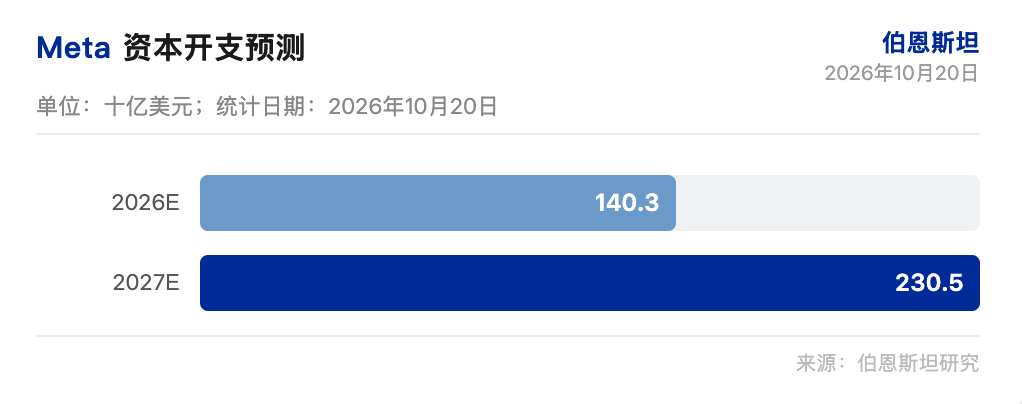
Bernstein forecast Meta’s 2026 capital expenditure at $140.3 billion and 2027 capital expenditure at $230.5 billion, above the $201.6 billion consensus figure cited in the report. For 2027, Bernstein projected EBIT of $97.890 billion versus consensus at $103.940 billion, and EPS of $33.21 versus consensus at $33.87.
The firm cut its 2027 EBIT and EPS forecasts to account for Muse investment, third-party cloud transactions and higher marketing spending.
Free cash flow looks under more pressure. Bernstein estimated 2027 FCF at -$59.684 billion, versus consensus at -$33.418 billion, a gap of $26.266 billion. For 3Q26, it forecast FCF at -$13.756 billion, compared with consensus at -$8.953 billion.
The report said 2027 capex is 14.3% above consensus. Higher marketing spending tied to Muse promotion, along with rising operating costs from third-party cloud transactions, is expected to weigh on near-term profit and cash flow even as revenue stays strong.
Other revenue is growing faster, but Muse monetization is still an open watchpoint
Meta’s other revenue topped $1 billion in a single quarter for the first time in 2Q26, up 73% year over year. Bernstein raised its forecast for that line to reflect business messaging, business agents, subscriptions and Muse monetization.
Even so, the report said early Muse monetization is still not part of current expectations. A visible contribution to other revenue growth may show up in 2027. Bernstein said four indicators matter most for Muse monetization: subscriber count, gross merchandise value, downloads and engagement. A meaningful move in any one of them could alter the gap between near-term expectations and the underlying fundamentals.
Report attribution and risk notice
This article is based on a summary and interpretation by Chaoxiang Research of a third-party brokerage report from Bernstein dated Oct. 20, 2026, together with public market information. The ratings, target price, earnings forecasts and related judgments cited in the piece are the views of Bernstein’s analysts and reflect the position of that institution alone, not Chaoxiang Research, and do not constitute investment advice.
The original text also said that markets involve risk, investment decisions should be made independently, and the article should not be used as a basis for buying or selling any security.