
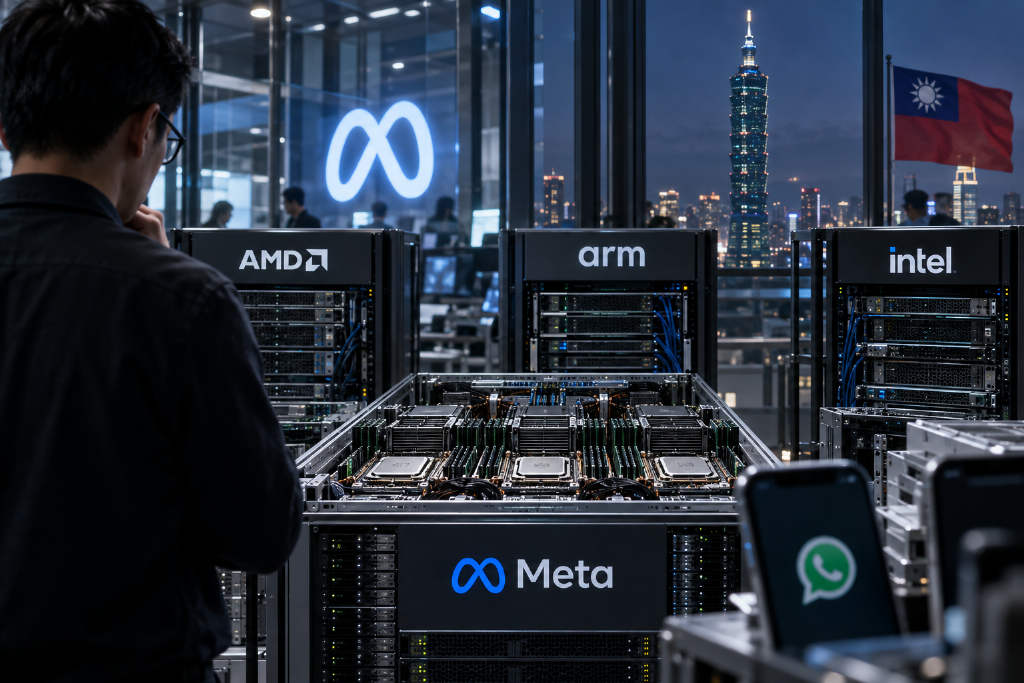
Meta launched Muse on Sept. 8, describing it as a personal AI agent that gives each user a dedicated cloud virtual machine. That has reopened a market debate over whether AI agents could lift demand for CPUs and server memory. Drawing on a CPU industry map compiled by LIWEI_TW Capital, ABMedia outlined where dozens of listed Taiwanese companies sit across the AMD, Arm and Intel camps and their supply chains.

Why Muse put CPUs back in the spotlight
One reason CPU demand has become a hotter topic is Meta’s Muse product. The service can be called through WhatsApp and a mobile app, and it uses Stripe Link one-time virtual cards for payments. Its core architectural feature is that each user gets a dedicated cloud computer.
Meta said each virtual machine is an isolated Linux environment with a browser, storage, CPU and memory that can compile code, build custom skills, handle parallel sub-agents and run scheduled tasks. Even if a user closes the app, the agent can keep running.
The article contrasts that setup with earlier personal agents, which mostly ran on users’ laptops or self-rented VPS instances. In this model, demand shifts from distributed to centralized infrastructure. Combined with Meta’s user base, that could make CPU and general-purpose server memory demand arrive faster and at a larger scale than the market had expected.
The report also points to a change in CPU-GPU deployment ratios. Arm and Intel have both said publicly that CPU-to-GPU ratios in AI training used to be about 1:8. With inference workloads, multi-agent orchestration and reinforcement learning gaining weight, that ratio has moved quickly to 1:4 and 1:1, and in some cases even 4:1, lifting the strategic importance of CPUs.
AMD: the most complete public partner list
Among the three camps, AMD has the fullest set of publicly disclosed partners. On May 21, AMD said it would invest more than $10 billion in Taiwan’s semiconductor ecosystem, expand advanced packaging manufacturing and partnerships, and begin deploying its rack-scale Helios platform in the second half of 2026.
The part most directly tied to CPUs is advanced packaging. AMD said EFB will be used for its sixth-generation EPYC server processor, code-named Venice. It is working with ASE and SPIL on wafer-level EFB mass production, and with Powertech Technology on panel-level 2.5D EFB.
On the systems side, AMD’s ODM partners include Wistron, Wiwynn and Inventec. In ABF substrates, Unimicron, Nan Ya PCB, Kinsus and Ingrasys are also listed as part of the ecosystem.
Arm: Meta co-develops the first in-house data center CPU
Arm’s first in-house data center CPU, the Arm AGI CPU, was developed with Meta as the main partner and co-developer, and optimized for Meta’s family of applications. The processor is manufactured on TSMC’s 3 nm process.
The companies named alongside it include Quanta, ASRock Rack, Lenovo and Supermicro among OEM and ODM partners.
Intel: fewer disclosures, but Taiwan links are still visible
Intel’s camp has seen less public disclosure than AMD and Arm. The article says the original map showed mostly indirect or limited disclosures for Intel, and the author added more detail based on public information.
On the foundry side, Intel Core Ultra AI PC processors such as Lunar Lake and Arrow Lake are manufactured by TSMC on its 3 nm process.
In advanced packaging and testing, the growing complexity of AI computing architectures has pushed chiplet testing and packaging overflow work to ASE and King Yuan Electronics. In high-end substrates, Unimicron is described as Intel’s preferred ABF substrate partner, while Nan Ya PCB and Kinsus provide support for high-layer-count substrate capacity.
On the systems and server side, Intel is working with Hon Hai on rack-scale architecture. ODM partners including QCT under Quanta, Wistron, Inventec and Compal handle Xeon server and full-rack system design, manufacturing and global delivery.
Earlier in the article, ABMedia also noted that the Taiwanese companies with clearer public evidence of Intel ties include LOTES, Gigabyte, Inventec and Quanta. It said that may reflect Intel’s lack of a published Taiwan partner list rather than a smaller business footprint.
Same CPU supply chain, different earnings logic
The report says that even within the broad label of “CPU supply chain,” the profit drivers differ by segment. Substrate makers benefit from supply shortages and price increases. Packaging companies benefit from advanced-process orders tied to capacity expansion. ODMs are more directly linked to shipment growth, but margins are thin. Upstream components and foundry work are harder to break out in terms of actual contribution.
ABF substrates
ABF substrate names in the article include Unimicron, Nan Ya PCB and Kinsus, which it describes as the tightest supply-demand segment at present. Lead times for ABF substrates have stretched from three to four months at the start of the year to more than 12 months, while new capacity takes two to three years to build. The supply gap is expected to last through 2028.
The degree of benefit differs across the three. More than 70% of Nan Ya PCB’s revenue comes from BT substrates and non-long-term-contract ABF products, giving it the greatest pricing flexibility. Unimicron, by contrast, has more than 70% of shipments tied to long-term contracts, which limits flexibility.
The article also flags risk. Estimates of the supply gap vary widely, and as expansion plans gradually come online, supply and demand could reverse and amplify share-price volatility.
Advanced packaging
For advanced packaging, the report focuses on ASE and Powertech Technology. On the positive side, ASE has a more diversified customer base and has raised its 2026 capital spending expansion plan three times this year. Powertech is focused on panel-level packaging, and AMD has completed validation.
The risk is that aggressive expansion also raises depreciation and overcapacity pressure. The article adds that some analysis suggests ASE’s third-quarter growth driver is not advanced packaging, while Powertech’s panel-level packaging is not expected to enter mass production until 2027, leaving the timeline uncertain.
Server ODMs
The server ODM group in the article includes Wiwynn, Quanta, Wistron and Inventec. Their advantage is the most direct link to shipment growth. In the first half of 2026, Wistron’s revenue rose 94% year over year and Quanta’s increased 86.5%.
But the downside is clear. ODM margins are thin, and higher CPU prices are not necessarily positive. Quanta posted a first-quarter gross margin of 4.78%, while Wistron reported 5.21%. Inventec’s gross margin declined, with part of the pressure coming from rising prices for high-value components such as memory and CPUs. In other words, stronger CPU demand can add to ODM revenue while weighing on gross margin.
Public links do not equal direct benefit
The article stresses that the supply-chain map answers who has publicly disclosed ties to which CPU camp. It does not answer who benefits directly or who earns the most. A check mark only means there is a public connection; it does not indicate revenue share or profit contribution. AMD’s column appears the fullest in part because AMD has published an official partner list.
On Muse itself, the report adds two conditions. Virtual machines can share physical cores, so CPU demand depends on parallel workloads rather than user count alone. Meta also has not disclosed server procurement details tied to Muse.
What to watch next, according to the article, includes the revenue share of CPU-related products in company filings, the timing of new substrate and packaging capacity, and changes in ODM gross margins. It closes by saying the piece is based on public information and is not investment advice.