Event Core: Meta Shifts from Compute Buyer to Seller – Market Reacts Sharply
On July 1, Bloomberg reported that Meta is preparing a new cloud computing business to sell surplus AI compute power to external customers, alongside a managed model service akin to AWS Bedrock. The news sent Meta's stock up over 10% intraday, closing +8%. In contrast, cloud compute providers CoreWeave and Nebius fell 13% and 17% respectively. The next day, Asian session saw a selloff in hardware stocks: South Korea's KOSPI dropped ~7%, with Samsung Electronics and SK Hynix both down over 8%. Overnight, the market began pricing in "compute oversupply" fears.
Bull Market Underpinning: Structural Rally Driven by Scarcity
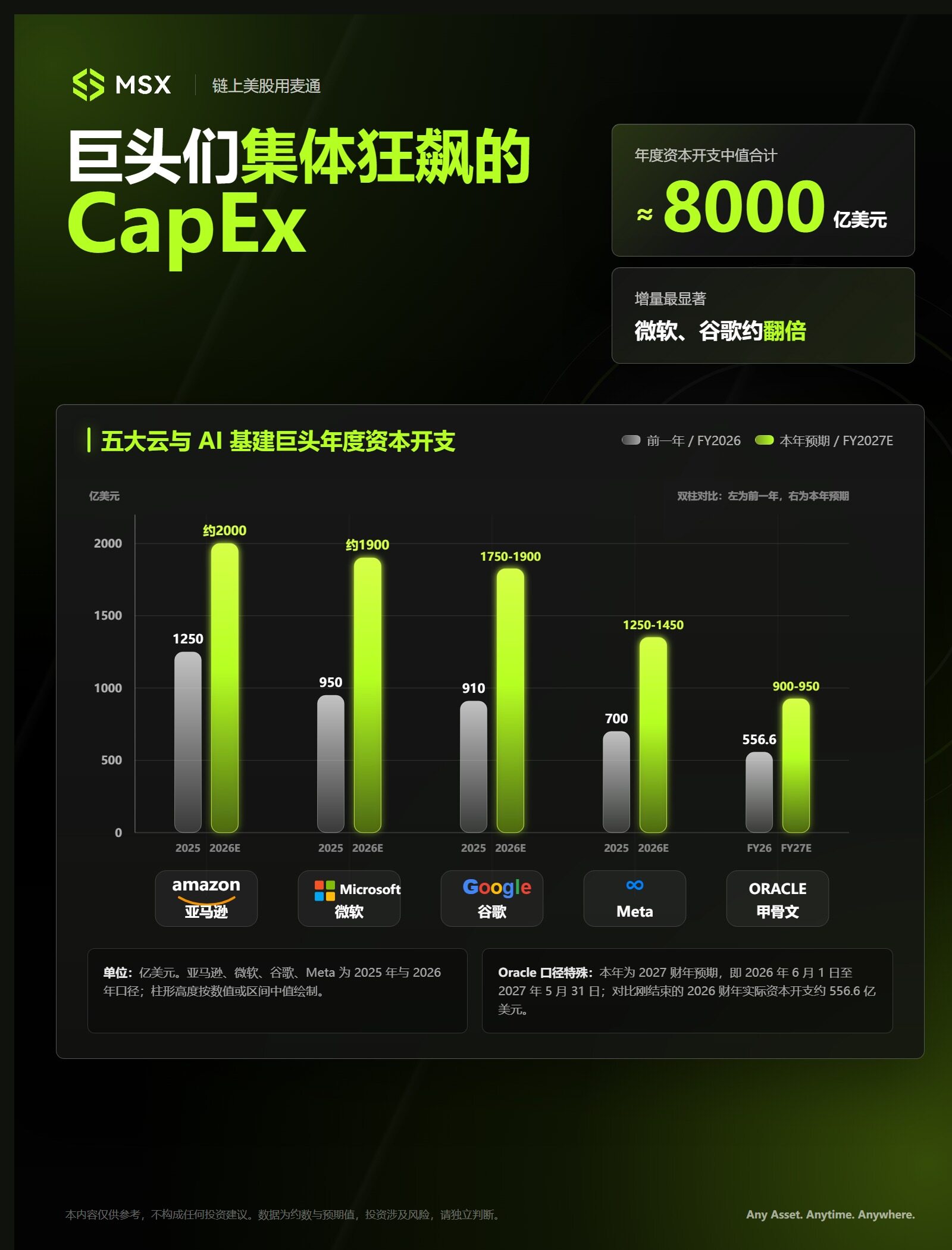
The AI bull market over the past two years has been fundamentally a "scarcity" story – a growing list of shortages from high-end GPUs, advanced packaging, HBM, optical modules, power, cooling, to even commodity DRAM and hard drives. This "bucket effect" gave every bottleneck node pricing power, allowing upstream vendors to raise prices and expand capacity. However, this narrative hinged on continued capital expenditure (CapEx) growth by hyperscalers: Microsoft, Meta, Amazon, and Google. Bridgewater estimates the Big Four will invest ~$650 billion in AI infrastructure in 2026, up nearly 60% from 2025's ~$410 billion; Goldman Sachs and Morgan Stanley project global AI-related CapEx (data centers, power, equipment, software) could reach ~$800 billion in 2026.

Meta's Dilemma: Long-Cycle Supply vs. Short-Cycle Demand Mismatch
Meta had raised its 2026 CapEx guidance to $125–145 billion, with ~$237.7 billion in non-cancellable contractual commitments (mostly servers, data centers, and third-party cloud compute). However, its in-house models currently lag competitors, and internal products have not fully ramped, leaving some built capacity underutilized. Selling or leasing out surplus compute makes economic sense – similar to xAI leasing its Colossus cluster (220K NVIDIA GPUs) to Anthropic for $1.25 billion/month (500MW capacity). Yet Meta, commanding billions of users via Facebook, Instagram, WhatsApp, etc., still relies on external models like Google's Gemini, exposing a gap between "owning compute" and "effectively deploying compute."

Market Reaction Deconstructed: Not Oversupply, but Pricing Power Transfer
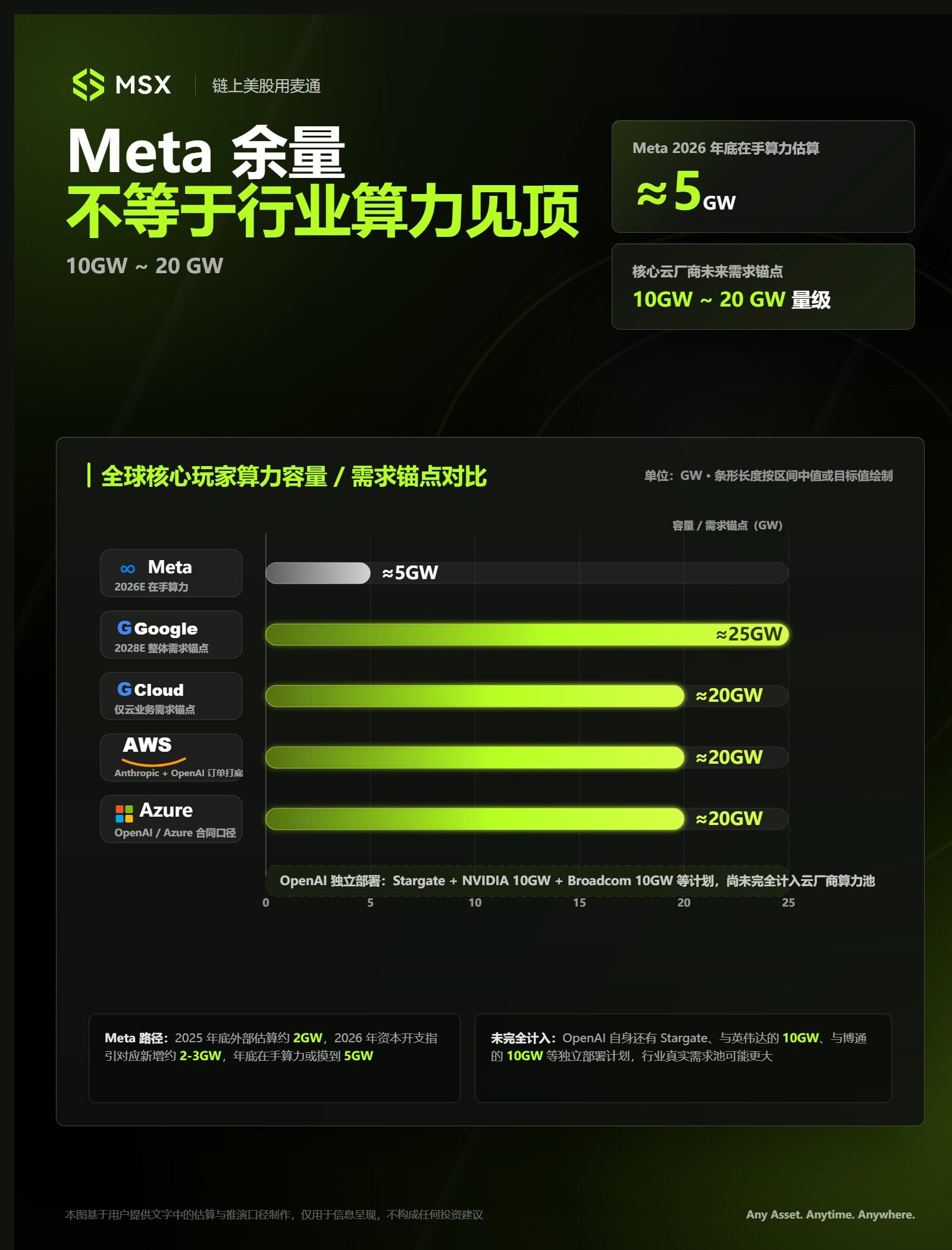
The surface-level pattern – "cloud down, hardware down, software up" – does not truly reflect compute oversupply. In absolute terms, even if Meta opens all its ~5GW of compute by end-2026, it is a drop in the ocean compared to Google, Anthropic, and OpenAI's plans for 10–20GW+ over three years. The real fear is the unraveling of the "CapEx certainty" premium that supported hardware margins. Capital markets have started rewarding disciplined spending and surplus monetization (Meta's stock rose), while punishing perceived wasteful spending. If this mindset becomes mainstream, the risk of hyperscalers slowing their arms race grows, breaking the high-growth premium on upstream hardware – the very bubble that fueled the bull run.
Future Outlook: Value Reshuffling Toward Compute Efficiency, Winner-Take-All Accelerates
Meta's move does not signal the end of the AI bull market; it marks a pivot from "hoarding compute" to "utilizing compute." As idle capacity is released into the market, inference costs drop, lowering barriers for software and application companies. This shift favors those who can efficiently turn compute into models, products, and revenue. Capital will concentrate among a handful of players capable of closing the loop: compute → model → product → income. The AI winner-take-all dynamics are only just beginning, with the spotlight moving from "how many GPUs you own" to "how well you use them."