
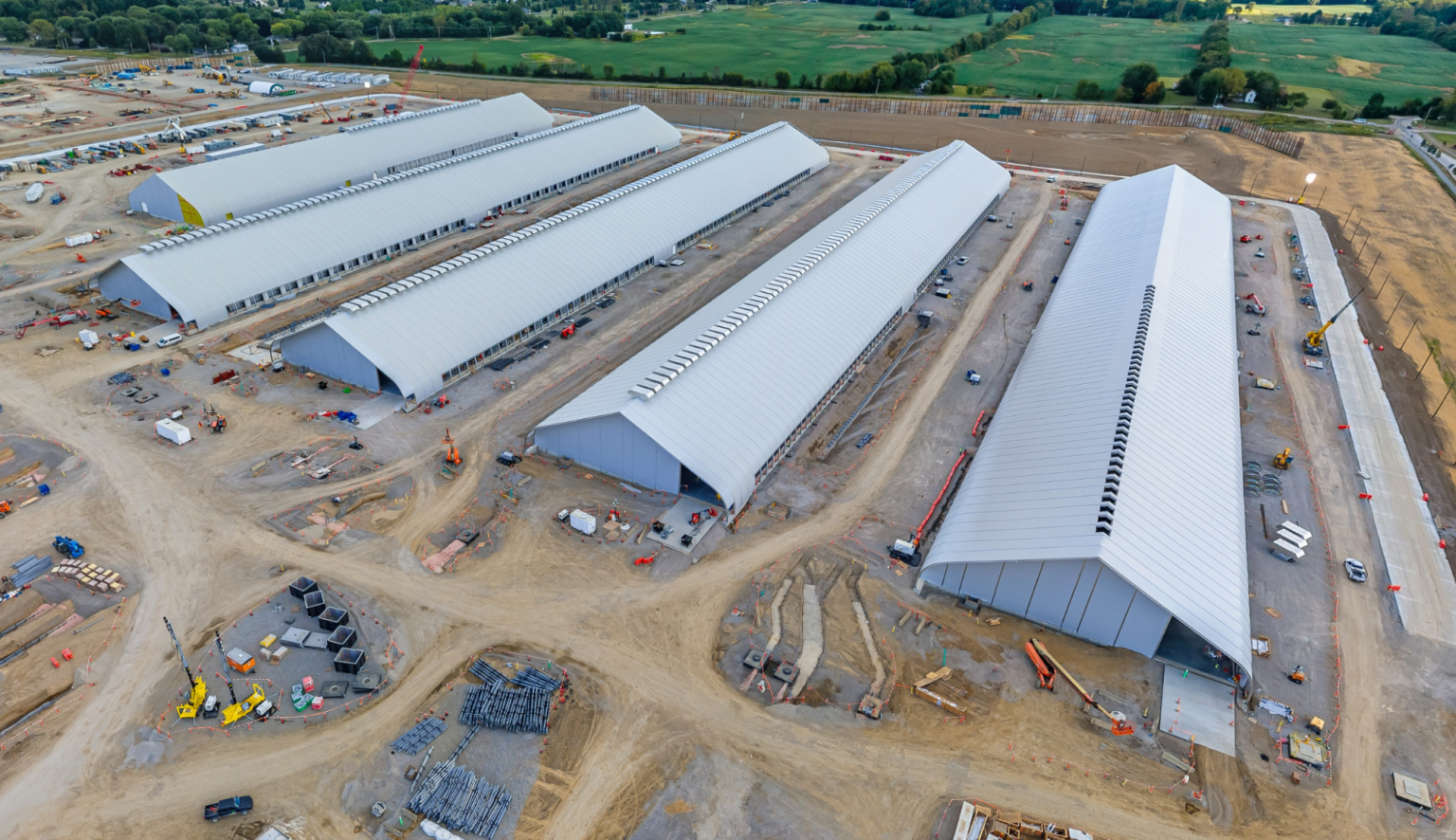
Meta has built out AI computing capacity inside industrial tents in New Albany, Ohio. Cleanview founder Michael Thomas, who tracked local permits and satellite imagery, said the company erected six large tents that now house AI chips worth billions of dollars and run around the clock.
The approach cuts sharply into the timeline usually tied to conventional data center construction. According to the source material, Meta’s first five permanent data center buildings at the same site each took two to three years to complete. The tent-based structures were finished in roughly four to six months, bringing compute online far faster than a standard buildout.
Permits filed in spring, facilities visible within months
Thomas said Meta filed permits between April and June for five tents of 125,000 square feet each. Satellite images he posted on X showed the structures already completed. The pace stood out: open land turned into operational compute space within a matter of months.
That speed appears to be the point. The report says Meta set aside the normal burdens tied to traditional construction standards in order to shorten the time needed to activate new AI capacity. Instead of waiting for permanent buildings, it used industrial tents as the first layer of infrastructure.
Tesla’s emergency playbook and xAI’s power model
The idea had been signaled before. Last year, Mark Zuckerberg told The Information that he planned to use weatherproof tents for Meta’s multi-gigawatt data centers as a way to accelerate expansion. At the time, the concept drew skepticism. The combination of permit records and satellite images now shows the plan in physical form.
The tent strategy also echoes Tesla’s 2018 move in Fremont, California, where the company set up a tent production line in a factory parking lot to push Model 3 output. In Meta’s case, the same logic is being applied to AI infrastructure: install the hardware first, leave permanent construction for later.
Power is being deployed with the same urgency. The New Albany setup uses a system codenamed Socrates with total capacity of 200 megawatts. It relies on modular gas turbines and fast-start reciprocating engines, including Solar Turbines Titan 250 units, Siemens Energy SGT400 equipment, and 15 Caterpillar 3520 series reciprocating engines.
Compute can move fast only if electricity does too
The source says xAI helped popularize this modular gas generation model. A normal grid connection can take years because utilities need to schedule work and build new lines. Modular gas systems can be installed on site in months. xAI’s Colossus supercomputing cluster in Memphis, Tennessee, used that path to secure power quickly, and Meta appears to be following it closely.
That changes the practical definition of a data center. It is no longer limited to permanent brick-and-concrete buildings. In this model, any structure that can be deployed quickly, energized quickly, and used to run AI chips at scale becomes part of the data center footprint, whether the shell is steel, concrete, or industrial fabric.