
WuBlockchain’s latest daily roundup covered a series of crypto developments across corporate bitcoin treasury strategy, U.S. rulemaking, market research, wallet security, and institutional ETF positioning.
Metaplanet moves to build a U.S. bitcoin treasury platform
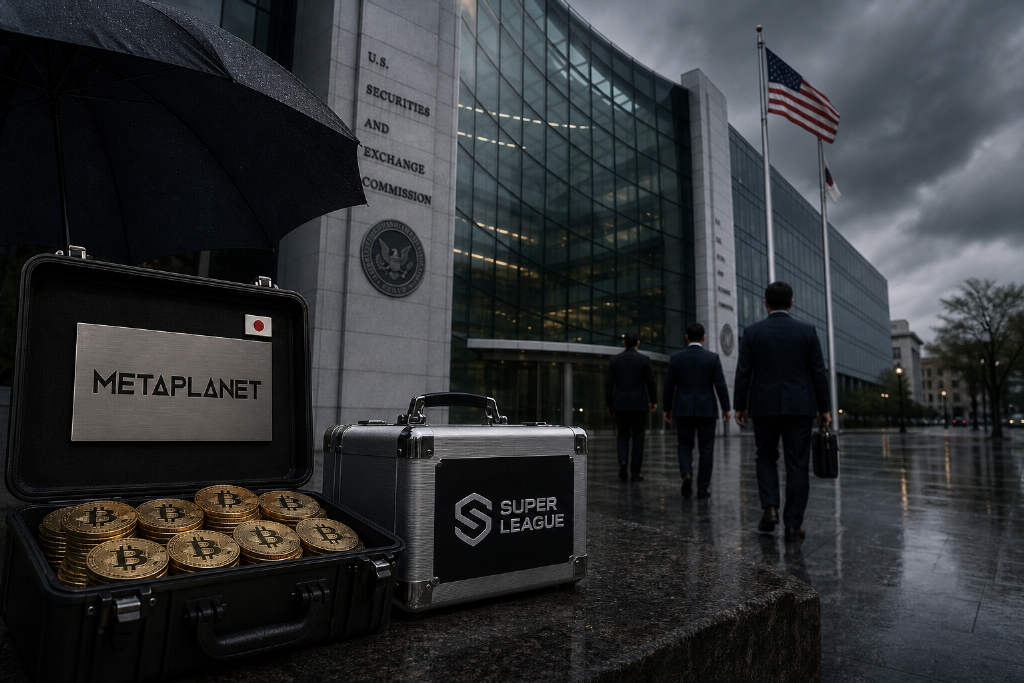
Japan-listed bitcoin treasury company Metaplanet (TSE: 3350) and Nasdaq-listed Super League Enterprise (Nasdaq: SLE) said they have entered into a definitive agreement under which Metaplanet plans to inject 2,100 BTC, worth about $132.1 million, and $2.5 million in cash into Super League through its U.S. subsidiary. In exchange, Metaplanet would receive common stock, preferred stock, and warrants, bringing the initial investment to about $134.6 million.
Once the deal closes, Super League is set to rename itself Superplanet, Inc. and plans to change its ticker symbol to SUPA. Metaplanet expects to hold about 95.7% of the company’s common shares. Superplanet is intended to operate as Metaplanet’s U.S. bitcoin treasury platform.
SEC proposes “Regulation Crypto Assets”
The U.S. Securities and Exchange Commission has proposed a framework called “Regulation Crypto Assets” to create a dedicated securities offering regime for certain investment contracts involving crypto assets.
The proposal includes two Securities Act registration exemptions. One would be a one-time exemption that allows an issuer to raise up to $5 million over a four-year period. The other would allow an issuer to raise up to $75 million in any 12-month period.
Both exemptions would require disclosures to investors. The larger exemption would also require financial statements and ongoing reporting obligations. The proposal also includes a conditional safe harbor under which a crypto asset would no longer be treated as subject to an “investment contract” if certain conditions are met. Securities issued under the new exemptions, along with some secondary-market transactions, could also be exempt from state-level securities registration and qualification requirements.
The SEC proposal will be open for 60 days of public comment after publication in the Federal Register.
BlackRock says bitcoin’s drawdown does not reflect a broken long-term case
In its latest report, Re-Underwriting Bitcoin, BlackRock said bitcoin has fallen more than 50% at one point since its October 2025 all-time high, but argued the move was driven by deleveraging, weak capital rotation, and slower buying from digital asset treasury vehicles rather than a change in bitcoin’s long-term investment thesis.
According to the report, open interest in crypto futures once exceeded $90 billion, with about 80% of that total coming from perpetual contracts outside CME. A tariff shock then triggered several rounds of forced liquidations, and bitcoin fell below $60,000 in June 2026.
BlackRock said spot bitcoin ETPs attracted about $60 billion in cumulative inflows from January 2024 to October 2025, followed by roughly $5 billion in net outflows. Over the same period, AI-themed funds recorded more than $46 billion in net inflows. The report also said selling by digital asset treasury firms such as Strategy and by large bitcoin holders added to market pressure.
Even so, BlackRock said a small bitcoin allocation can still serve as a long-term portfolio diversifier and described the asset as a potential hedge against declining fiat purchasing power.
VanEck says 8 of 12 capitulation signals are active
VanEck said in its latest Bitcoin ChainCheck report that, as of Aug. 12, eight of the 12 bitcoin market capitulation signals it tracks were active, while all 12 had entered capitulation territory at some point during the past three months.
The firm said bitcoin’s drawdown from its October 2025 high has now entered its 10th month, and the market may be nearing or may already have entered an accumulation phase. Based on historical cycles, VanEck placed the potential turning window roughly between September and November.
It also cautioned that historical backtests do not show clear excess returns over the next three to six months after similar capitulation readings. Outperformance versus the benchmark appeared only over a one-year horizon, and the sample size was limited.
Over the past 30 days, the amount of BTC held for more than one year fell by about 357,000 BTC to 11.84 million BTC, equal to 59.1% of circulating supply. During the same period, U.S. spot bitcoin ETPs posted about $663 million in net inflows, while 30-day realized volatility dropped to 27.2%.
Investigators say FBI may know the identity of the Coldcard suspect
Research tied to Block and Galaxy Research indicated that FBI law enforcement may already know the identity of the attacker behind the first wave of theft in the July 2026 Coldcard hardware wallet vulnerability incident. That first wave involved 1,082.65 BTC, valued at about $11.8 million.
Block’s investigation found that the attacker used an account at a paid blockchain data service provider while sweeping funds on-chain, and that internal logs from the provider closely matched the hacker’s request pattern.
The vulnerability traces back to the libngu library introduced in 2021, which caused a random number generator flaw that left private keys generated by many devices vulnerable to recovery. Officials are still tracking multiple waves of attacks, and affected users have been urged to move their assets as soon as possible.
CryptoSlate reports institutional bitcoin ETF holdings rose in Q2
CryptoSlate said bitcoin fell 14.2% in the second quarter of 2026, yet institutional bitcoin ETF holdings increased from 498,389 BTC to 535,723 BTC, a gain of 7.5%.
At the same time, the number of institutions disclosing bitcoin positions through 13F filings fell from about 2,000 to about 1,900, down roughly 6.8%. The increase in holdings mainly came from banks and quantitative funds. Sovereign wealth funds and university endowments were described as largely maintaining their positions, while hedge funds cut some plain ETF exposure, though their true exposure remained difficult to assess because of options positions.