
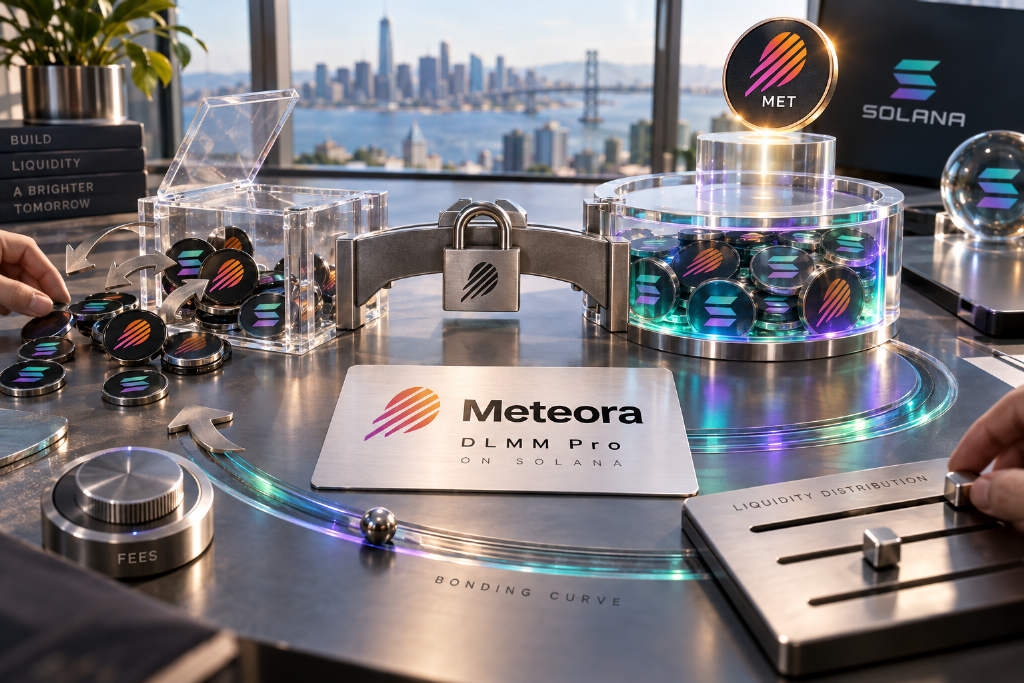
Meteora moved early on a part of the Solana launch market that has drawn growing attention. After the project introduced DLMM Pro, MET jumped 50% in a single day.
The market response was tied to more than a new product name. DLMM Pro is aimed at a structural issue in Solana token launches: once a token finishes its bonding-curve phase and reaches the point known as “graduation,” the remaining tokens and funds are usually moved into a separate liquidity pool for regular trading.
DLMM Pro targets the pool migration problem in Solana launches
Under the common Solana setup described in the report, a new token launch usually happens in two stages.
First comes a bonding curve. The token starts cheap, and the price rises as more buyers come in. Once the price reaches a preset level, the token “graduates.”
Then the launch venue is shut down and the remaining tokens and capital are moved into a standard liquidity pool, where trading starts again under a different structure.
That migration creates several problems. Aggregators and routing tools have to recognize the new pool, capital that was already deployed cannot simply continue in the same form, and teams cannot easily shape the opening market the way they want.
The report says this is largely how Solana works today. Tokens launched on Pump.fun move to PumpSwap after graduation. Raydium sits at the other end of that route, taking in graduated tokens from other platforms while also offering its own launch tools. Meteora’s own DBC product follows the same pattern, with pools moving once the price reaches the required level.
DLMM Pro is trying to remove that step altogether.
The idea is to let a token stay in one pool from issuance through the later, more mature trading phase.
One pool from launch to maturity, with more control over the opening market
The report highlights three main features.
- First, teams can decide how liquidity is arranged at launch. They can choose whether they want the price path to be steadier or more aggressive at the start.
- Second, fees can start high and then decline over time. Newly launched tokens tend to be the most volatile, and liquidity in the pool is more exposed during that period, so higher fees act as compensation for that risk. Once trading becomes more stable, fees can be lowered to keep users active.
- Third, there is no pool migration. One pool is meant to cover the full path from issuance to a mature market.
Meteora is also pairing the design with several supporting functions. Each liquidity provider receives a position certificate, described in the report as something like a title deed. It can be transferred, several positions can be merged into one, and custody can be delegated. Users who want limit orders can place them in the same pool, and once those orders are filled, the funds can keep earning fees. The report adds that costs are also expected to fall, though it says that will need to be tested once the feature is live.
The structure is not unique to Meteora. The article points to Bankr on Base as an example of a launch platform using a similar setup, where pools do not move and fees continue flowing to the creator.
September was the strongest month of the year, with fees rising faster than volume
The surge in MET was not only about DLMM Pro.
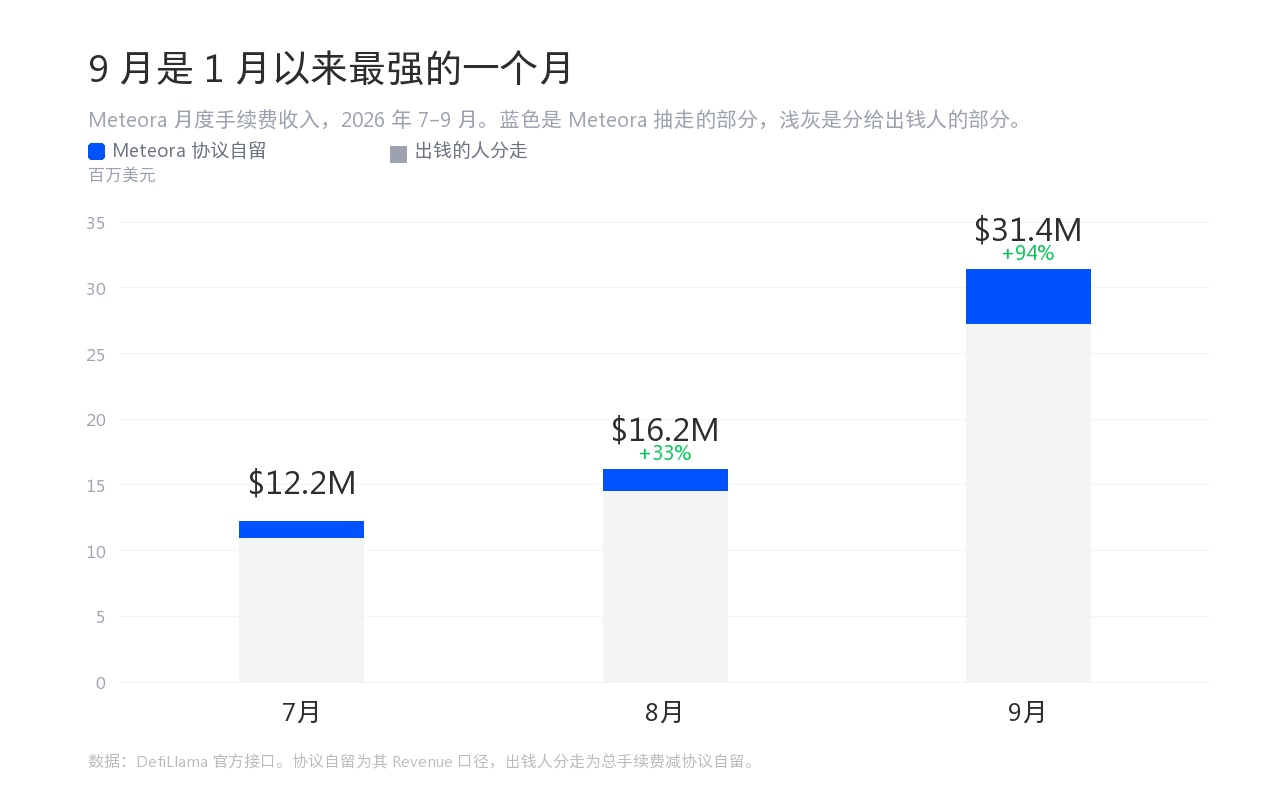
According to DefiLlama data cited in the report, Meteora’s fee revenue over the past three months was:
- July: $12.21 million
- August: $16.19 million
- September: $31.43 million
That puts September up 94% from August, nearly doubling month over month.
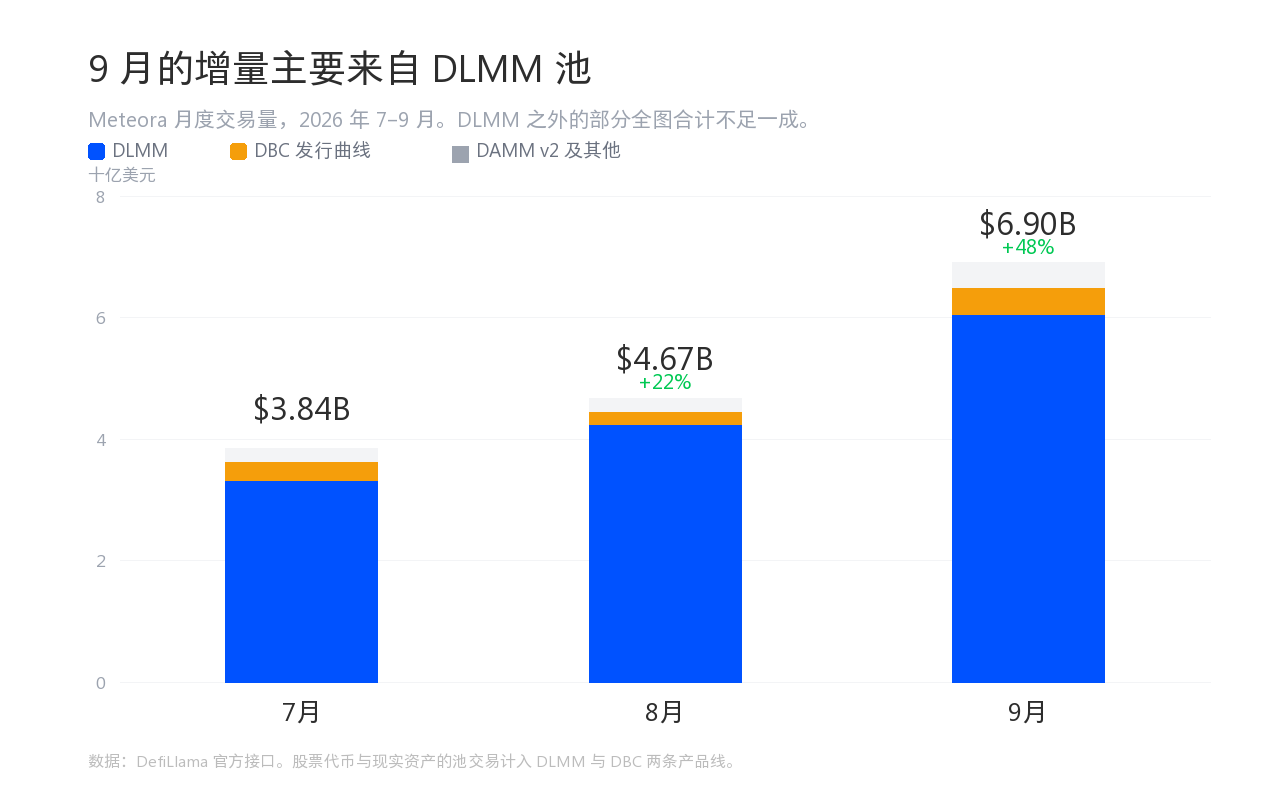
Trading volume over the same period was:
- July: $3.84 billion
- August: $4.67 billion
- September: $6.90 billion
September volume was up 48% from August.
In other words, volume rose 48% while fee revenue rose 94%, meaning fees expanded much faster than trading activity.
The report attributes that gap to Meteora’s dynamic fee model. Unlike pools that charge a fixed rate, Meteora charges more when prices swing more sharply. With volatility elevated in September and trading still active, the same amount of volume generated more fee income. The article describes this as a core part of Meteora’s earnings model and one of the clearest differences between its pools and others.
Support for stock tokens on Sept. 9 helped revive the DBC line
The article also links September’s strong numbers to a broader set of tradable assets.
Based on updates in Meteora’s official documentation, its launch tool began supporting stock tokens on Sept. 9. Stock tokens, real-world assets, and other new token types can now be used as one side of a pool.
That matters because these pools were previously focused on newly issued crypto tokens. With the change, a wider range of assets can enter the same trading framework.
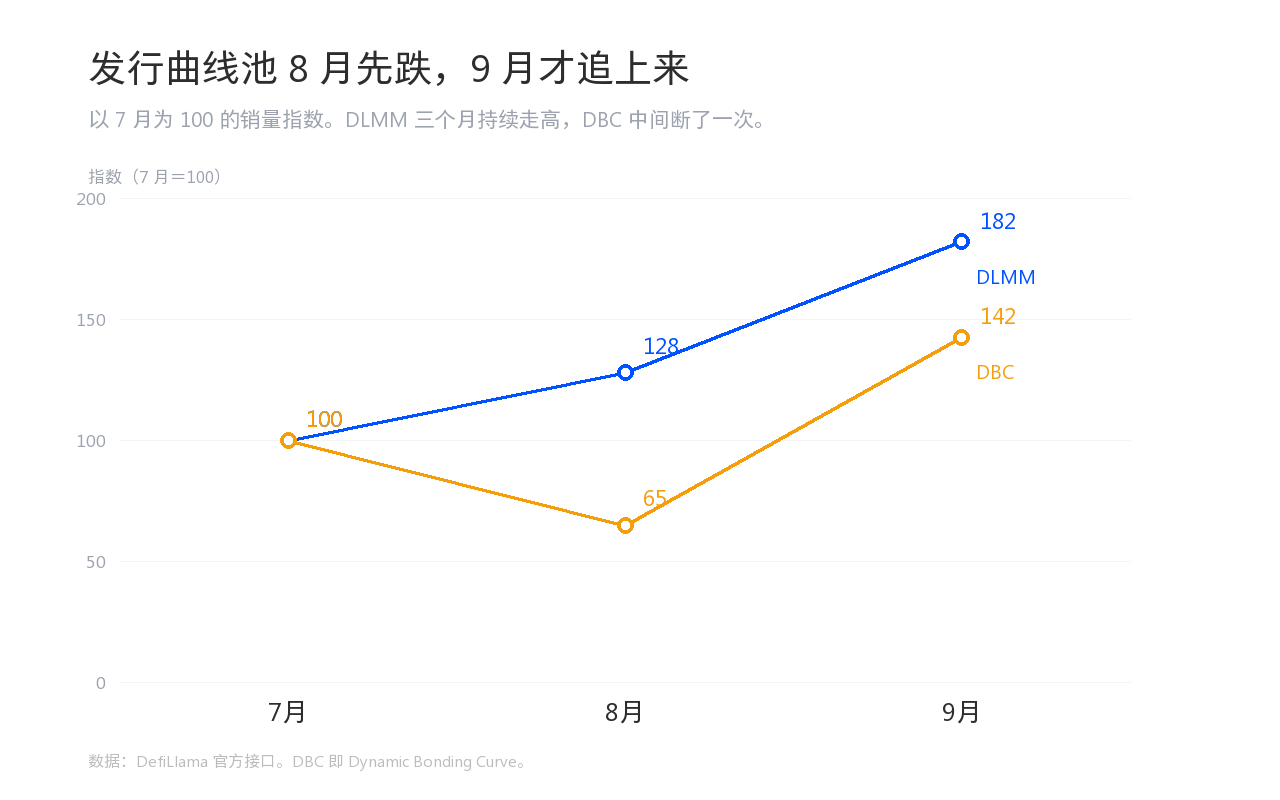
DBC, the bonding-curve pool line, is one of the product lines handling these assets. Using July as 100, the report says DBC reached 142 in September, the highest level in the three-month period. What stands out is that DBC had fallen to 65 in August, making it the only one of the three product lines to shrink that month. It only caught back up after stock token support was added on Sept. 9.
Stock-linked assets behave differently from newly launched tokens. They trade during fixed market hours and their prices are generally less erratic. Pools for those assets need tools that can set narrower price ranges and handle accounting more precisely. The report argues that DLMM Pro’s three main controls fit that use case.
Protocol revenue still does not flow automatically into MET
For MET holders, the clearest revenue-sharing mechanism at the moment is referral staking.
That program went live on July 21. Part of DLMM fee income is converted into USDC and distributed to stakers and to users who refer others into staking.
The first round ended in late August, with 76 million MET staked and $336,000 distributed. The second round ended on Sept. 21, with staking volume rising to 89 million MET and distributions topping $700,000.
The other mechanism discussed in the report is buybacks, where the project uses funds to purchase MET in the market.
Meteora spent $1 million in the first quarter and bought back about 7 million MET at an average price of $0.1427, according to the article. Cumulative spending has reached $13.67 million, equal to 3.97% of total supply. But the repurchased tokens were not burned; they were retained. The report says Meteora’s first-half report and its August community call did not mention buybacks, suggesting that no buybacks were likely carried out in the second quarter.
That leaves the current setup in a fairly clear state: protocol fees are rising, and distributions to stakers are rising too, but there is still no automatic mechanism that directly connects those two trends to MET’s price. Whether buybacks happen, and how much gets distributed, remains a decision made by the project team.