
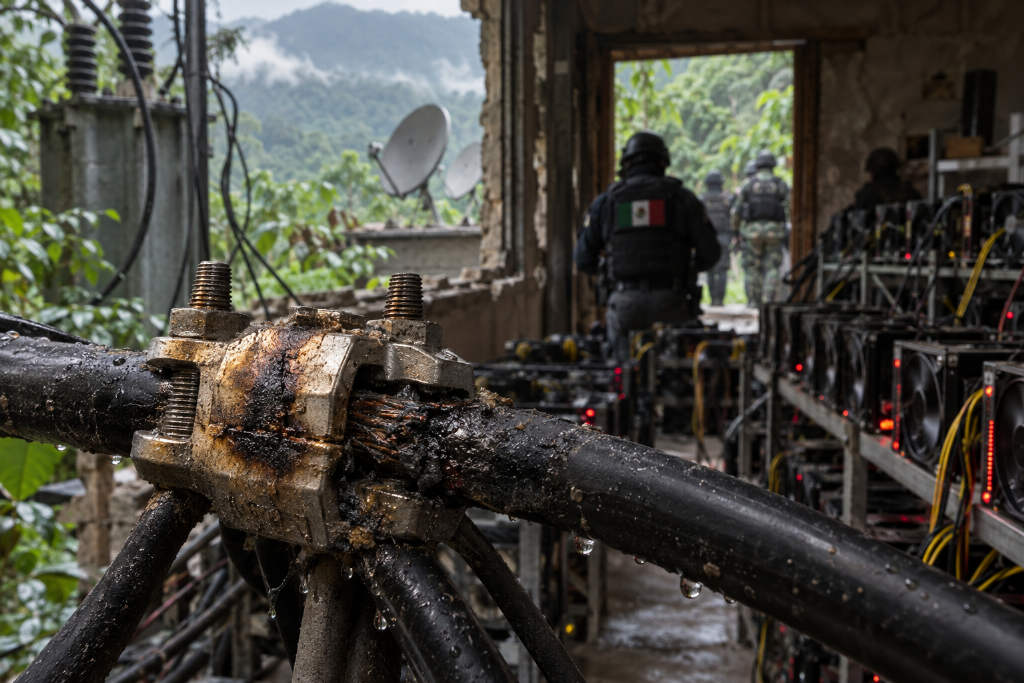
Mexican authorities raided a suspected cryptocurrency mining site hidden deep in the Sierra region of Puebla in early September 2026, finding about 300 machines running inside an old house in the middle of dense forest.
The search team was led by personnel from Mexico’s Federal Attorney General’s Office, known as FGR, and included members of the navy and state public security police. After moving through thick jungle, officers surrounded the property and forced the door open. Inside, they found no signs of daily life. The building was filled with specialized equipment operating around the clock and producing a loud mechanical hum.
Local reports described much of the hardware as GPUs, which suggests the site was more likely mining GPU-compatible cryptocurrencies rather than Bitcoin. Investigators also found transformers, 80 medium-voltage connection terminals and eight satellite dishes mounted on the roof. Because the location was so remote, the site relied on satellite links to connect to outside networks.
Case opened under suspected theft of state energy
Local police later confirmed that the mountain property had been used as a suspected illegal crypto mining operation. Mining itself, however, is not treated as a standalone criminal offense in Mexico. Prosecutors have instead opened the case under suspected theft of state energy.
According to investigators, the group took advantage of its proximity to hydroelectric infrastructure to siphon off large amounts of power. One of the main clues was an abnormal electricity connection discovered during the investigation, including an unauthorized transformer installation. Police followed that trail and eventually located the mining site.
Financial investigators are also examining the money behind the operation. The equipment was described as high-value, and authorities are tracing which accounts paid for the machines. Possible money laundering remains under investigation.
Why the operation was hidden in the mountains
There was a practical reason for placing the site far from populated areas. Mining equipment generates heavy heat loads and constant noise, making it difficult to hide in cities or residential neighborhoods. Security officials in Puebla said operations of this kind tend to move into remote areas because of their power consumption and noise profile.
The Sierra location also offered another advantage. It sits near the Nuevo Necaxa hydroelectric facilities, where electricity resources are abundant and access to power infrastructure is closer at hand. Investigators said the network used that proximity to steal energy on a large scale.
Stolen electricity can push costs close to zero
The report cites comments carried by Reuters and estimates linked to the Cambridge Bitcoin Electricity Consumption Index, which put the cost of producing one Bitcoin at close to $45,000. Bitcoin’s market price in early September was around $77,000 to $78,000.
That spread may look profitable, but legal miners still face tight economics because electricity is usually the largest expense in the business, accounting for about 60% to 80% of total costs. Samuel León of Universidad Iberoamericana in Mexico, who studies electricity theft, said that if the power is stolen, the main cost of the business “almost drops to zero.”
That changes the risk and profit profile dramatically. A miner that does not pay for electricity can operate with much lower cost pressure and much higher paper profits. Authorities therefore suspect that power theft linked to mining in the region has grown beyond isolated actors and into a broader network.
Authorities had already uncovered other sites
This was not the first such case in the area. In early 2025, law enforcement dismantled another site near Nuevo Necaxa. That investigation pointed to property linked to the Mexican Electricians’ Union, or SME, which was accused of being used for illegal power connections tied to mining.
Later in 2025, two more concealed mining sites were discovered near the border between Puebla and the neighboring state of Tlaxcala. Officials said afterward that the cases no longer looked like a single isolated operation, but part of a network targeting areas near hydroelectric plants and using large-scale illegal hookups to obtain electricity.
Public losses sit behind the “zero-cost” model
The savings captured by an illegal mining site do not disappear. They show up as losses elsewhere in the public system. Public figures from Mexico’s state power company indicate that from January to July 2024, so-called non-technical losses tied to electricity theft, illegal line connections and meter tampering reached about 6,346 gigawatt-hours. The estimated value was about 13.8 billion pesos, or roughly $817 million.
That figure covers only part of a year for one utility. The regulatory setting adds another layer of complexity. Personal crypto mining in Mexico does not carry a dedicated criminal classification and is not banned in principle. Cryptocurrencies are not recognized as legal tender, but holding, trading and mining them are generally not prohibited. The article describes the sector as permitted but conservative, with fragmented oversight.
Investigators are also following the money
According to Chainalysis’ 2026 report, at least $154 billion flowed into illicit cryptocurrency addresses worldwide in 2025, up 162% year over year. About $104 billion of that total went to sanctioned entities, while stablecoins accounted for roughly 84% of illicit transaction volume. The report said the increase was driven mainly by sanctions evasion, state or quasi-state fund flows and money laundering networks.
That helps explain why investigators moved quickly from illegal power connections to the source of the money used to buy the machines. The article notes that Bitcoin was designed around a transparent ledger, where the movement of each coin can be traced on-chain. The physical energy used to produce digital assets, though, can still turn into a public loss that no one wants to own.
The 300 machines found in the jungle have now been shut down. But as long as stolen electricity leaves room for outsized profits, similar operations may surface somewhere else.