

A report published Sunday by payments infrastructure firm Decta said the market for MiCA-compliant euro stablecoins expanded sharply in the year leading up to the end of the European Union’s transition period for crypto-asset service providers, or CASPs. According to the report, the combined market capitalization of eight compliant euro stablecoins rose to $673.9 million on June 28, 2026, up from $295.6 million on June 30, 2025.
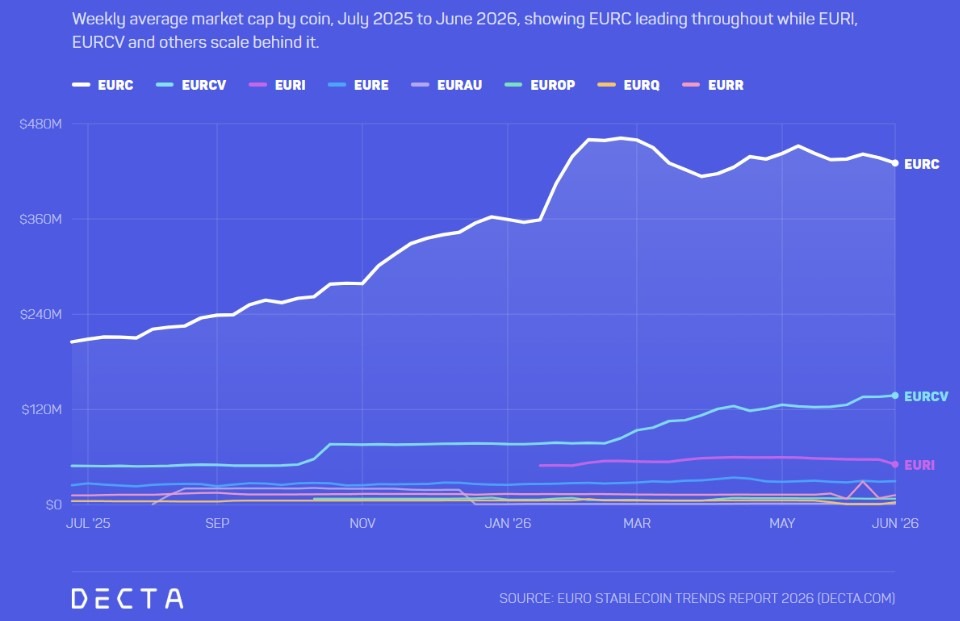
Decta said trading activity also increased during the same period. Aggregate trading volume across the tracked euro stablecoins climbed 43.1%, reaching $67.3 million from $47 million a year earlier. The number of MiCA-compliant euro stablecoins included in the report also increased, rising from five to eight over the study window.

The firm noted that its methodology focused on euro stablecoins that were actively issuing tokens and that showed both market capitalization and trading volume during the period under review. That makes Decta’s sample narrower than the interim MiCA register maintained by the European Securities and Markets Authority, or ESMA, which includes a broader set of tokens that may not satisfy Decta’s activity criteria.
Growth is clear, but euro stablecoins remain a small segment
Decta’s findings suggest that euro-denominated stablecoins are gaining ground under the MiCA framework, but from a relatively limited base. The broader stablecoin market remains overwhelmingly dominated by dollar-backed products. CoinGecko data cited in the report places the market capitalization of US dollar-pegged stablecoins at about $300 billion.

Against that backdrop, the eight actively traded and MiCA-compliant euro stablecoins tracked by Decta amount to only 0.22% of the dollar stablecoin market. In other words, even after a year of strong percentage growth, the euro stablecoin segment remains far from challenging the scale of dollar-denominated competitors.

The timing of the report is significant. Decta’s data sample ends just days before the close of the MiCA transition period for CASPs. From July 1, firms offering crypto-asset services in the European Union generally needed MiCA authorization, making the report one of the last snapshots of market conditions immediately before that regulatory deadline took full effect.
MiCA’s competitive impact is still under debate
The Decta report adds new figures to an ongoing policy debate in Europe over whether MiCA’s tighter stablecoin rules are helping euro-based digital money mature safely or constraining its ability to compete with dollar-backed tokens. Supporters of the framework argue that stronger oversight improves resilience and trust. Critics say the compliance burden may be limiting product appeal and commercial adoption.

That debate was highlighted on April 27, when Blockchain for Europe released a report arguing that MiCA had made euro stablecoins safer but commercially weaker. According to that analysis, MiCA’s reserve requirements and its prohibition on interest payments put euro stablecoins at a disadvantage relative to products operating under looser structures elsewhere.
The discussion intensified further in May after Brussels-based think tank Bruegel published a policy paper calling for softer liquidity requirements for stablecoin issuers and suggesting they could potentially be granted access to European Central Bank funding. Bruegel argued that a more flexible framework could improve the competitive position of euro stablecoins against the dollar-backed market leaders.
The European Central Bank, however, pushed back on that idea. On May 23, the ECB warned EU finance ministers that a broader expansion in euro stablecoin issuance could weaken bank lending and complicate the transmission of monetary policy. The central bank also rejected concerns that stricter EU rules would necessarily accelerate digital dollarization.

Overall, Decta’s data points to meaningful growth in the compliant euro stablecoin market as MiCA’s CASP transition period came to a close. Still, the numbers also underline how small the sector remains in absolute terms. With MiCA authorization now broadly required across the EU, the next phase of the market will likely be judged not only by compliance progress, but by whether euro stablecoins can grow without losing ground to dollar-based alternatives.