MiCA Transition Ends: A New Era for EU Crypto Regulation
On July 1, 2026, the EU's Markets in Crypto-Assets Regulation (MiCA) transitional period officially ended. From this date, any entity providing crypto-asset services within the EU must hold a MiCA license. The French regulator AMF warned that violations could result in up to two years imprisonment and a €30,000 fine, with powers to publish blacklists and request site blocking. This is the largest-ever exchange crackdown in Europe, directly impacting platforms like Binance and MEXC that lack MiCA authorization.
MiCA Framework: Unified Licensing and Ten Service Categories
MiCA is the EU's first comprehensive regulatory framework for crypto assets, effective since 2023 and applicable to all 27 member states plus Norway, Iceland, and Liechtenstein (EEA). Before MiCA, regulation was fragmented—exchanges needed separate registrations in Germany, France, etc. MiCA replaces this patchwork with a single rulebook. Under MiCA, Crypto-Asset Service Providers (CASPs) must apply for authorization in a member state, specifying the services they offer. The ten categories include operating a trading platform, custody, exchange, order execution, portfolio management, and advisory services. A single license covers only the categories applied for. MiCA also has a sub-framework for stablecoins: asset-referenced tokens (ARTs) and e-money tokens (EMTs) must meet authorization and reserve requirements, with stricter rules for significant stablecoins. The passporting mechanism allows a licensed entity to serve all EU markets via a single notification.
Transitional Period Disparities: Country-by-Country Differences
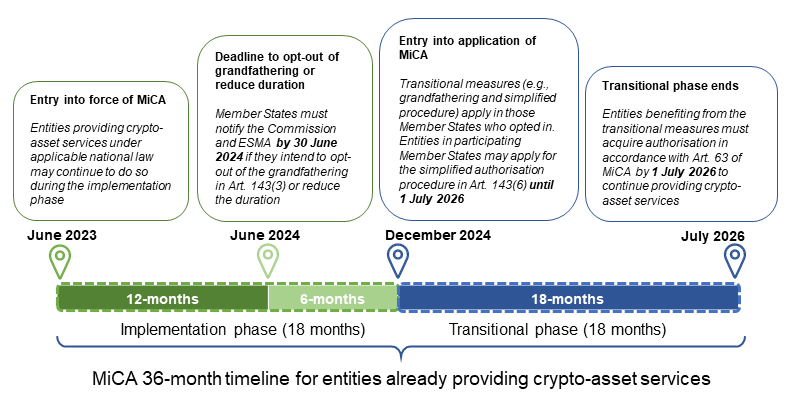
MiCA allowed member states to set transitional periods up to 18 months. Implementation varied: the Netherlands ended its period on July 1, 2025; Germany shortened it to end of 2025 to accelerate approvals; Lithuania saw 240 registered crypto firms shut down when its transition expired. By June 2026, 20 of 27 EU states had already ended their national transitional periods before the July 1 final deadline. According to crypto news data, only about 194 firms had obtained full MiCA authorization as of May 2026, compared to an estimated 1,100-3,000 previously operating under national regimes. Law firm Hogan Lovells estimates 75% of legacy platforms will lose their legal status after the transition ends.
Exchange and Stablecoin Shakeout: Binance, KuCoin Halted; USDT Exits
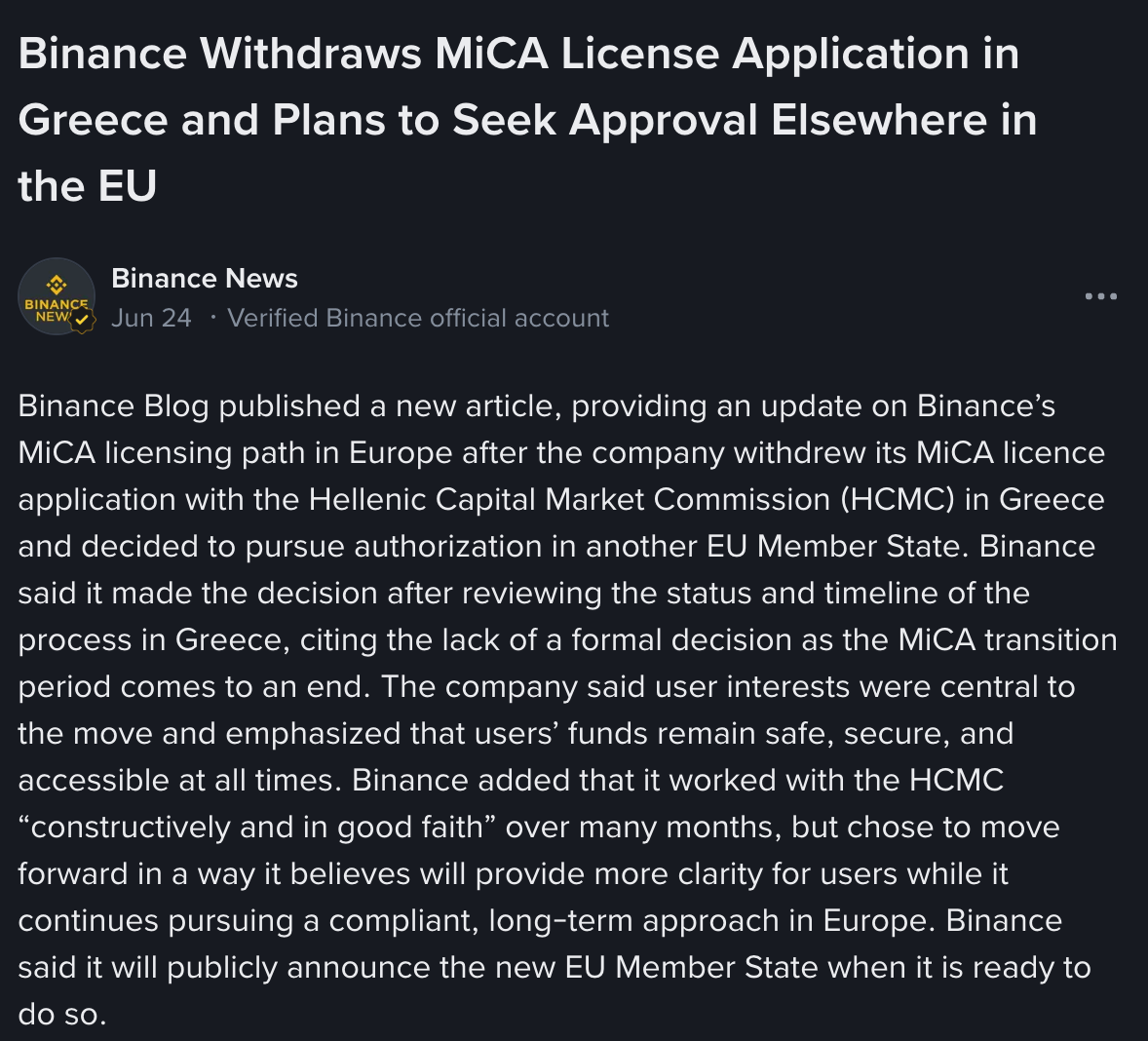
Major exchanges face different outcomes. Binance submitted a MiCA application via Greece‘s Hellenic Capital Market Commission (HCMC) in January 2026. However, Reuters reported on June 16 that HCMC plans to reject it, citing concerns over Binance’s legal history and governance structure after a joint review by Greek, Irish, and Latvian regulators. KuCoin obtained Austrian FMA authorization in November 2025 but was prohibited from launching operations due to vacancies in key AML and sanctions compliance roles. KuCoin appealed but cannot accept new EU users.

Stablecoin reshuffling is nearly complete. Tether’s USDT failed to obtain MiCA authorization. CEO Paolo Ardoino stated MiCA requires most EMT reserves to be held in EU-regulated bank accounts, incompatible with Tether‘s model. Consequently, Coinbase delisted USDT in December 2024, Crypto.com followed on January 31, 2025, and Binance and Kraken delisted in March 2025, effectively removing USDT from major EU compliant exchanges. Circle’s USDC and EURC received EMT authorization; USDC’s market cap reached approximately $75 billion in June 2026, becoming the dominant stablecoin in EU compliant scenarios. No issuer has yet obtained authorization under the ART framework, the highest MiCA threshold.

User Actions and Future Regulatory Direction
After July 1, EU users on unlicensed platforms face several risks: platforms may stop accepting deposits, require withdrawals within a deadline, or restrict accounts without notice. OKX Europe analysis found that between May 2025 and May 2026, about 41% of European crypto app downloads came from unauthorized exchanges, and an estimated 60% of European crypto users are currently on unlicensed platforms. If a platform has notified users of migration (as seen with Bybit, Bitvavo, Kraken, Coinbase, and Crypto.com for some EU users), it typically requires re-KYC and acceptance of updated terms—a normal process under MiCA AML requirements.

MiCA is not the end. On May 20, 2026, the European Commission launched a formal review consultation with 86 questions covering stablecoin competitiveness (especially euro stablecoins’ weakness versus dollar stablecoins), DeFi, staking lending, RWA tokenization, and whether ESMA should gain direct supervisory authority over major CASPs. France, Austria, and Italy support ESMA’s direct supervision to narrow standard gaps between member states. Meanwhile, 37 banks including BNP Paribas, ING, and UniCredit have formed the Qivalis consortium to develop a euro-pegged compliant stablecoin, aiming to compete in a market dominated by dollar stablecoins.