
The MiCA Transition Deadline: A Watershed for EU Crypto Regulation
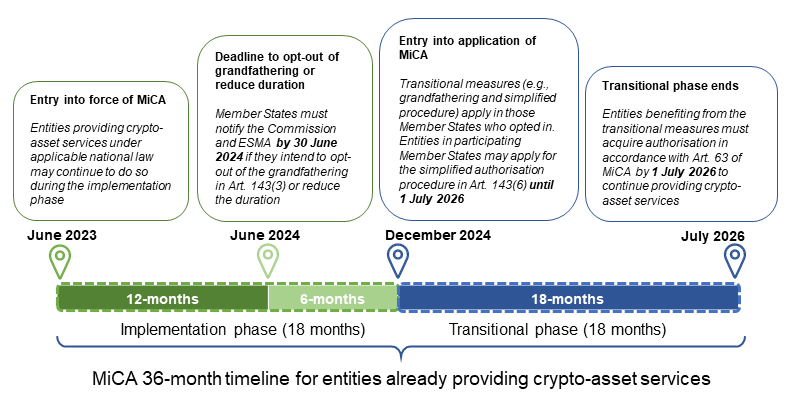
On July 1, 2026, the 18-month transition grace period for the EU's Markets in Crypto-Assets Regulation (MiCA) officially expired. From this date onward, any entity offering crypto asset services within the 27 EU member states plus the three EEA countries (Norway, Iceland, Liechtenstein) must hold a valid MiCA license. Unlicensed operators face severe consequences: French regulator AMF has explicitly warned that violations can result in up to two years imprisonment and fines of €30,000, with regulators retaining the power to publish blacklists and apply for website blocking.
The scale of this regulatory purge is unprecedented. According to data cited by Crypto News, as of May 2026, only approximately 194 crypto firms had obtained formal MiCA authorization across the EU, compared to an estimated 1,100 to over 3,000 service providers previously registered or operating under individual national regimes. Legal firm Hogan Lovells estimates that about 75% of legacy platforms will lose their legal eligibility after the grace period. This includes major exchanges such as Binance and MEXC, which have not secured MiCA licenses, fundamentally reshaping the EU crypto competitive landscape.
Core Design of the MiCA Regulatory Framework
MiCA is the EU's first comprehensive regulatory framework for crypto assets, enacted in 2023. Prior to MiCA, regulation across European countries was highly fragmented: the same exchange had to register separately in Germany, France, and others, with varying thresholds and enforcement levels. MiCA aims to replace this patchwork with a single rulebook.
MiCA categorizes Crypto Asset Service Providers (CASPs) into ten specific service categories, including operating a trading platform, custody, crypto-to-fiat exchange, order execution on behalf of clients, portfolio management, and advisory services. A single MiCA license only covers the categories specified in the application; an exchange conducting matching, custody, and transfers must apply for authorization covering multiple services. A key innovation is the 'passporting' mechanism: once a firm obtains a MiCA license in any member state, it can extend services to other member states through a notification process without needing to reapply in each country, significantly reducing compliance costs.
For stablecoins, MiCA establishes a dedicated sub-framework: e-money tokens (EMTs) pegged to a single fiat currency and asset-referenced tokens (ARTs) pegged to a basket of assets must meet issuance authorization and reserve requirements. Larger issuers face stricter constraints. The stablecoin rules took effect in June 2024, while the CASP rules became effective at the end of December 2024.

Variations in National Transition Periods and Licensing Reality
To provide a buffer for existing platforms, MiCA allowed member states to set transition periods up to 18 months. However, many countries shortened them. The Netherlands ended its grace period as early as July 1, 2025; Germany shortened it to end-December 2025; Lithuania saw over 240 registered crypto firms shut down when its transition ended. By June 2026, 20 of the 27 member states had ended their national transition periods before the July 1, 2026 deadline.
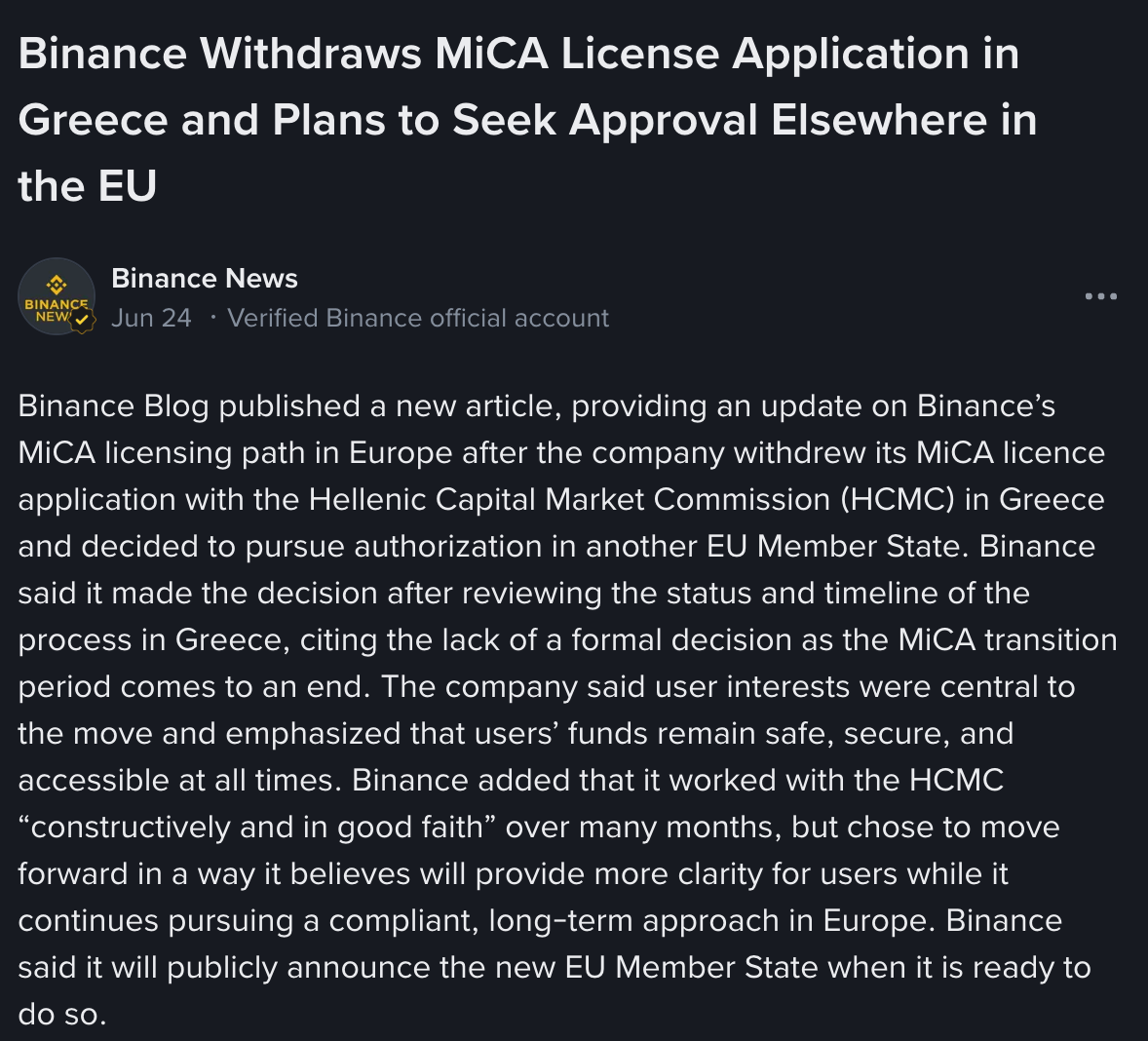
The disparity between licensed and legacy operators is stark: 194 MiCA-authorized firms versus an estimated 1,100-3,000 previously registered platforms. This means a large number of small and mid-sized platforms, as well as some major exchanges, must exit the EU market. KuCoin's situation is particularly convoluted: it obtained a MiCA license from Austria's FMA in November 2025, but the FMA subsequently prohibited it from conducting business due to vacancies in key AML and sanctions compliance roles. KuCoin has appealed and still cannot accept new EU users. Binance submitted a MiCA application through Greece's HCMC in January 2026, but on June 16, Reuters reported that HCMC is planning to reject the application, citing concerns over Binance's past legal record and governance structure after a joint review by Greek, Irish, and Latvian regulators.

Stablecoin Shakeout Complete: USDT Exodus, USDC Ascendancy
While the exchange shakeout is ongoing, the stablecoin market has already undergone a complete restructuring. Tether's USDT, the world's largest stablecoin, never obtained MiCA authorization. CEO Paolo Ardoino publicly stated that MiCA's requirement to hold the majority of EMT reserves in EU regulated bank accounts is incompatible with Tether's existing reserve model. Consequently, Coinbase delisted USDT in December 2024, Crypto.com followed on January 31, 2025, and Binance and Kraken delisted USDT in March 2025. USDT has been fully expelled from major EU compliant platforms.

In contrast, Circle's USDC and EURC have both received EMT authorization. As of June 2026, USDC's market cap stands at approximately $75 billion, making it the dominant stablecoin in EU compliant scenarios. Meanwhile, the asset-referenced token (ART) framework remains the highest hurdle, with no issuer having obtained authorization to date.
User Actions and Future Regulatory Outlook
For EU users, using unlicensed platforms after July 1 carries multiple risks: platforms may stop accepting deposits, demand withdrawals within a deadline, or restrict account operations without prior notice. An analysis by OKX Europe found that between May 2025 and May 2026, approximately 41% of European crypto app downloads came from exchanges without MiCA authorization, and it is estimated that about 60% of European crypto users are currently using unlicensed platforms. Users should immediately check whether their platform holds a MiCA license. If not, they should transfer assets to compliant platforms or self-custodial wallets as soon as possible. If a platform has notified users of account migration—as experienced by some EU users of Bybit, Bitvavo, Kraken, Coinbase, and Crypto.com—users typically need to complete new KYC verification and accept updated terms of service, a normal process under MiCA's AML requirements.

MiCA is not the final destination. The European Commission launched a formal review consultation of the MiCA regulation on May 20, 2026, with comments accepted until August 31, and a final report due to the European Parliament by June 30, 2027. The 86 consultation questions cover stablecoin competitiveness (especially the weak position of euro stablecoins versus dollar stablecoins), DeFi, staking and lending, RWA tokenization, and whether ESMA should obtain direct supervisory authority over major CASPs. France, together with Austria and Italy, explicitly supports ESMA directly supervising top CASPs to reduce standard gaps between member states. Meanwhile, a consortium of 37 banks, including BNP Paribas, ING, and UniCredit, has formed the Qivalis alliance to develop a euro-pegged compliant stablecoin, aiming to carve out a space for euro digital currencies in a market dominated by dollar stablecoins. This regulatory revolution is far from over, and crypto firms must stay attuned to future rule changes.