
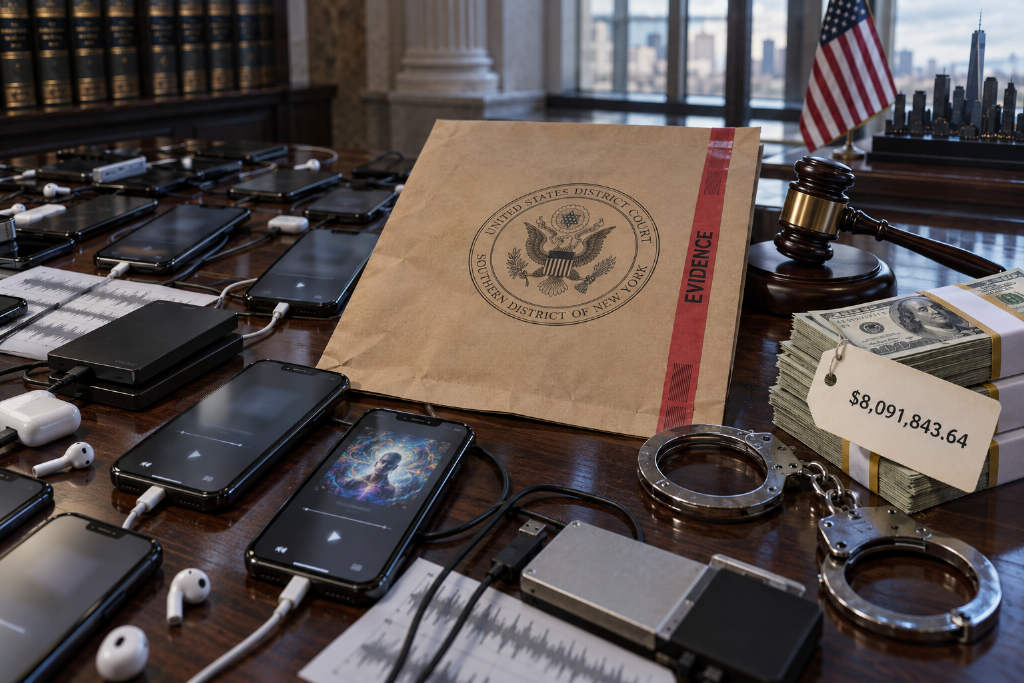
The first criminal streaming fraud case in the United States has ended with a prison sentence. Michael Smith, a 54-year-old from North Carolina, was sentenced on Oct. 6, 2026, by the U.S. District Court for the Southern District of New York to 18 months in prison and ordered to forfeit $8,091,843.64. Prosecutors said he used thousands of bot accounts to repeatedly play songs registered under his own name and collect royalties.
How the fake listener network worked
The accounts were built from large volumes of purchased email addresses and registered under fake names. Typing and account setup work was handled by overseas workers and co-conspirators in the United States. At its peak, the operation had 10,000 active bot accounts running at the same time. Smith mostly bought family plans because they offered the lowest average cost per account.
An early calculation he sent to himself laid out the economics plainly: 1,040 bot accounts could generate about 661,440 streams a day. Using an estimate of half a cent per stream, that worked out to annual revenue of $1,207,128.
According to the case record, Smith received more than $14 million from royalty payment organizations. After subtracting royalties tied to real listeners and the money he paid into the royalty pool through subscription purchases, both sides agreed on a loss amount of $8,091,843.64.
Prosecutors highlighted the scale with a stream comparison
Prosecutors used one comparison to show how large the operation had become. In April 2023, counting only streams from YouTube Music family-plan accounts, Taylor Swift’s full catalog recorded 9.3 million plays. In the same month, works registered to Smith recorded 80.9 million plays, about 8.7 times as many.
Why AI-generated songs were central to the scheme
The reason was detection. If a single track drew an abnormal number of plays, it could be flagged and taken down. In an email dated May 9, 2019, Smith wrote: “Without content, I can’t run bots. And I need enough content so I don’t overplay each song. That’s the issue. If the same song gets too many plays, it gets taken down.”
The indictment press release said Smith began obtaining hundreds of thousands of AI-generated songs around 2018. He worked with the chief executive of an AI music company and a music promoter, who supplied thousands of tracks each week. In a 2019 email, that executive wrote: “This isn’t ‘music,’ it’s ‘instant music.’” Smith then assigned random song titles and artist names to audio files that originally had garbled filenames so they would look like works made by real musicians.
The royalty pool structure sat at the center of the case
The scheme relied on how streaming royalty pools are allocated. Streaming services place a portion of revenue into a royalty pool and distribute it based on each song’s share of total plays. That meant the fake streams were not taking money from the streaming services themselves. They were diluting the share that would otherwise go to legitimate creators and rights holders.
Questions had been raised for years
The report said distributors and streaming services had grown suspicious as early as 2018. In 2023, The Mechanical Licensing Collective, or MLC, the U.S. entity responsible for collecting and distributing songwriting royalties from streaming services, stopped paying him more than $700,000 in royalties. Each time, Smith denied wrongdoing and then switched distributors and service providers. The report said the pattern over seven years was not that nobody noticed, but that detection did not stop the operation.
The charge and the sentence
Smith pleaded guilty to one count of conspiracy to commit wire fraud, which carries a statutory maximum sentence of five years. Judge John G. Koeltl imposed an 18-month sentence, less than half of what prosecutors had sought and below the recommendation from probation.
Prosecutors argued that “every penny of loss went to the defendant,” and cited the Music Fights Fraud Alliance, which said: “The sentence imposed by the court will be the first real signal the public sees of the actual legal consequences of streaming fraud.” The defense said Smith was “deeply sorry.”
Defense arguments on AI music and Spotify policy
The defense also argued that making music with AI is not illegal in itself and cited a public statement from Spotify in September 2025: “All music is treated equally, regardless of the tools used to create it.”
The report added that Spotify has applied a rule since April 2024 under which a track with fewer than 1,000 plays on Spotify over the prior 12 months does not qualify for recorded-music royalties. It also has an undisclosed minimum listener threshold. Trade publication Music Business Worldwide ran a calculation from both angles: assuming a catalog of 300,000 songs, Smith’s earlier setup of 1,040 accounts would have produced about 805 plays per song a year, below the threshold; with 10,000 accounts, that figure would rise to about 7,700 plays per song a year, enough to clear it.
Forfeiture was mentioned, victim compensation was not
The U.S. Department of Justice press release mentioned forfeiture but did not mention restitution to victims. The report said the losses were spread across all rights holders in the royalty pool, making it difficult to identify a complete list. The defense said Smith had secured an audio production job paying $5,000 a month. At that rate, repaying the full $8,091,843.64 would take about 135 years.