


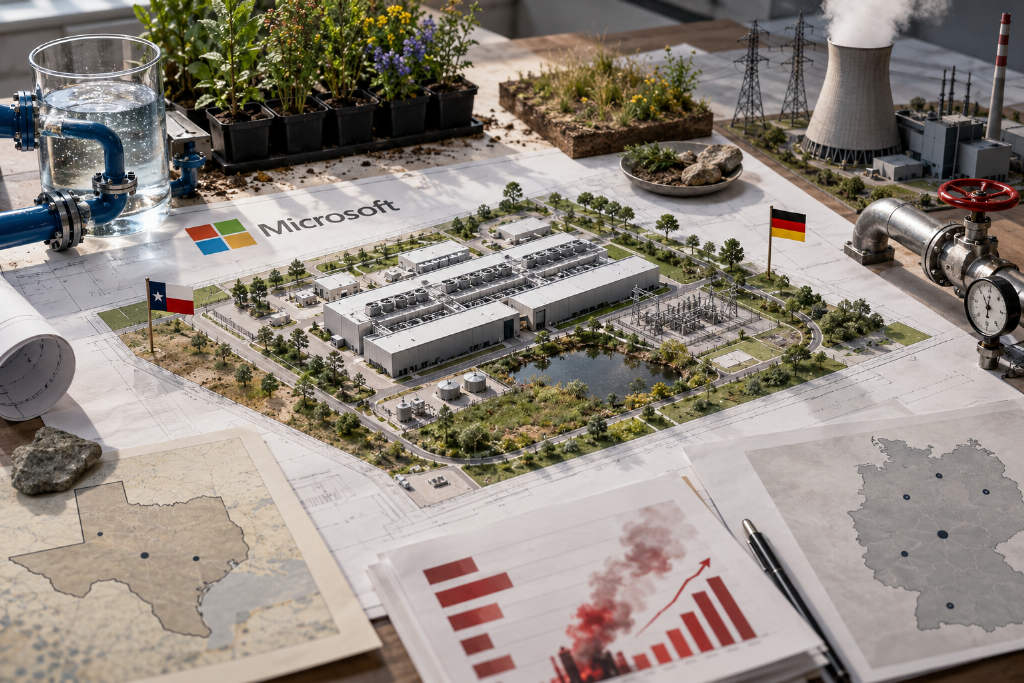
Microsoft plans to expand its biomimicry design program to more than 20 data center sites in the US and Germany, adding native trees, gardens, and ecological restoration around its facilities. The idea is to make data centers blend into the surrounding landscape. Critics in Texas and environmental groups say the approach does little to answer bigger concerns over gas-fired power, water use, and the scale of electricity demand tied to new AI infrastructure.
The tension is visible in Microsoft’s own numbers. The company planted more than 25,000 trees next to a data center in Virginia, yet its carbon emissions rose 25% in 2025. For opponents, that gap explains why the company’s “good neighbor” pitch has not won broad support.
Program expands from a Dutch pilot to more than 20 sites
Biomimicry, as Microsoft presents it, means borrowing from nature and folding data centers into the local environment through native vegetation, gardens, and habitat restoration.
According to a Microsoft announcement dated Sept. 16, the pilot began in 2022 at a data center in the Netherlands. The company now plans to expand it to more than 20 sites in the US and Germany, with all new US projects included.
The timing is not hard to read. Communities across the US have stepped up opposition to new data center developments. Microsoft President Brad Smith also introduced a five-point plan in January 2026, saying the company would absorb the costs itself and would not push up local power prices.
Kaitlin Chuzi, Microsoft’s global director of land strategy, told The Verge: “We are actually customizing solutions based on local habitat, strengthening what is already there and restoring what may have been lost in the past.”
Some support exists, but questions remain over measurement
The report says Microsoft’s work has drawn some favorable responses.
Dave Giordano, executive director of Root-Pike WIN, said it was rare locally to see a forebay added to a stormwater pond to catch sediment. Erin Kinney, a senior research scientist at the Houston Advanced Research Center, said the customized approach was “really exciting,” but added that the real test would be how Microsoft measures and discloses the benefits.
Tree planting does not erase land and water impacts
One gap appears in land use. In 2022, Microsoft cleared more than 2,600 trees across 33 acres, about 13.4 hectares, to build a data center in San Antonio. A Microsoft spokesperson said in an email that the company is investing in restoration of more than 400 acres, or over 162 hectares, of forest and grassland in the area.
Water is another point of friction. A large share of a data center’s water footprint often comes from electricity generation, since fossil fuel and nuclear plants also need water for cooling.
The Houston Advanced Research Center estimated that Texas data centers would use about 25 billion gallons of water in 2025, roughly 94.6 billion liters, or about 0.4% of statewide water use. By 2030, that share could rise to 0.5% to 2.7%.
Gas-fired power remains the hardest issue to offset
For critics, the biggest problem is natural gas.
On June 22, 2026, Chevron and Microsoft signed a 20-year power purchase agreement to supply a new AI data center campus in West Texas. The plant is expected to start delivering electricity in 2028 and scale up to 2.67 GW, enough to power more than 530,000 Texas homes.
Chevron said the project would be one of the largest co-located natural gas power plant and data center developments in the US. In this case, co-located means the power plant would sit directly beside the data center.
Adrian Shelley, Texas director of consumer advocacy group Public Citizen, said nature-based solutions are “all good things,” but described the broader effort as “basically putting lipstick on a pig.” He said he does not see how investment in biomimicry design would make a gas plant into a welcome neighbor.
Rising emissions complicate Microsoft’s 2030 goals
Microsoft’s latest sustainability report said the company emitted about 20 million metric tons of carbon dioxide equivalent in 2025, up from roughly 16 million metric tons the year before, a 25% increase.
That puts pressure on two of Microsoft’s 2030 targets: becoming carbon negative and achieving water positivity, meaning it would replenish more water than it uses.
Former employee Holly Alpine, who left Microsoft in 2024 after working on ecological restoration around data centers, offered a sharper critique. She said the biomimicry projects were “very well designed,” but argued they could not outweigh the harm caused by Microsoft’s cloud services and AI tools used by oil and gas companies to increase production.
In a paper she co-authored in August in a Nature journal, Alpine argued that the emissions added by AI-driven oil and gas expansion would exceed the emissions avoided through AI’s role in speeding up renewable energy.