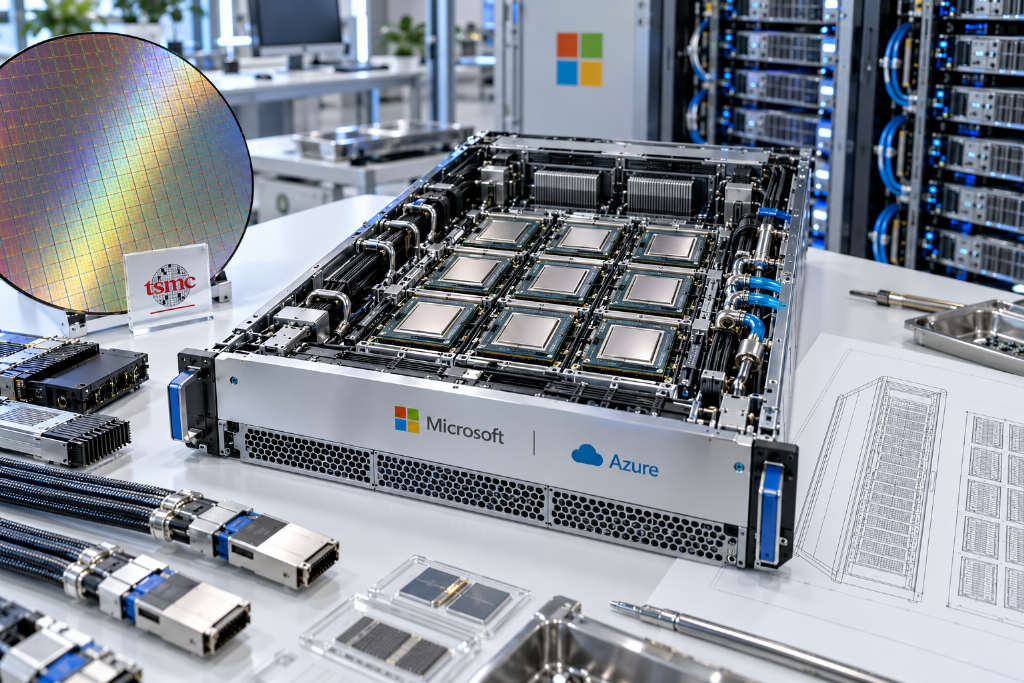
Microsoft has introduced its third-generation in-house AI chip, Maia 300, and plans to deploy it at scale starting next year, with total deployment potentially exceeding 1 million units, according to a Reuters report cited by Taiwan's Central News Agency. The chip is designed to support Microsoft's internal AI services.
The report said Maia 300 uses a chiplet-based design rather than the large single-compute-die approach used in Nvidia's AI accelerators. The chiplets handling key compute functions are built on TSMC's 2 nm process, while other chiplets use a lower-cost 3 nm process for moving data out of the processor and across other parts of the system.
Microsoft said Maia 300 can handle code generation and carry out complex business tasks on behalf of users. The previous generation has already been used to run Microsoft's internal AI models as well as OpenAI models delivered through Microsoft Azure. Maia 300 will be installed in racks holding 96 chips each, with power consumption of about 167 kW per rack. By comparison, Nvidia's latest GB300 AI server rack uses 72 GPUs and consumes about 142 kW. Microsoft also said deployment will reach several gigawatts, and it had previously projected capital spending of more than $175 billion this year.
Microsoft has unveiled its third-generation in-house AI chip, Maia 300, with deployment starting next year potentially exceeding 1 million units to support the company's internal AI services, according to a Reuters report cited by Taiwan's Central News Agency.
Chiplet design built around TSMC manufacturing
The report said the chiplets responsible for key compute functions are made using Taiwan Semiconductor Manufacturing Co.'s 2 nm process. Maia 300 is designed to handle code writing and to carry out complex business tasks on behalf of users.
The previous generation of the chip has already been used to run Microsoft's internal AI models, as well as OpenAI models offered through Microsoft Azure cloud computing services.
A different path from Nvidia
Microsoft is taking a different technical approach from Nvidia. Nvidia's AI accelerators use one large compute chip surrounded by high-bandwidth memory chips. Maia 300, by contrast, uses a core compute processor made up of chiplets. The chiplets handling key compute functions use TSMC's 2 nm process, while other chiplets use a lower-cost 3 nm process to move data out of the processor and transfer it to other parts of the system.
Rack setup and power draw
Maia 300 will be installed in racks, with each rack holding 96 chips and consuming about 167 kW of power.
For comparison, Nvidia's latest GB300 AI server rack is configured with 72 GPUs and consumes about 142 kW.
Scale of rollout
Microsoft said it plans to begin large-scale deployment of Maia 300 next year, with the rollout reaching several gigawatts. The company had previously said its capital expenditure this year is expected to exceed $175 billion.
This article was originally published by Bit.Fan. For more cryptocurrency news and market insights, visit www.bit.fan. Disclaimer:
The market information, project data, and third-party content displayed on this platform are for industry information sharing only and do not constitute any form of investment advice or return commitment.
Cryptocurrency trading carries high risks. Users should fully assess their risk tolerance and make independent decisions. All profits, losses, and legal responsibilities are borne by the users themselves.