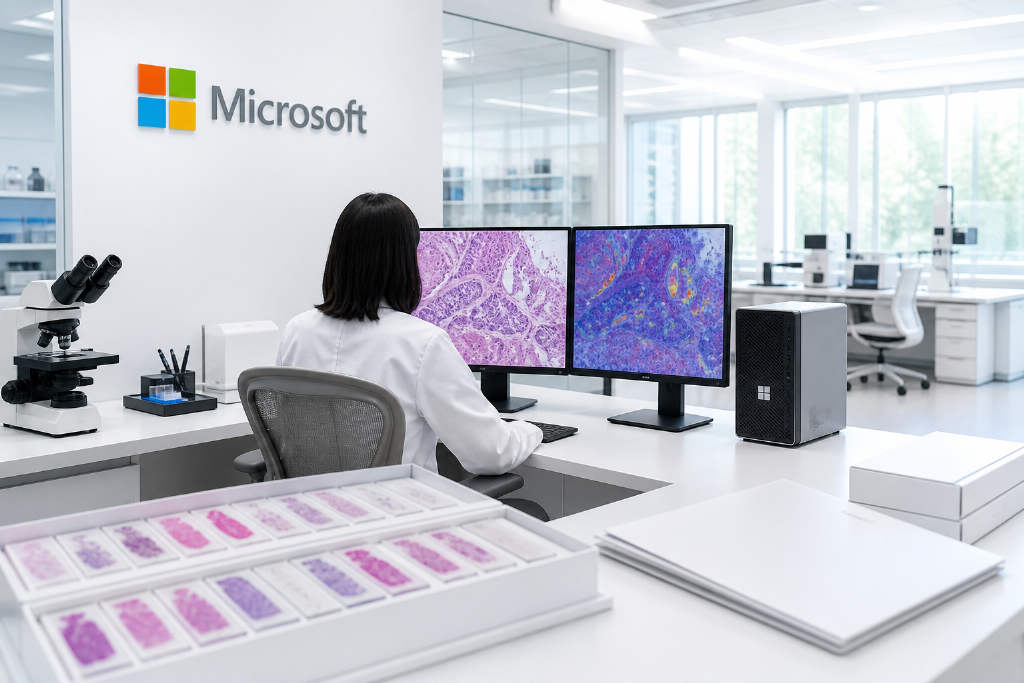
Microsoft Research has introduced two pathology foundation models, GigaPath-Flash and GigaTIME-Flash, with a focus on cutting compute costs for large-scale research workloads. According to the announcement cited by Techub News, the models use distilled backbone networks to reduce computational demand while maintaining performance. That design is intended to make repeated analysis across larger patient cohorts more practical.
Microsoft Research said the open-source models are built to help researchers work with diverse cancer datasets and study disease biology, biomarkers, and clinical outcomes. At the same time, the organization drew a clear boundary around their use: the models are not intended for clinical diagnosis or treatment decisions. The release centers on research efficiency and accessibility rather than clinical deployment.
Microsoft Research has released two pathology foundation models, GigaPath-Flash and GigaTIME-Flash, in a move aimed at making large-scale pathology research easier to run through higher computational efficiency.
According to the announcement cited by Techub News, the new models use distilled backbone networks to lower compute requirements while maintaining performance. Microsoft Research said that setup also supports repeated analysis across larger patient cohorts.
The open-source models are intended to help researchers use diverse cancer datasets to explore disease biology, biomarkers, and clinical outcomes. Microsoft Research also stated clearly that the models are not for clinical diagnosis or treatment decision-making.
This article was originally published by Bit.Fan. For more cryptocurrency news and market insights, visit www.bit.fan. Disclaimer:
The market information, project data, and third-party content displayed on this platform are for industry information sharing only and do not constitute any form of investment advice or return commitment.
Cryptocurrency trading carries high risks. Users should fully assess their risk tolerance and make independent decisions. All profits, losses, and legal responsibilities are borne by the users themselves.