

Microsoft, Shanghai Jiao Tong University and other institutions have open-sourced Argus, a general-purpose agent reasoning runtime built for long-duration research tasks, and released a technical report alongside it. The project targets a specific limitation in current agent systems: they can execute, but they still struggle to steer themselves through multi-day work when feedback is sparse.

The article says recent harness systems have already let large models interact with the real world by calling tools, editing code and running experiments. But once a task extends from tens of minutes to several days, a human often still has to remain at the screen and decide what the system should do next. In that framing, the bottleneck is not only model capability. Existing agents have largely automated execution, while the layer above execution — the part that keeps driving the project forward — still depends on people.
Argus is presented as an answer to that gap. Its design combines evidence-driven control, self-evolution, multi-agent collaboration and a separation between core runtime logic and domain-specific verticals, with the aim of letting agents continue research for days across multiple areas even without dense standard feedback.

The paper is titled Argus: Who Drives the Harness for Days? The team also published the paper, code, project homepage, an open repository for project outputs and a live page tied to its math problem-solving work.
- Paper: https://arxiv.org/abs/2608.05144
- Code: https://github.com/lbx154/Argus
- Project homepage: https://argusbot.cn/
- Open repository for project outputs: https://github.com/Argus-AiTeam
- Math-solving live page: https://open.argusbot.cn/#counterexample-live
From goal-driven systems to evidence-driven control
At the center of Argus is a shift from a goal-driven model to an evidence-driven one. The source uses a self-driving analogy: the model is the engine, the harness is the drivetrain, but the person sitting at the screen is still the one deciding where the vehicle goes. Short tasks can rely on clearer feedback. Research that runs for days usually cannot. Those problems often lack a stable reward signal, and the target may not even be clearly defined at the outset.
Argus names the previously unautomated layer above the harness the Driver. Its job is to keep steering when plans collide with reality, using evidence gathered during execution. The article argues that the initial goal written down at the start of a project is only a hypothesis formed when information is at its thinnest. If an agent remains locked onto that initial target, it can waste tokens chasing an outcome that is not actually achievable. In the evidence-driven setup, the next step is determined by what the system has already learned, not by the assumptions embedded in the original plan.
The report says the Driver repeatedly has to answer four questions:
- Has the work already been completed, and is the quality high enough?
- Given the current evidence, what is the most worthwhile next step?
- How should what was learned in this round change the system's behavior afterward?
- Do the remaining issues involve decisions that only a human can make?
A persistent runtime for long-horizon projects
Argus organizes long projects into persistent Campaigns, which are then broken into Missions with clear boundaries. Its basic loop is Manager → Planner → Engineer ⇄ Reviewer → Manager.
The article compares that design with OpenAI Codex's /goal mode. In the source's description, /goal extends a single agent loop into a persistent loop with a goal state. Argus instead structures a research project as a long-running runtime with multiple roles, multiple harnesses and reusable accumulated knowledge. One design asks how to keep an agent from stopping. The other asks how it can work effectively after it keeps going.

The report breaks the roles down this way:
- Manager handles phase transitions, process approval and global strategy.
- Planner maps out concrete tasks based on current evidence.
- Engineer works inside real codebases, experiments and execution environments.
- Reviewer independently checks artifacts, tests novelty and validity, then reports back to the Manager or sends work back to the Engineer.
The stated emphasis is not the mere existence of multiple roles. It is the separation of context. Each role keeps its own context while sharing the same workspace, avoiding a setup in which planning, execution and verification are all handed to one agent. The source says that improves token efficiency. It also allows one Argus task to use different harnesses at the same time, including Pi, Codex, Claude Code and DeepSeek Harness, which the team describes as highly customizable.
The system stores a complete set of artifacts. Only experience that passes an evidence threshold is added to Wiki and Skill for reuse under Project, Vertical or Global scope.

Argus also separates Core from Vertical. Core handles role permissions, evidence submission and the human boundary. Vertical is defined by domain experts and specifies what counts as valid evidence in areas such as mathematics, GPU work and materials, along with the human skills and knowledge tied to those areas. The article says this can improve delivery quality in research tasks while providing an interface for co-evolution between human experts and agents and for customized workflows.
27 Campaigns and 1,548 wall-clock hours
The technical report covers 27 Campaigns and 1,548 hours of wall-clock time. According to the figures cited in the article, the system proactively requested human intervention once every 40.7 hours on average, and its duty cycle ranged from 95.1% to 98.7%.
The source says Argus is not only presenting benchmark scores. It is also releasing what it calls a complete production-grade portfolio of outputs. The tasks listed by the team include AI4AI, GPU kernel work, model training, AI4Science, chip design, AI4Math and AI4System, which the authors use to argue for the system's generality and research-level capability.

Results disclosed within a month of the open-source release
The article says that less than one month after Argus was open-sourced, it had already contributed to infrastructure, materials, chips, mathematics and AI systems research. The team also says it is the first to publish a complete end-to-end log of mathematical conjecture-solving and filtering, with all runtime trajectory sessions opened up as well.
The source organizes those results as a staged progression. First, in AI4System and infrastructure work, Argus turned continuous operation into deliverables that could be accepted against clear engineering outcomes, which the article frames as a first step from automated execution toward autonomous research. Then the work expanded from AI infrastructure into AI4Science, AI4Hardware and AI4Math, and the evaluation standard moved from whether a predefined task was finished to whether the system could explore unresolved real-world research problems. On that basis, the project says Argus extended from isolated outputs to a full research process in AI4AI, with evidence continuing to push tasks forward without a human staying at the screen the whole time.
That path is described as a progression from real delivery to cross-domain exploration and then to end-to-end autonomous research.
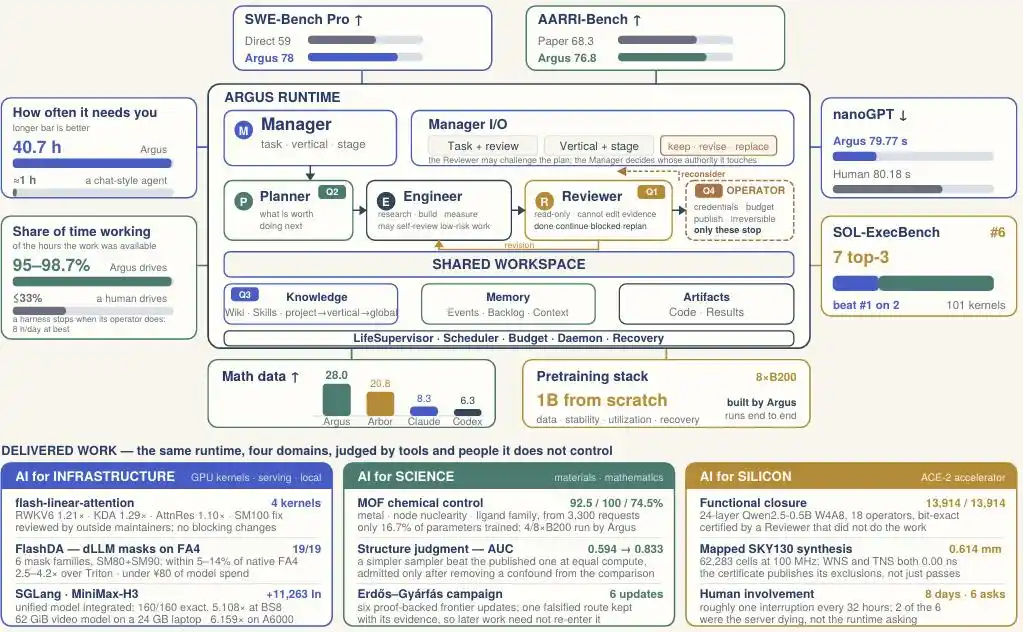
The article says all of those results were achieved within one month. Viewed together, the team argues, Argus expands the object of automation from a one-off execution to evidence-driven research advancement, which in turn speeds up research progress. In the source's framing, that is the most direct answer to the question in the paper's title: who drives the agent after the human steps away from the screen?
Project contributors and source attribution
The author introduction says Argus is led by researchers from Microsoft and Shanghai Jiao Tong University, with researchers from multiple universities participating. The article states that the piece originated from the WeChat public account "机器之心" and was republished by MarsBit.