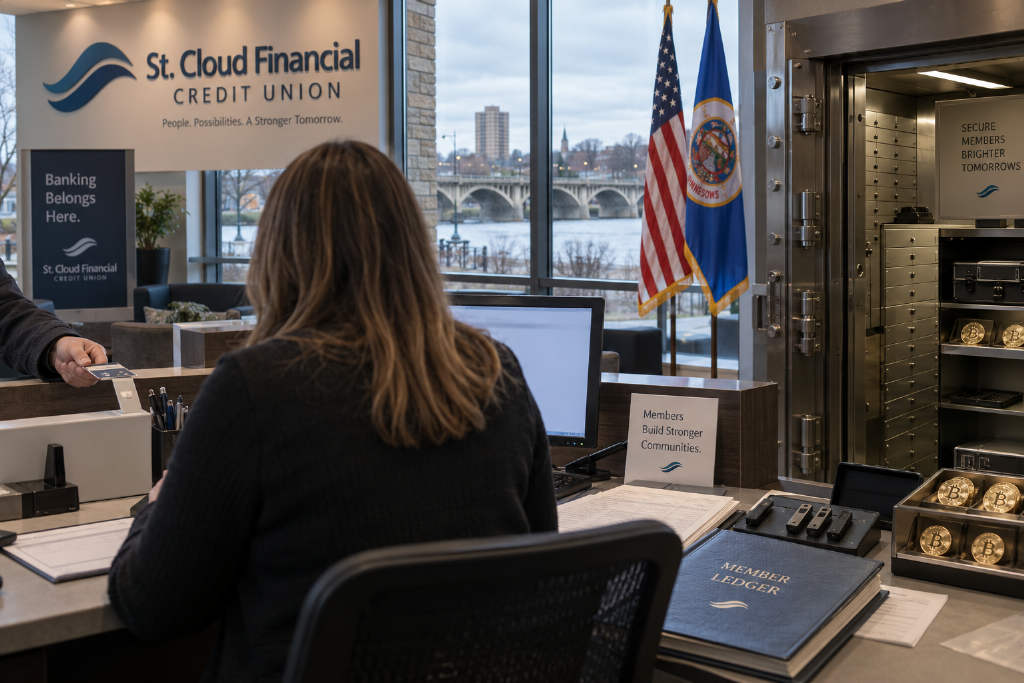
St. Cloud Financial Credit Union in Minnesota has become the first credit union to place Bitcoin on its core ledger, according to CEO Jed Meyer. The institution, founded in 1930 by postal workers, is now custodying real Bitcoin for its members through a patent-pending hybrid custody model. Meyer said each member holds separate Bitcoin ownership within a multisignature vault structure.
He added that the credit union is already holding more than 20 BTC for members even without deliberate promotion of the service. Members can buy and sell Bitcoin directly through the credit union, and the institution plans to integrate the Lightning Network. Meyer also discussed how stablecoins, the U.S. dollar and Bitcoin relate as emerging monetary networks, and drew a distinction between Bitcoin ETFs and custody offered by a credit union.
On regulation, Meyer referenced Minnesota custody law, review by the National Credit Union Administration, or NCUA, and the CLARITY Act. The credit union has also launched a stablecoin called Cloud Dollar and operates under a cooperative ownership model. Meyer said credit unions need to control their own payment rails and keep educating skeptics.
St. Cloud Financial Credit Union in Minnesota has become the first credit union to incorporate Bitcoin into its core ledger, according to CEO Jed Meyer.
The credit union, founded in 1930 by postal workers, is now custodying real Bitcoin for members. Meyer said it uses a patent-pending hybrid custody model that gives each member separate ownership of Bitcoin inside a multisignature vault.
Meyer said the institution is already holding more than 20 BTC for members even though it has not actively promoted the service. The offering lets members buy and sell Bitcoin directly through the credit union, with plans to add Lightning Network support.
He also discussed the relationship between stablecoins, the U.S. dollar and Bitcoin as new monetary networks, and outlined the difference between a Bitcoin ETF and custody provided by a credit union.
On the regulatory side, Meyer pointed to Minnesota custody law, review by the National Credit Union Administration (NCUA), and the CLARITY Act.
The credit union has also launched a stablecoin called Cloud Dollar and uses a cooperative ownership model. Meyer said credit unions need to control their own payment rails and continue educating people who remain skeptical.
This article was originally published by Bit.Fan. For more cryptocurrency news and market insights, visit www.bit.fan. Disclaimer:
The market information, project data, and third-party content displayed on this platform are for industry information sharing only and do not constitute any form of investment advice or return commitment.
Cryptocurrency trading carries high risks. Users should fully assess their risk tolerance and make independent decisions. All profits, losses, and legal responsibilities are borne by the users themselves.