
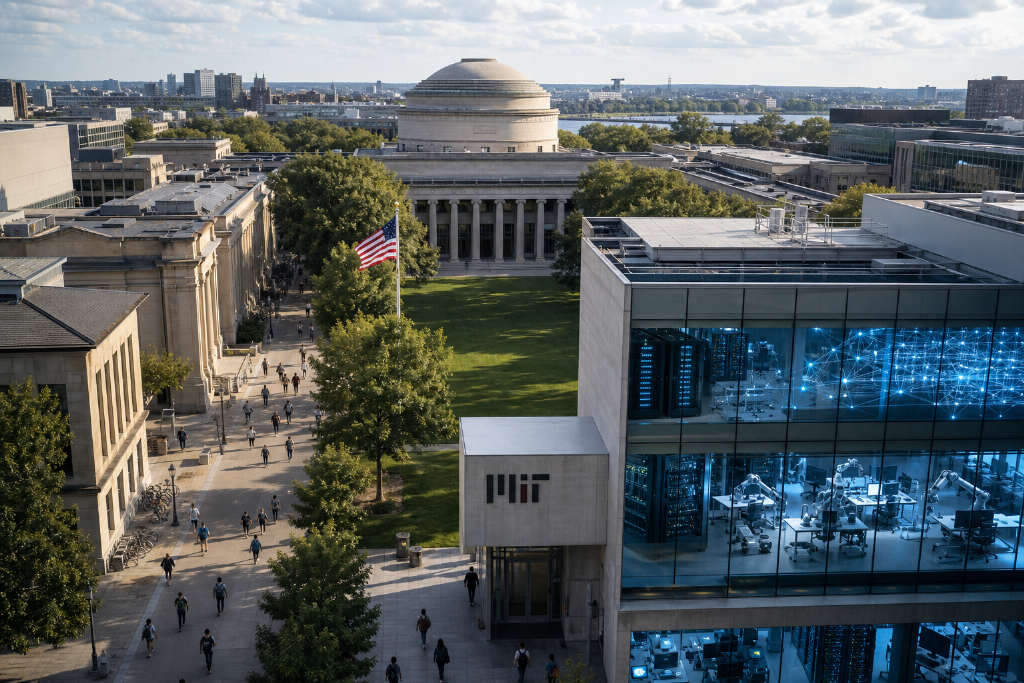
On Aug. 25, Massachusetts Institute of Technology President Sally Kornbluth sent an open letter to the campus community calling generative AI a "watershed moment" for higher education. MIT released a 40-page final report from a special committee the same day, and the document surfaced a sharper issue inside that shift: some faculty members have begun considering AI agents as research assistants in place of undergraduates in UROP positions.
In her letter, Kornbluth wrote that MIT would continue to define and protect the highest-quality residential education, describing it as education "of humans, by humans" and aimed at human flourishing. The article notes that language of that kind is usually reserved for moments seen as historically large, and Kornbluth explicitly placed generative AI in that category for MIT and for higher education more broadly.
A 40-page MIT report put faculty incentives in plain view
The committee report was produced by a group that included professors from five schools, undergraduate students, doctoral students, the library director, and the head of a teaching lab. According to the report, the committee learned during a faculty hearing that some instructors were weighing the use of AI agents as research assistants instead of hiring undergraduates through MIT’s Undergraduate Research Opportunities Program, or UROP.
For MIT students, UROP has long served as an entry point into real research. It places undergraduates in labs, lets them work directly with faculty, and gives them an early experience of problems that do not come with prewritten answers in a textbook. It also carries practical value through pay and credentials.
The committee did not dismiss the logic behind replacing students with software. The report said it could see why advisers might move in that direction on grounds of speed and efficient use of resources, especially at a time when research funding is tight. It then turned to a larger question: what is research at MIT supposed to do?
The answer in the report was direct. Research at MIT is not just an end in itself. On campus, it is also an apprenticeship model, a way to train the next generation of researchers and keep fields moving forward. Treating research as a place where learning happens through doing will inevitably create elements that look inefficient. The report argues that this is a feature, not a bug.
That distinction matters because the article frames AI’s role here in a specific way. AI has not replaced the professor. It is reaching first for the lowest rung on the ladder that leads to that professor’s position.
MIT undergraduates showed more anxiety about replaceability than empowerment
An appendix to the report includes numbers from MIT’s spring 2026 quality-of-life survey, which drew about 8,200 responses. One question asked whether AI made respondents feel more capable or more replaceable.
Across the full sample, 40% said AI made them feel more capable, while 27% said it made them feel more replaceable. Look only at undergraduates, though, and the result turns more negative: 40% of undergraduate students said AI made them feel more replaceable, while 34% said it made them feel more capable.
The article says faculty members and graduate students showed the opposite pattern. It attributes the gap to where each group sits in the production of knowledge. Professors are paid to ask questions that have not yet been asked. Undergraduate students, by contrast, spend much of their training solving problems that already have known answers and learning the process behind them. Repeating answerable tasks happens to align with what AI systems do well.
The report says AI is shaking core parts of the MIT learning experience
Another section of the report describes AI as destabilizing the foundations of the MIT educational experience. The article says the report tracks those effects across problem sets, take-home exams, UROP, office hours, and study groups.
It argues that AI is making students more isolated, weakening their sense of mastery and confidence, and eroding trust between students and faculty because very few students now learn without using AI in some form. That in turn makes it harder to evaluate whether a student has actually learned the material.
The article gives a concrete example of what "more isolated" means in practice. When MIT students get stuck at 3 a.m., the first instinct is increasingly to ask an AI system rather than message a classmate. Study groups then become less common, because AI can be faster, even if the tradeoff is more solitude.
Access to knowledge and access to tools are not the same thing
The piece places MIT’s debate in a longer historical arc. In the 20th century, advanced economies expanded higher education through compulsory schooling, public universities, libraries, scholarships, and student loans. The shared aim was to move knowledge into more people’s heads. Compulsory education was tied to productivity, and higher education was meant to expand it much more.
In the 21st century, the article says governments have started making a different promise: broad access to AI tools. It points to South Korea’s announcement this year that it would spend 10 trillion won to give the public free access to AI with unlimited token use.
The article argues that the two ideas sound equally democratic but are not the same. Broad access to knowledge puts something inside the mind. Broad access to tools keeps that capability outside the mind. What is internalized becomes yours. What stays external is effectively rented. The article compresses that idea into a line modeled on a familiar Bitcoin phrase: "Not your brain, not your knowledge."
MIT Media Lab research found the weakest brain connectivity in the LLM group
To support that argument, the article cites a study from MIT Media Lab published last year titled Your Brain on ChatGPT, with the subtitle on cognitive debt in writing with AI assistance.
The study recruited 54 students from five universities in the Boston area and split them into three groups for SAT-style essay tasks. One group used GPT-4o, one was limited to traditional search engines, and one used no tools at all. The experiment ran for four months across three rounds, with each round lasting 20 minutes, and participants wore EEG devices throughout.
According to the article, the brain-only group showed the strongest and most broadly distributed neural connectivity. The search-engine group sat in the middle. The LLM group was the weakest. Researchers used the term "cognitive debt" to describe the pattern, meaning that early reliance on AI can produce shallow encoding, with knowledge failing to settle deeply into the brain.
The article adds that when the original LLM group was told in a fourth round to switch back to brain-only writing, its neural connectivity still remained weaker. A second detail stood out in interviews: when students were asked whether the essay felt like it belonged to them, the LLM group reported the lowest sense of ownership.
Gallup data points to a reassessment of degree value
The article also cites Gallup data from this year. The share of Americans expressing high confidence in higher education fell to 38%, down 19 percentage points from 11 years earlier. Another finding was even more direct: 46% of Americans said advances in AI would make college degrees less important over the next five years.
In the article’s framing, that matters because the signaling value of a degree is under pressure when access to knowledge becomes immediate and cheap.
Taiwan’s question is shifting from who can attend to who still wants to
The piece then turns to Taiwan’s higher-education system. After education reforms in 1994, the number of universities in Taiwan rose from 58 to 148 over 20 years, and the college entrance rate once exceeded 70%. Higher education expansion became a social commitment.
By academic year 114, the total number of college and university students in Taiwan had fallen to 1.057 million. Over the previous five years, 13 universities either closed or merged, and six schools posted freshman enrollment rates below 60%.
The article says a falling birthrate is clearly the main reason for the contraction, but it separates one question from another. Demographics determine how many people can attend. They do not determine how many still want to. If an 18-year-old can pay less than NT$1,000 a month for a tool that is more patient than most teaching assistants, more immediate, and broader in knowledge, then the return on four years of tuition and four years of time becomes harder to defend.
MIT’s language for learning under pressure: productive struggle and creative friction
The article states clearly that its projection about the future split of universities is the author’s own view, not MIT’s conclusion. That view is that higher education may slowly divide into two forms serving two different groups.
One path would serve most people, for whom college becomes a less economical choice. The point, as the article puts it, is not that these students are less capable, but that they may become more calculating about cost and return.
The other path would serve people willing and able to pay more for the most traditional and least efficient forms of intellectual training. The article argues that this type of education may become more scarce, not less valuable, because what becomes rare in a world of outsourced reasoning is the ability to judge whether reasoning is sound and to ask a question no one has asked before.
It says the way those abilities are built has not changed in a century. People have to get problems wrong many times themselves. They have to argue with others in the same room over something difficult. They have to tolerate an inefficient process for the brain to form deep marks.
The MIT report uses two terms for that process: "productive struggle" and "creative friction."
AI versions of professors may be cheaper, but professors are not
The article gives one example from Harvard Business School. It says the school turned seven professors into AI versions this year, and for $699 buyers can get a set of startup coaches that never tire. At the same time, the time of those seven professors themselves has not become cheaper. If anything, becoming their actual student may grow more expensive.
From there, the article sketches a possible outcome. If an organization needs fewer positions that require human judgment, and those positions demand more expensive and longer training, the result could be fewer people managing more people. Not because they are inherently smarter, but because the path upward has been dismantled.
The MIT report’s three directions for response
In a closing FAQ section, the article summarizes the committee’s recommendations in three parts:
- reshape teaching and assessment to be AI-aware;
- put people and the residential community experience back at the center;
- build mechanisms for sustained reflection and iteration.
The report’s core line, as presented in the article, is that learning requires productive struggle. What looks inefficient is not necessarily educational failure. In this argument, it may be part of the point.
The article does not end with a categorical prediction. Its final judgment is narrower: if the shift happens, it probably will not arrive as a dramatic day when universities suddenly shut down. It will show up more quietly, through a steady decline in the number of ordinary people willing to attend college.