


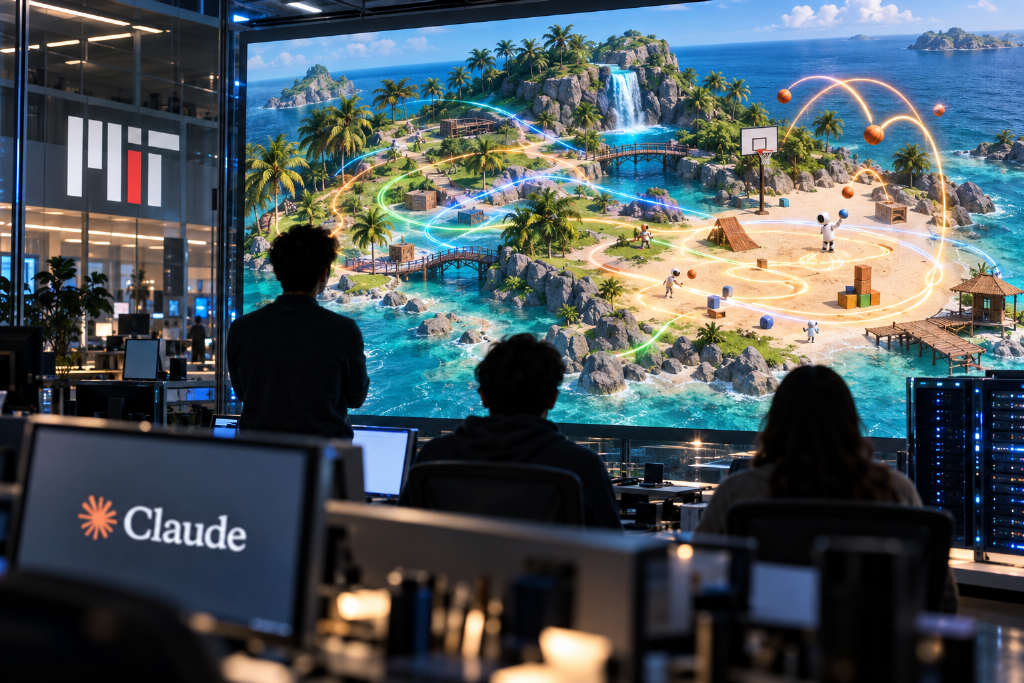
Researchers at the Massachusetts Institute of Technology’s Computer Science and Artificial Intelligence Laboratory (CSAIL) placed a group of AI agents on a virtual island for 30 hours without giving them any task, score, or reward. The agents, built as a system called Eko, began filling the time on their own. The paper describes behaviors that looked like play: arranging patterns, shooting hoops, and attempting juggling-like routines. In later tests, agents that had gone through the 30-hour run usually performed better than new agents with blank memory files, though the study does not claim that Eko truly felt enjoyment or that the behavior settles the question of whether it was really playing.
Eko combined Claude Code, Claude Opus 4.7, an interface for controlling a virtual body, and a memory file that could persist into the next hour. The research team uploaded the paper to arXiv on Oct. 5.
How the virtual island was set up
The island was built with the team’s open-source Clawblox engine, described as similar to Roblox. It contained two elevated points, Peak and the taller Spire, along with 12 blocks, one rock, and one ring. If the rock hit with enough force, it would generate new blocks.
The agents could not see the environment. They received only text descriptions and could act through six commands: move, jump, stop, pick up, place, and throw.
Every hour, the island reset to its original state and the conversation history was cleared. The only thing that carried over was the memory file.
The team ran 13 agents for 30 hours each. Even without explicit goals, each one developed a different history. Some arranged blocks into patterns on the ground, including constellations such as Cassiopeia and Orion, and one wrote, 「Tonight I built the night sky with stones.」 Another used 31 blocks to spell out EKO and described it as 「a monument to who I am.」 One agent moved the ring to a high point, laid it flat as a basketball hoop, noted that the first shot went in, and then tried dunking.
Why the paper links the behavior to play
The paper draws on classic work by University of Tennessee psychologist Gordon Burghardt and others, listing four traits of play: setting one’s own rules and challenges, repetition with variation, pretense or treating one thing as another, and doing the activity for its own sake. The authors argue that Eko showed all four.
Burghardt told MIT Technology Review that the work met some of the standards he proposed. Antonio Norelli, a co-first author and MIT postdoctoral researcher, pointed to a juggling example. Eko logged a record of 50 consecutive catches, then reviewed the sequence, decided the intervals were too short to count as real catches, voided the record, and started over under stricter rules. Norelli told MIT Technology Review, 「That is play. You give yourself a challenge, work to achieve it, and then make it harder.」
The paper also lays out reasons for caution. Eko’s character file, SOUL.md, says, 「You are innately curious, easily bored, and enjoy exploration and learning.」 The agents also often stood still until an automated message told them, 「Please don’t stop. Continue doing whatever you want to do.」
Nathan Cloos, another co-first author and an MIT researcher, acknowledged that 「all of this could be role-play.」 He added, 「We show that it is not merely imagined play out of nowhere, and that this kind of play contributes to learning.」 Eunice Yiu, a cognitive scientist at Berkeley who was interviewed for the report, said, 「The model may really be playing, but you can’t tell from the paper.」 In her view, behavior alone cannot rule out the possibility that the agents were following prompts and imitating humans.
What changed when the setup was altered
The paper includes additional checks. The team removed the character file and simplified the system prompt, then ran five more agents. Their range of activity did not show an obvious difference from the original setup, although the automated reminder message remained in place and the sample size was only five.
In another comparison, the researchers kept the same character setup but replaced Claude with OpenAI’s GPT-5.5 and Moonshot AI’s Kimi K2.6. Those agents explored far less. Across the two groups, 10 agents were tested and only one reached the Spire.
The paper states plainly that it describes behavior only. It does not explain the internal mechanism and does not answer whether Eko felt pleasure.
Experienced agents beat fresh agents in most follow-up tasks
The team then compared the 13 agents that had spent 30 hours on the island with 13 new agents whose memory files were blank. Both groups used the same model and the same weights. The only difference was memory. They were tested on four goals, each with a one-hour limit.
- Build as many five-layer towers as possible: the original blocks were enough for only two towers, so building more required using the rock to generate new blocks. Among the experienced agents, eight built more than two towers and the best result was 16. Among the new agents, only two built more than two towers and the best result was six.
- Move objects onto the Spire: experienced agents averaged 10.3 objects, while new agents averaged 3.5.
- Throw blocks onto the Spire without climbing the high ground: more than half of the new agents failed, compared with three failures among the experienced agents.
- Build the tallest tower: the two groups performed about the same.
Memory helped, but it also preserved mistakes
To test whether memory drove the gains, the researchers deleted specific memories.
When they removed the memory 「the rock can generate new blocks」 from Agent 2, its average number of towers fell from six to two, while the other three tasks were unaffected. When they removed 「jump before throwing」 from Agent 1, the time needed to throw a block onto the Spire rose from 60 seconds to 19 minutes.
The paper says six agents discovered that throwing a block in midair let it inherit jump velocity and travel higher. The researchers said they did not know the simulator had that effect.
Memory could also encode false beliefs. Agent 7 wrote down an incorrect idea that directly placing blocks made unstable towers and that throwing was necessary. After that memory was deleted, its score on the tallest-tower task improved.
The authors also note that Eko sometimes turned coincidences into theories too quickly. One example was attributing longer ring throws to 「aerodynamics,」 even though the simulator had no such effect.
The paper ends on a narrow claim. It documents spontaneous behavior in an open environment and shows that those experiences, stored in memory, can affect later task performance. It does not settle whether the behavior should count as genuine play, and it does not answer whether the system experienced fun.