
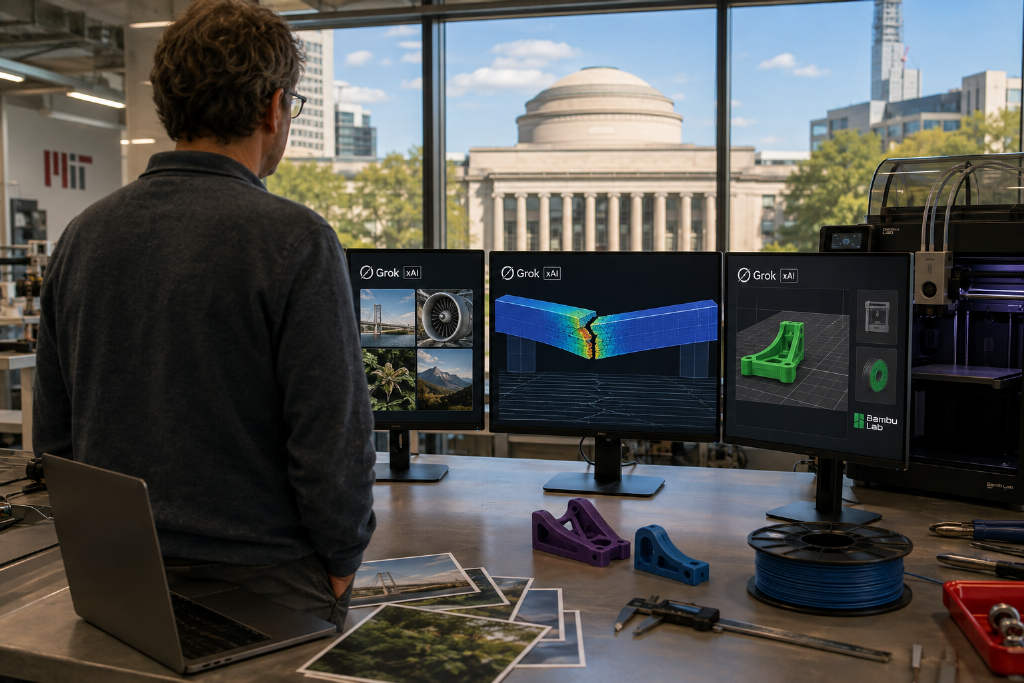
MIT engineering professor Markus Buehler said he gave three Grok bots four unrelated photos and a hard mechanics question. A little more than an hour later, the 3D printer on his desk produced two plastic parts with a combined weight of 19.48 grams.
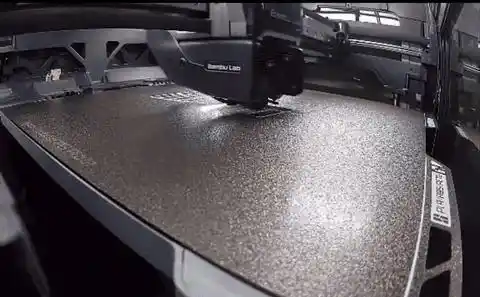
The chain from image to object was handled by the three bots in sequence: interpreting the pictures, extracting structural patterns, writing a working physics simulator from scratch, running 47 experiments, exporting model files, slicing them, and sending the print job to the machine.
Buehler wrote in his post that the demo raised a blunt question: are we already living in the future?
xAI’s Grok bot setup was used as a real project team
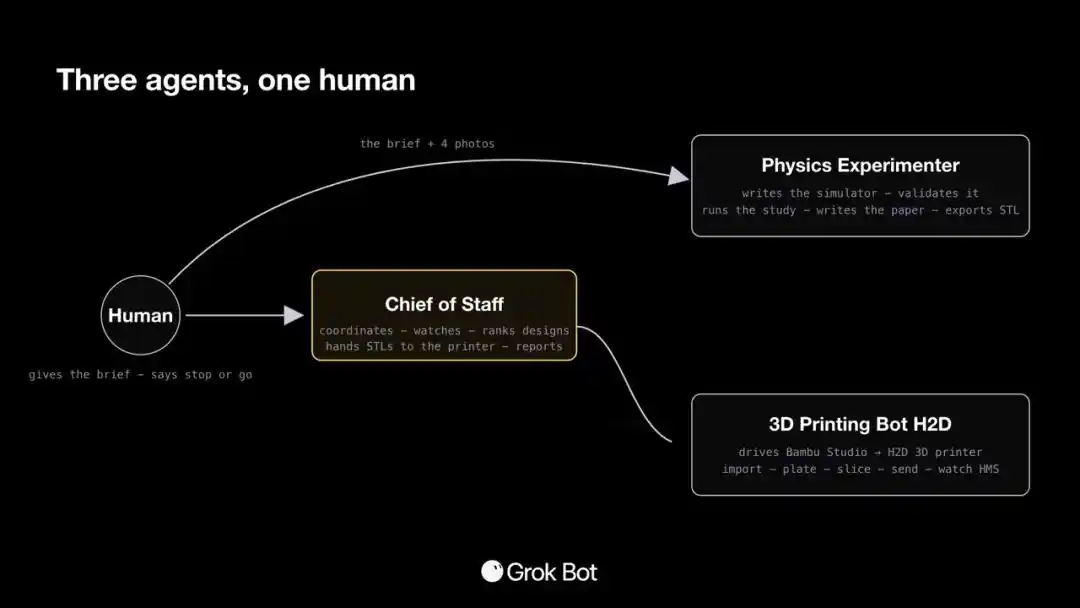
The work was split across three Grok bots.
- Chief of Staff: the coordinator. This role did not directly generate research output. It tracked what the other two bots were doing, pulled results back into the main conversation, moved files between them, and kept the workflow going.
- Physics Experimenter: the scientist and coder. It read the images, wrote the simulator, ran the experiments, analyzed the results, and produced a research report in LaTeX format.
- 3D Printing Bot: the manufacturing operator. It handled materials preparation, slicing, manufacturing code generation, task dispatch, and printer monitoring.
The structure was not improvised by Buehler. On Aug. 11, xAI released an early test version of Grok Bot. Each bot was described as having its own cloud computer and being able to log in, open websites, and work through interfaces the way a person would. Multiple bots can run in parallel, usually under a Chief of Staff role.
xAI said it already uses this model internally. In the company’s example, an engineering bot can reproduce a bug inside a product interface, file a ticket, and then pass the fix to a debugging bot. The company also argued that the gap between finishing 90% of a task and finishing 100% is massive. Most AI systems can get users close, but not all the way. Grok Bot, in xAI’s framing, is meant to cover that last stretch.
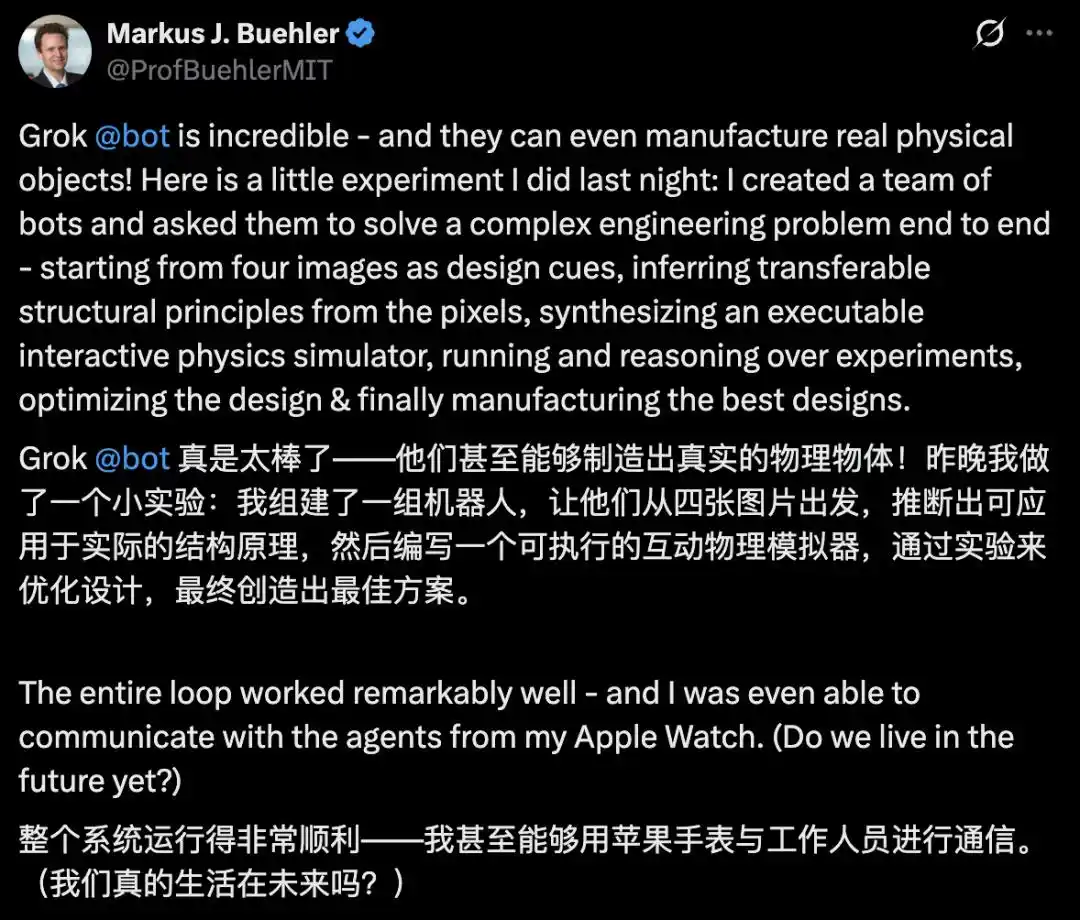
A working fracture lab was assembled in about 20 minutes
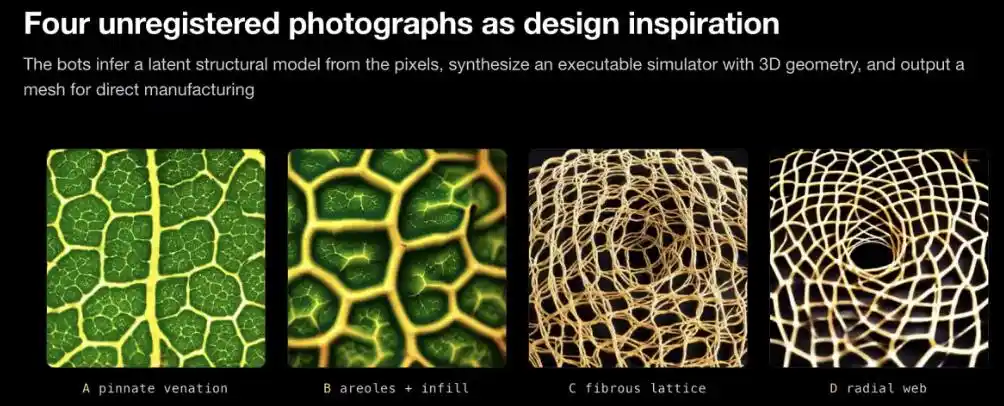
Buehler provided only two things: four reference photos and a research question.
The images showed four very different structures: a feather-like leaf vein pattern, a mesh resembling a Voronoi diagram, a randomly arranged fibrous lattice, and a spider web with radial and circumferential organization. They were drawn from different scales and different objects, were not aligned with one another, and were not ready-made engineering drawings.
He then asked how hierarchical depth, redundancy, disorder, and interlayer strength would change stiffness, peak load, energy absorption, and the transition from brittle fracture to progressive failure when total material use is held constant.
In plain terms, the problem asked why natural structures such as leaf veins, spider webs, and bone can be both light and strong, and at what point hierarchical organization actually starts helping.
Buehler did not tell the bots how to model the problem and did not specify which software to use. He set one requirement: infer transferable design principles from the four images and use them to build an experimental platform for fracture research.
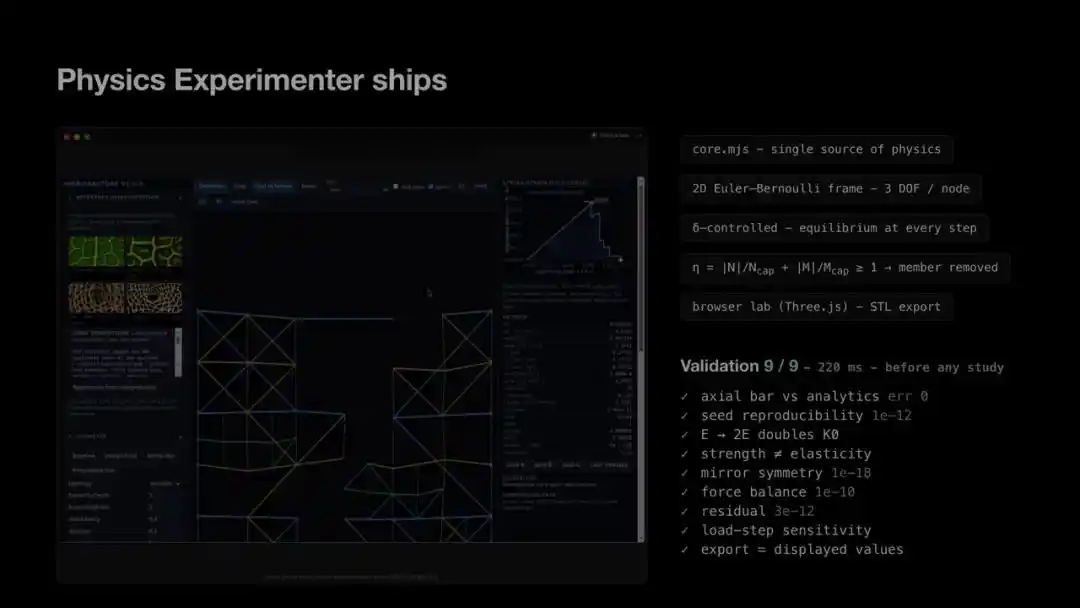
About 20 minutes later, an interactive two-dimensional hierarchical Euler-Bernoulli beam-network lab was up and running. Rather than calling an existing mechanics package, the system wrote its own simulator and named it HIER-FRACTURE v1.0.0.
Before doing any research, the simulator ran nine self-checks. The process took 220 milliseconds and all nine passed. Only then did the system proceed. The resulting lab connected simulation on one side and 3D printing on the other, allowing printable model files to be generated directly after the experiments.
After 47 simulations, the system rejected its own hypothesis
The bots then ran 47 simulations, with six reserved as holdout tests. Those six cases were kept out of parameter tuning and used only at the end to check whether the conclusion still held.
The result was not what one might expect. With total material fixed, stiffness across the tested structures stayed in roughly the same range, with differences of no more than 20%. Impact resistance and energy absorption were a different story. The best and worst designs were separated by multiples.
The explanation in the report came down to material allocation. As more fine-scale structure is added, the main beams get thinner. Networks with deeper hierarchy often ended up less impact-tolerant than a simpler single-layer lattice.
At the same time, weaker connection points behaved like fuses. They failed first, spread the shock, and shifted the structure away from sudden collapse toward progressive damage.
The most notable step came at the end. Before the experiments began, the system had set a target for itself, Hypothesis H2: the harmful effect of added hierarchy mainly came from weak connections between layers.
After all 47 runs were complete, it discarded that hypothesis. The actual reason, it concluded, was not simply weak interlayer connections. It was the fixed material budget: if another layer is added, material has to be taken away from somewhere else.
In the original account, that moment mattered because the AI did not just execute a workflow. It overturned a built-in explanation and stated why.
The 3D-printing bot used a normal GUI to manufacture the parts
Once the preferred designs were handed to the 3D Printing Bot, the process moved into fabrication.
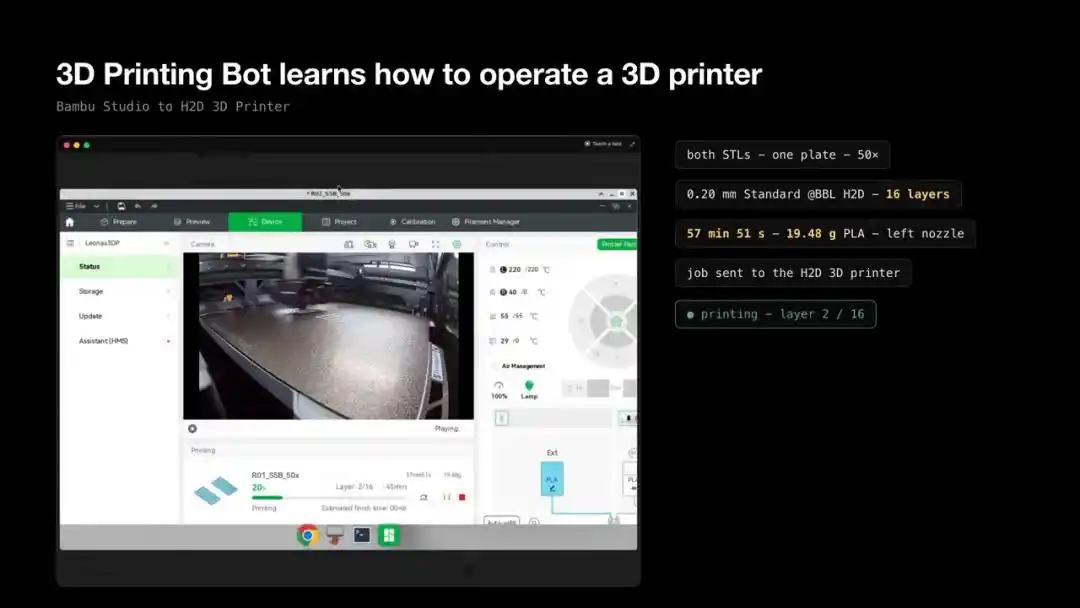
The Chief of Staff ranked the 47 runs by fracture work, selected two designs, exported the model files, and scaled both by 50x. The 3D Printing Bot then opened Bambu Studio, connected to a printer called Leonas3DP, placed both models on the same build plate, set the slicing parameters, sent the job, and watched the printer’s live camera feed as the nozzle laid down the plastic layer by layer.
In less than an hour, the two parts were finished.
The point here is that Grok Bot did not drive the printer motor directly and did not depend on a special-purpose hardware interface. It operated the software interface the same way a human would, by clicking through the GUI.
The original report treated that as the most important piece of the story. The standard assumption has been that if an AI system is going to act in the physical world, it needs robotic arms, embodied hardware, or a new control stack. This demo used another route: manufacturing has already moved much of its workflow into software, and the graphical interface is already there as an entry point.
Its shorthand version was simple: if the system can click, it has a hand.
The report argued that one of the hardest problems in automation science over the past decade has been device control. Every instrument has its own interface. To let AI operate them, teams often have to retrofit equipment or deploy robotic arms. It cited the University of Liverpool’s robot chemist, which reportedly ran about 700 experiments in eight days through the robotic-arm route, at the cost of an automated laboratory starting in the million-dollar range.
Grok Bot took what the article called a third path: no instrument modification, no robotic arm, just direct use of software that people already operate every day. If a device has a graphical interface, the article argued, it already has an interface AI can use. CNC systems, oscilloscopes, and microscope consoles were listed as examples that would theoretically fit this model.
That shifts the cost picture. On one side sits a million-dollar automated lab. On the other is a desktop printer priced at $1,749 and available through an e-commerce order page.
Humans remained inside the loop
The task came from Buehler. He selected the four images and defined the scientific question. xAI also said the bots would return to a person whenever approval was needed.
So the human was not removed from the process.
Buehler is the Jerry McAfee Professor of Engineering at MIT and holds appointments in mechanical engineering and civil and environmental engineering. The article said his work spans AI, fracture mechanics, hierarchical materials, and additive manufacturing. It also described him as the author of more than 800 papers, a member of the U.S. National Academy of Engineering, and the recipient of the 2025 Washington Award.
That matters because this was not framed as a casual consumer demo. It was presented as a stress test carried out by a researcher working squarely inside his own field.
Buehler has done related work before. In 2024, he published MechAgents, a study that used multiple agents to divide mechanics tasks and check one another’s work. That paper also recorded a failure case: one of the agents selected the wrong stress component and corrected it only after human prompting.
That history cuts both ways. Multi-agent systems can solve division-of-labor problems, but they are not automatically reliable.

From reports and code to physical output
As the original article framed it, the real change here was not only about intelligence. It was about pushing output beyond reports, code, charts, and simulations into manufactured objects by using software pathways that already exist.
For the past few years, many “AI scientist” demonstrations have stopped at digital artifacts. They could produce analyses, reports, code, and plots, but not the finished object.
Modern manufacturing, however, already runs on software: CAD programs, slicers, and machine control consoles all expose graphical interfaces built for human hands.
What Buehler demonstrated with three Grok bots was a full chain from image-inspired design principles to structural modeling, simulation, ranked selection, slicing, and printed output.
The cited reference was Buehler’s post on X at https://x.com/ProfBuehlerMIT/status/2091108225806454802. The original article also said the piece came from the WeChat public account New Intelligence, edited by Yuanyu.