
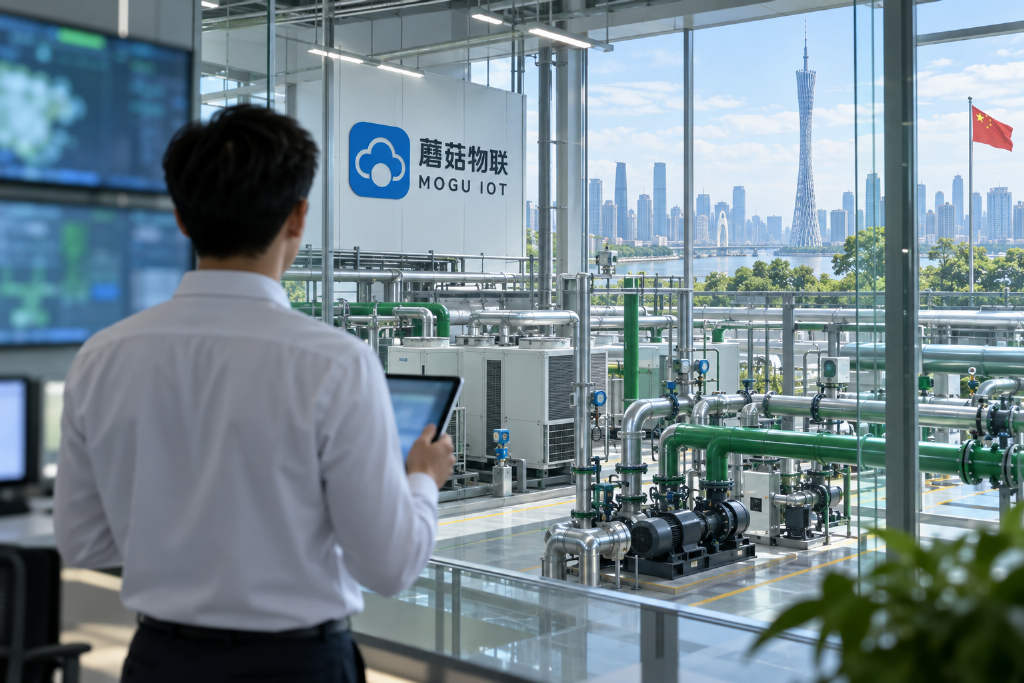
Mogu IoT, a Guangzhou-based Physical AI company, has wrapped up the C1 and C2 parts of its Series C financing, bringing in nearly RMB 200 million altogether. Existing backers, including Yunhui Capital, kept buying in.

Lots of AI companies are still trying to show they can actually make money. So this financing says something. Mogu IoT frames it as confidence in its closed-loop business model for Physical AI. The company said its systems now manage more than 260,000 energy devices in utility stations, serve over 6,000 enterprises, have saved more than 3.6 billion kWh of electricity, and can unlock nearly 20% additional energy-saving potential.
Old investors doubled down after a decade of staged development
Founder Shen Guohui was born in 1982. He studied mathematics, then entered a graduate program in management science and engineering, where his research focused on operations optimization in water conservancy and power engineering. After receiving his master’s degree in 2006, he joined a large factory, became vice general manager of a refrigerator and washing machine division within three years, and later took part in smart home rollout at the group level.
Shen said ten years in manufacturing led him to one plain conclusion: if home appliances selling for several hundred or several thousand yuan could be digitized and made intelligent, then doing the same for industrial equipment priced at hundreds of thousands or even millions of yuan per unit would create far more value. In 2016, he founded Mogu IoT.
The company spent its first three years on the unflashy stuff, as Shen put it: device connectivity. That meant IoT gateways, communication protocols for energy equipment, and data applications. He compared that stage to digging a well: “The logic of digging a well is to pick one direction and keep digging downward. Once you hit the underground river, everything opens up.”
Looking back, Shen splits Mogu IoT’s first decade into three phases. The first three years were about device connectivity. The next three years went into building industrial SaaS around the equipment supply chain. Then came the third phase, after the 2022 ChatGPT wave, when the team decided large models would become “knowledge workers” and began developing Lingzhi AI, a multi-source domain model.
Li Xing, partner at Yunhui Capital, said Mogu IoT’s management team saw the development logic of the industrial internet several years ago, picked a bottom-up route, focused on public utility energy as a general scenario, and used an FSU strategy aimed at three customer ends at once. In Li’s view, that move set the company up well for the AI era, letting it use its public utility energy data edge to quickly build industrial vertical models and agents, form business barriers, and expand in both domestic and overseas markets.
Li said: “Choosing the right strategic direction shows the wisdom of Mogu IoT’s management team, and its rapid grasp of the opportunities in the large-model era proves the management’s alertness, flexibility, and decisiveness. A team and company like this deserve continued long-term investment.”
Why the company chose energy-efficiency AI
Shen breaks energy users into two simple sides: the energy side, which supplies power, and the production side, which uses it. His point is straightforward. The production side is deeply tied to specific products and processes. The energy side is much more uniform. Compressors, chillers, pumps, and fans all run on common core indicators and can be rolled out across factories, data centers, commercial complexes, and schools.
As he put it, “It is naturally much easier to become the best in one field than to master all trades.”
Mogu IoT said integrated energy systems usually make up 30% to 60% of a company’s total electricity use. That makes them one of the most standardized and repeatable entry points for Physical AI. By its rough calculation, the annual value of the energy-saving opportunity here reaches RMB 240 billion.
Shen also argued that every energy revolution, from the coal era to the new energy era, came with a control revolution. In his telling, the control revolution happening now is Physical AI.
For Mogu IoT, the defining feature of Physical AI is not whether a system has limbs or can move around. That is not the point. The real question is whether it can complete a physical loop of perception, decision, and execution. Shen offered two practical tests. First, is there an AI visualization interface where data maps directly to execution? Second, has the vertical model completed filing with the Cyberspace Administration of China? He said: “It must stand up to verification by a national-level review authority. That is the most basic and mandatory requirement for doing Physical AI.”
He added that plenty of AI systems can make presentations. Very few are trusted to directly control energy equipment. In that world, the contest is not just about model performance. It also comes down to high-quality domain data, generalization ability, safety control, and an “experience feedback” loop where each real-world result sharpens the next round of model performance through agents.
“Dark data” and safety controls form the core moat
Mogu IoT says the rarest asset in the Physical AI era is not the model itself but “dark data” — real operating data moving between devices and sensors that has never been collected at internet scale. The company argues this kind of data can be vectorized and compressed into latent space, turning into hidden variables that help models make sense of the physical world.
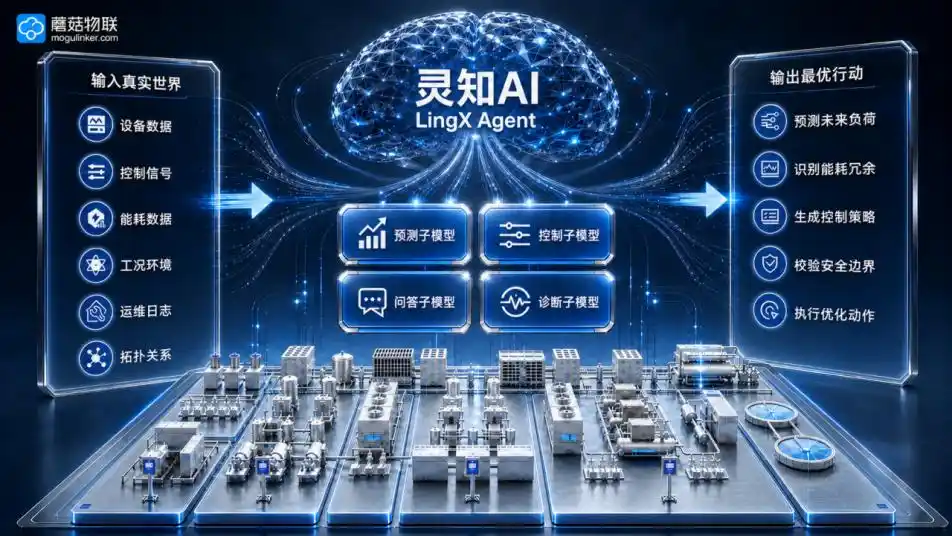
That is why Lingzhi AI is positioned as a multi-source vertical model. It is trained on three kinds of data: text, time series, and graphics. Behind it is an energy-sector multimodal database covering more than 30 classes of equipment, eight types of data dimensions, and 260,000 cloud-connected energy devices running online in real time.
Shen said the company started digging this well ten years ago. During its early industrial SaaS period, Mogu IoT insisted on public cloud deployment, while some rivals picked private deployment to chase near-term revenue. His take was blunt: “And what happened? Their data ended up scattered across individual customers, and now they cannot buy it back even if they are willing to pay.”
Beyond data, the company treats safety, compliance, and controllable risk as hard requirements. No wiggle room. Lingzhi AI uses a three-layer fusion architecture: an expression fusion layer, a prediction fusion layer, and a decision-execution fusion layer. The third layer is where the action is. According to the company, an independent safety constraint mechanism runs rule checks and boundary validation before any control command is sent to equipment.
Built on top of Lingzhi AI, Mogu IoT’s in-house LingX agent adds two industrial control modules. One is a safety and reliability gate, including rule checking, simulation trial runs, equipment interlock protection, and boundary validation. The other is a data support framework covering standardized access for heterogeneous data, time-series databases, data lakes, and semantic indexing.
Shen said: “Others are teaching AI to talk. We are teaching AI to work. But if AI is going to work, it must be 100% safe, verifiable, and traceable.”
Commercial traction: 6,000 enterprises and 3.6 billion kWh saved
For AI companies, commercialization is still the real test. Shen pointed to a common industry path described by one expert: Project, then Product, then Platform. In his view, many AI companies are still stuck in the Project stage and run into the old problem of revenue going up without any real increase in profit.
He said energy-control AI faces two levels of standardization difficulty: product standardization and delivery standardization. Delivery is where the gap really shows. A lot of companies can make standardized products, but commissioning and deployment still rely on veteran engineers, and results differ depending on who handles the implementation.
Mogu IoT’s answer is an integrated cloud-edge-device stack. On the cloud side sit the data layer, Lingzhi AI and LingX, and the application layer. On the edge side, intelligent edge servers handle low-latency real-time control. On the device side, IoT gateways and inspection robots take care of perception and execution.
The company now uses two pricing models. One is a productized model centered on an initial installation fee plus annual maintenance fees. The other is a service model based either on a share of the energy savings achieved or on AI-managed operations.
Mogu IoT said this standardized cloud-edge-device setup has already created a commercial loop: more than 6,000 enterprise customers served, more than 3.6 billion kWh saved, and nearly 20% additional savings potential compared with non-AI energy-saving methods. It also says the long-term value of energy-control AI is not just about cutting power use. It reaches into unattended operations too.
Zhu Bin, partner at Yuanhe Origin, said Mogu IoT represents Physical AI in the energy-control field and has built an industrial closed loop of perception, decision, and execution. He said the company benefits from massive real-time physical data gathered during the IoT era from air-compression stations and refrigeration stations, while the broad client-side use of Lingzhi’s vertical model has made Physical AI unusually concrete as a productivity tool that can generate measurable value for customers.
From a China Resources Sanjiu case to future API billing
Shen recalled one specific deployment scene at 3 a.m. in a China Resources Sanjiu pharmaceutical factory. Back then, equipment sterilization work required two employees to remain on overnight duty. After Mogu IoT finished an unattended-operation upgrade, AI took over inside the utility room during those overnight hours.
According to Shen, the project started with a pilot at an air-compression station at the Shenzhen Guanlan base. After two rounds of validation and energy-saving rates above 15% at a refrigeration station, China Resources Sanjiu decided to buy a group-level energy AI management platform and roll it out to bases across the country, including Zaozhuang and Chenzhou. The case was later included in China Resources Sanjiu’s ESG report and in a collection of state-owned enterprise reform cases by the State-owned Assets Supervision and Administration Commission.
The company said it also plans to test an API billing model in the future, similar to token-based charging. Shen said acceptance should improve as customers place more value on unattended operations.
Why RYODEN chose a Chinese AI company
On overseas expansion, Shen’s view is pretty direct. He said domestic customers are generally less willing to pay, while companies in Japan, Europe, and the United States are more open to paying a premium for AI. He also argued that serving Southeast Asia does not really count as true overseas expansion and is, in essence, similar to serving the domestic market.
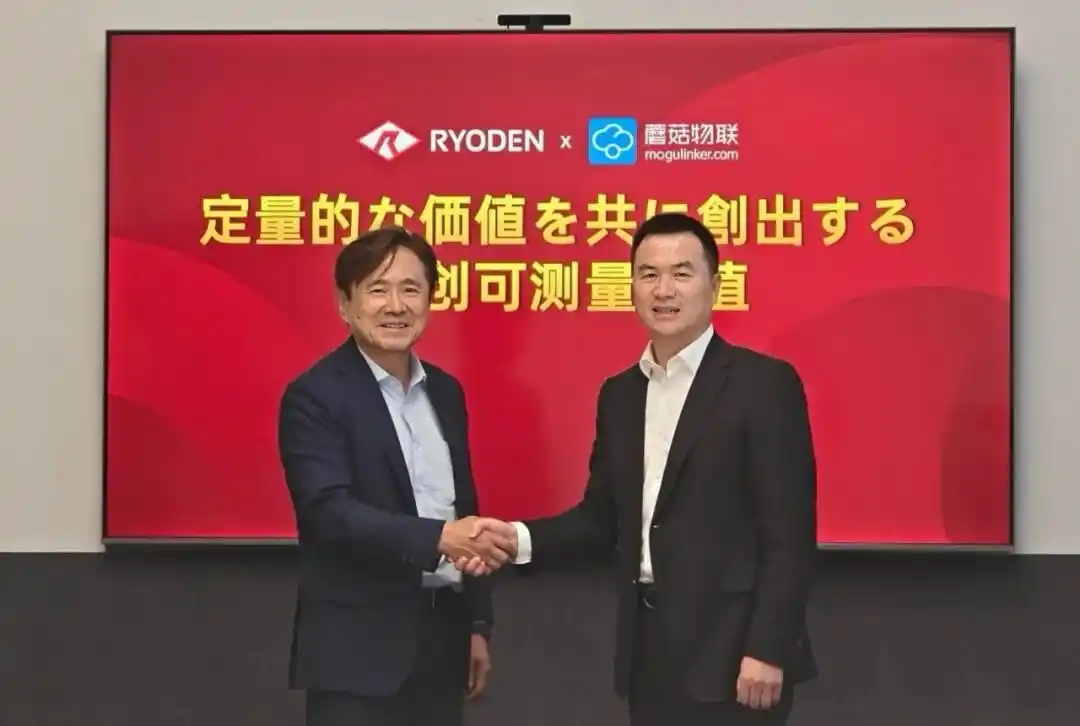
In July this year, Mogu IoT entered into a strategic partnership with RYODEN, a core listed company under the Mitsubishi Group. The two sides will work together on both technology and market development for Physical AI control in energy efficiency. The article describes this as the first joint development cooperation in Physical AI control technology for energy efficiency between a Chinese AI technology company and a global automation heavyweight.
Shen said Mitsubishi, a century-old automation giant, went through multiple rounds of comparison and on-site case verification across technology companies in China and the United States before choosing Mogu IoT. His explanation was simple: “Because our AI model is the most solid, our data foundation is the strongest, and we have the most cases — Mogu has served 130 Fortune 500 companies.”
Asked about players like Siemens moving into energy-management AI, Shen said he is not worried. Even the biggest companies, he said, still need data, communication protocol integration, and field know-how to build energy-efficiency AI. You cannot skip any of that.
He added that connecting communication protocols across full-category equipment was the result of ten years of work at Mogu IoT. In his view, even if a large company threw in ten times the manpower, it would not necessarily move faster. That is why he believes partnership beats direct competition, and he put it like this: “Everyone can work like building with Lego blocks, each using their own strengths to assemble a complete industrial AI map.”
Shen’s view of the next decade
Looking back on ten years of entrepreneurship, Shen summed up his approach in twelve Chinese characters: respect common sense, respect underlying rules, and keep iterating. He said iteration is the most important gene in a company, adding: “There is no such thing as a company that succeeds forever; there are only companies of their time.”
As for the next five to ten years, his forecast is blunt: “In the future factory, the production side will be taken over by embodied intelligent robots; the energy side will be taken over by Mogu IoT’s Lingzhi AI and Agent.”
The original article was published on the WeChat account Touzijie (ID: pedaily2012) and written by Liu Bo. It was republished by MarsBit.



