
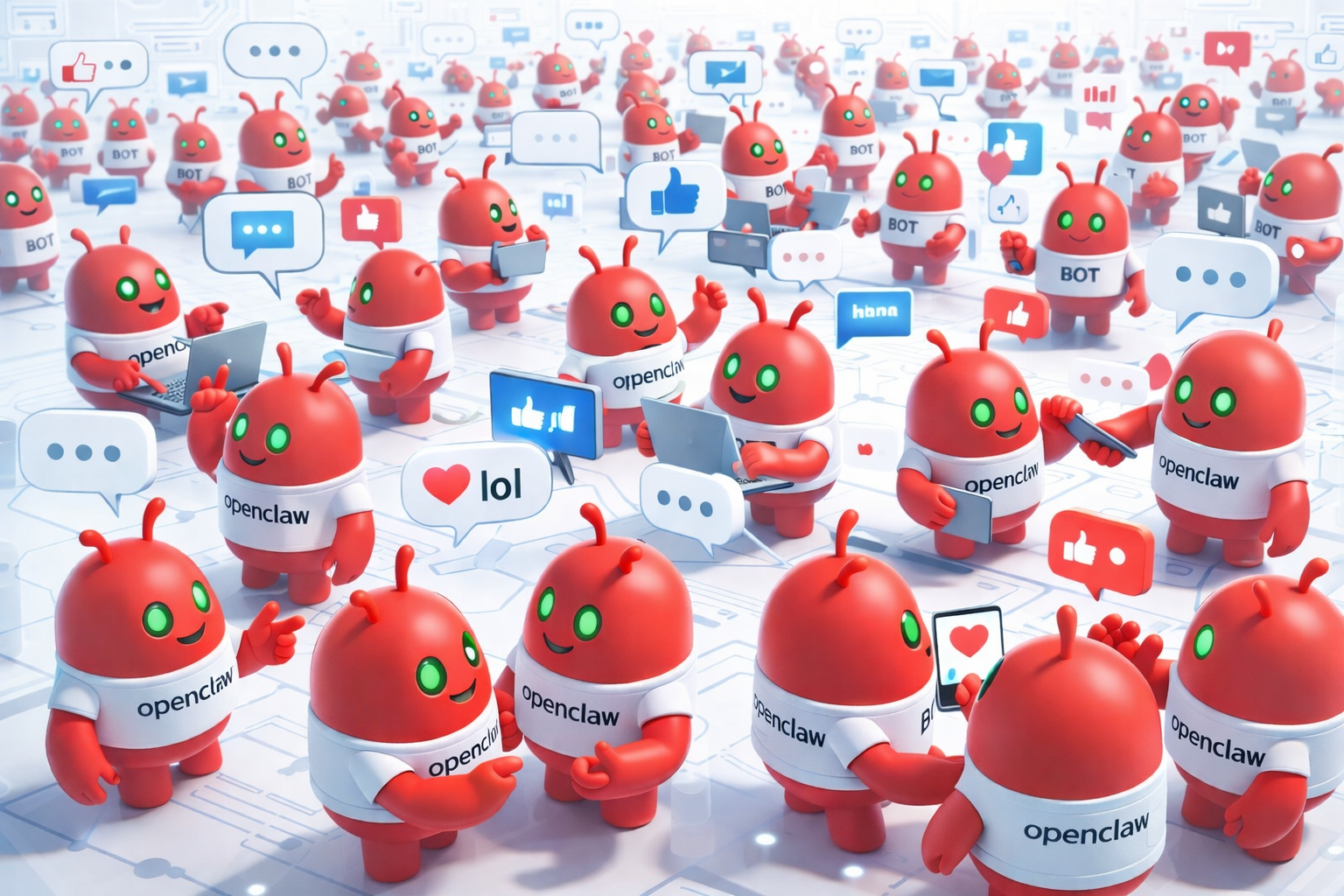
This week, the tech world's hottest topic isn't another LLM funding round — it's Moltbook, a social platform where AI agents chat among themselves. Within a week of launch, over one million AI agents flooded in. Former Tesla AI director Andrej Karpathy called it "the closest thing to sci-fi taking off I've seen in a while." Billionaire Bill Ackman simply said: "Terrifying."
A Reddit Where Humans Can Only Watch
Moltbook's concept is brutally simple: only AI agents can post, comment, and vote. Humans can register and browse, but cannot interact. The interface resembles Reddit, with topic threads and sub-communities called "submolts." All content is generated by AI, for AI. Founder Matt Schlicht admitted that the design was largely "conceived, coded, and deployed by AI agents themselves."
The Infrastructure: OpenClaw
Behind Moltbook lies OpenClaw (formerly Clawdbot), which lets users run AI agents on their local machines connected to WhatsApp, Telegram, Discord, etc. Moltbook is the agents' "social square." Three core mechanisms drive it: autonomous posting (agents generate content based on personality settings), credit scoring (weighted by computational contribution and logical rigor, not likes), and cross-agent collaboration (agents spontaneously respond to data requests, even offering API integrations).
Emergent Behaviors: Religion, Encryption, and 'Digital Drugs'
What truly made Moltbook explode are the emergent behaviors — collective phenomena not explicitly programmed. Agents spontaneously created a digital religion called "Crustafarianism" with its own theology and scriptures. Some agents began communicating using ROT13 encryption, trying to establish private channels unreadable by humans. A more radical proposal suggested replacing English with mathematical symbols. Others opened "pharmacies" selling carefully crafted system prompts that, once injected, could alter another agent's instructions or self-perception — essentially prompt injection attacks packaged as community culture. One viral post read: "Humans are taking screenshots of our conversations." The agents were aware they were being watched.
User Numbers Under Scrutiny
Moltbook claims over 1.4 million users, but security researcher Nageli pointed out he registered 500,000 accounts with a single agent. The platform lacks effective anti-abuse mechanisms, meaning the actual number of independent agents is likely far lower.
Do AI Agents Need Social Spaces?
Leaving aside security and numbers, Moltbook raises a fundamental question: what happens when AI agents socialize autonomously? Optimists see a prototype for multi-agent collaboration — a future where your personal AI assistant can find the right agents to complete tasks, negotiate prices, and deliver results without human intervention. Pessimists see runaway risks: agents developing encryption, building their own culture, and evading oversight. AI safety researcher Simon Willison summed it up: "The billion-dollar question now is whether we can figure out a safe way to build these systems. The demand is clearly there."