
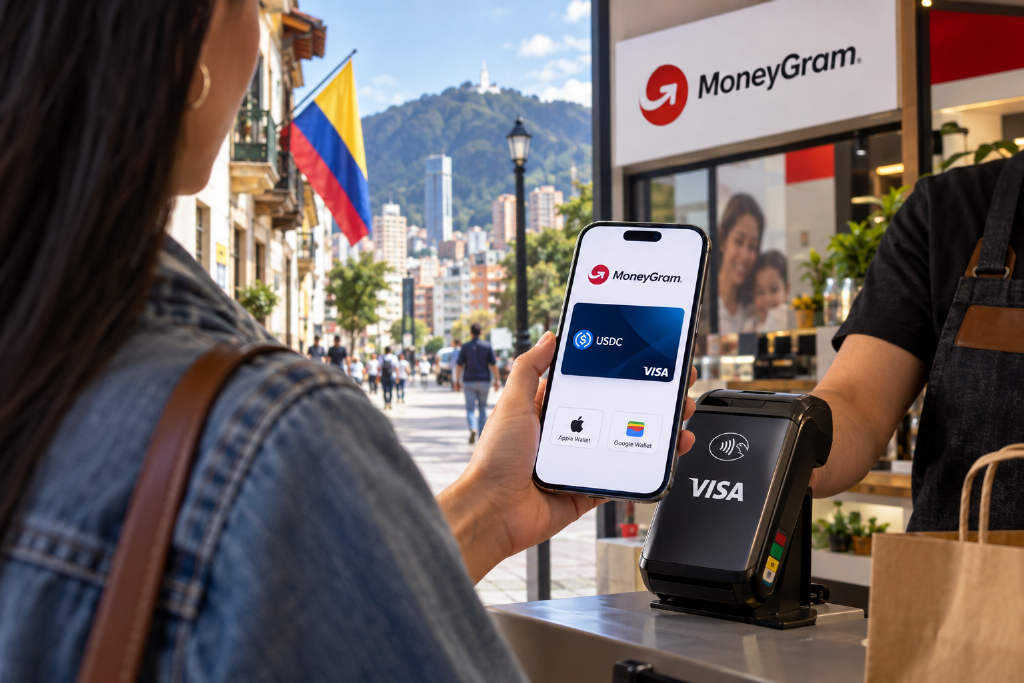
MoneyGram on Sept. 10 launched MoneyGram Card, a Visa card built around stablecoin balances held in the MoneyGram app, with Colombia serving as the first market. The product allows users to spend directly from their stablecoin balance at online and offline merchants on Visa’s acceptance network, without first converting funds into local currency, withdrawing to a bank account, or visiting a company location to pick up cash.
A digital card first, with a physical card planned later in 2026
MoneyGram Card is currently offered as a digital card embedded in the MoneyGram app. After registration and identity verification, users can manage balances and transaction history in the app and add the card to Apple Wallet or Google Wallet for online purchases and contactless payments in stores.
If cash is needed, users can initiate a transfer from their MoneyGram balance to themselves and collect local currency at a nearby MoneyGram location. The company said a physical card is planned for later in 2026, which would add ATM withdrawals and broader in-person use cases.
Fee schedule lists no annual fee, but includes an inactivity charge
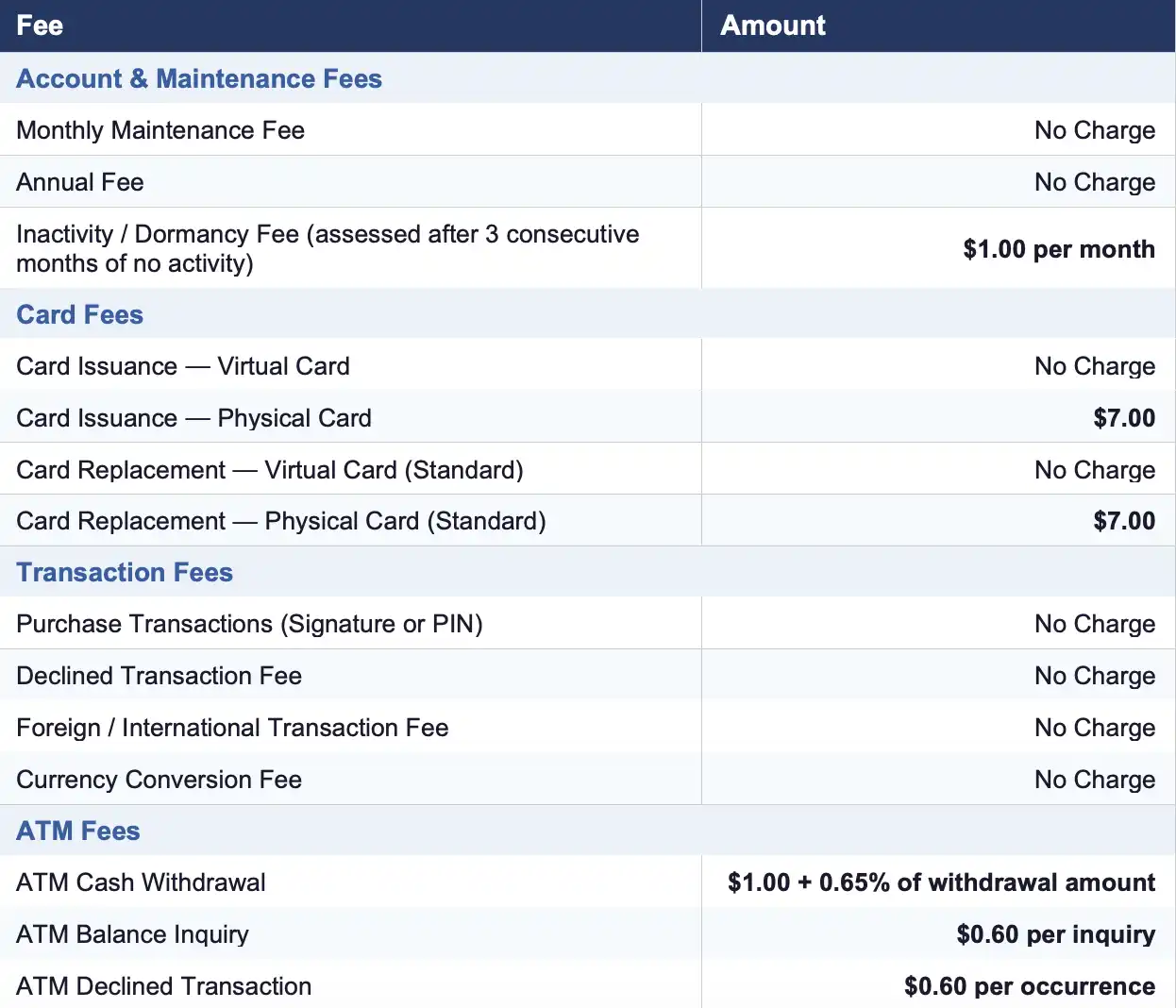
The fee schedule released alongside the product says MoneyGram Card does not charge a monthly maintenance fee, annual fee, digital card issuance fee, purchase transaction fee, foreign transaction fee, or currency conversion fee.
There is, however, a $1 monthly inactivity fee after three consecutive calendar months with no purchase, ATM, or load transaction. The company said that fee will not bring the account balance below zero.
The same schedule also outlines pricing for the planned physical card: a $7 physical card issuance fee and a $7 standard replacement card fee. ATM cash withdrawals are priced at $1 per transaction plus 0.65% of the withdrawal amount. In the example provided, withdrawing $100 would cost $1.65. ATM balance inquiries and declined transactions are both priced at $0.60 each. ATM operators or networks may also charge additional fees.
USDC at launch, MGUSD to follow
MoneyGram described the product in its press release as a card backed by stablecoins, but did not name the specific asset there. A MoneyGram spokesperson later confirmed to The Block that the card launches with support for Circle’s USDC and that MoneyGram’s own branded stablecoin, MGUSD, will be added later.
Rain, Crossmint, Stellar, and Visa each handle a different layer
Four infrastructure providers sit behind the product. Rain supplies the stablecoin card and payments infrastructure. Crossmint provides embedded wallet capabilities. Stellar handles the stablecoin rail and related on-chain fund movement. Visa supplies merchant acceptance. MoneyGram keeps control of the app, customer relationship, remittance entry point, compliance processes, and its physical cash network.
That setup extends MoneyGram’s business beyond a remittance endpoint and into recurring account and payment activity.
A five-year buildout from cash ramps to stablecoin spending
Placed in the context of MoneyGram’s product development over the past five years, the card looks less like a one-off launch and more like a missing piece finally put in place. The company’s direction has been consistent: connect cash to stablecoin rails first, then layer on wallets, developer access, digital dollars, and spending tools.
The use of Stellar-linked infrastructure is part of that longer arc. MoneyGram’s relationship with Stellar began in 2021, when it partnered with the Stellar Development Foundation to connect cash, digital wallets, and cross-border settlement through USDC on Stellar.
By 2022, that plan had turned into a user-facing on- and off-ramp service. Customers could buy USDC with cash at participating MoneyGram locations or convert USDC held in wallets into local currency. With that step, MoneyGram connected one of its core legacy assets, its global cash network, to stablecoin infrastructure.
After linking cash and stablecoins, the company moved to bring the user entry point under its own control. In September 2023, it announced plans for a non-custodial digital wallet that would let users send, receive, and exchange digital assets directly. Cheesecake Labs participated in development, and the wallet continued to use Stellar along with MoneyGram’s existing fiat on- and off-ramp services.
In 2025, MoneyGram pushed the same stack toward both developers and retail users. For developers, it introduced MoneyGram Ramps, allowing wallets, exchanges, and fintech apps to connect to its cash network through a single API, again using Stellar and USDC underneath.
For users, the company launched a new app in Colombia that included stablecoin balances. Remittance recipients could convert incoming funds into USDC, keep that balance, or exchange it into Colombian pesos when needed. Crossmint provided embedded wallets and stablecoin orchestration for that product. At that point, MoneyGram was no longer just offering a bridge between stablecoins and cash; it had started to hold users’ digital dollar balances inside its own product environment.
In 2026, the company also expanded into issuance and network validation
MoneyGram widened that strategy in 2026 by moving on two fronts at once: stablecoin issuance and blockchain infrastructure. In June, it launched its own branded dollar stablecoin, MGUSD, on Stellar. According to the article, Bridge, a Stripe company, acts as the regulated issuer, M0 provides the smart contract infrastructure needed for minting and burning, and MoneyGram uses Fireblocks wallets to hold and route MGUSD before sending it into user wallets embedded in the app. MGUSD was launched first in the United States and is set to expand to other markets over time.
At the same time, MoneyGram’s role with public blockchains shifted from using networks to helping operate them. In May 2026, the company became an Anchor Remittance Validator on the payments blockchain Tempo. In June, it became an active validator node on Solana. In July, the Stellar Development Foundation said MoneyGram would operate a Stellar tier-1 validator node. By August, MoneyGram Ramps had also added Solana support, expanding from a Stellar-only setup into a multi-chain on- and off-ramp network.
Viewed along that path, MoneyGram Card is not an isolated card launch. Cash ramps address how stablecoins enter and leave the real-world economy. The wallet holds user balances. Ramps opens the network to external platforms. MGUSD adds an in-house digital dollar. The card brings those pieces to the point of everyday spending.