
Bloomberg reported on Oct. 6 that Moonshot AI, the company behind Kimi, has completed its final pre-IPO private funding round at a valuation of about $50 billion. The company has also begun preparing investor outreach and could start preliminary discussions as soon as this month. Earlier reports said Moonshot AI had confidentially filed for a Hong Kong listing, with Bank of America acting as overall coordinator and China International Capital Corporation, Deutsche Bank and Goldman Sachs serving as sponsor banks. Bloomberg said discussions were ongoing and the IPO timetable could still change. Moonshot AI did not respond to a request for comment.
On the same day, Bloomberg also reported that Kling AI, Kuaishou’s AI video asset, was working with China International Capital Corporation, Goldman Sachs and UBS on a Hong Kong IPO. The listing could come as early as next year and is targeting fundraising of at least $1 billion. The report said details were still subject to change, while Goldman Sachs and UBS declined to comment.
The Information had previously reported that regulators had launched data security probes into DeepSeek and Moonshot AI. There is no public conclusion yet on whether that will affect valuation or listing timelines.
Two same-day IPO reports point to a broader Hong Kong AI listing window
The article frames the two reports as more than isolated IPO stories. Its argument is that Hong Kong’s AI capitalization cycle is shifting from one-off cases to a batch process. Market absorption for new listings, the Chapter 18C route, and demand from southbound funds are presented as the main forces behind that opening. For companies preparing to list, filing earlier is described not just as a matter of timing, but as a way to defend pricing power.
Moonshot AI’s valuation climb puts the focus on ARR, not current scale
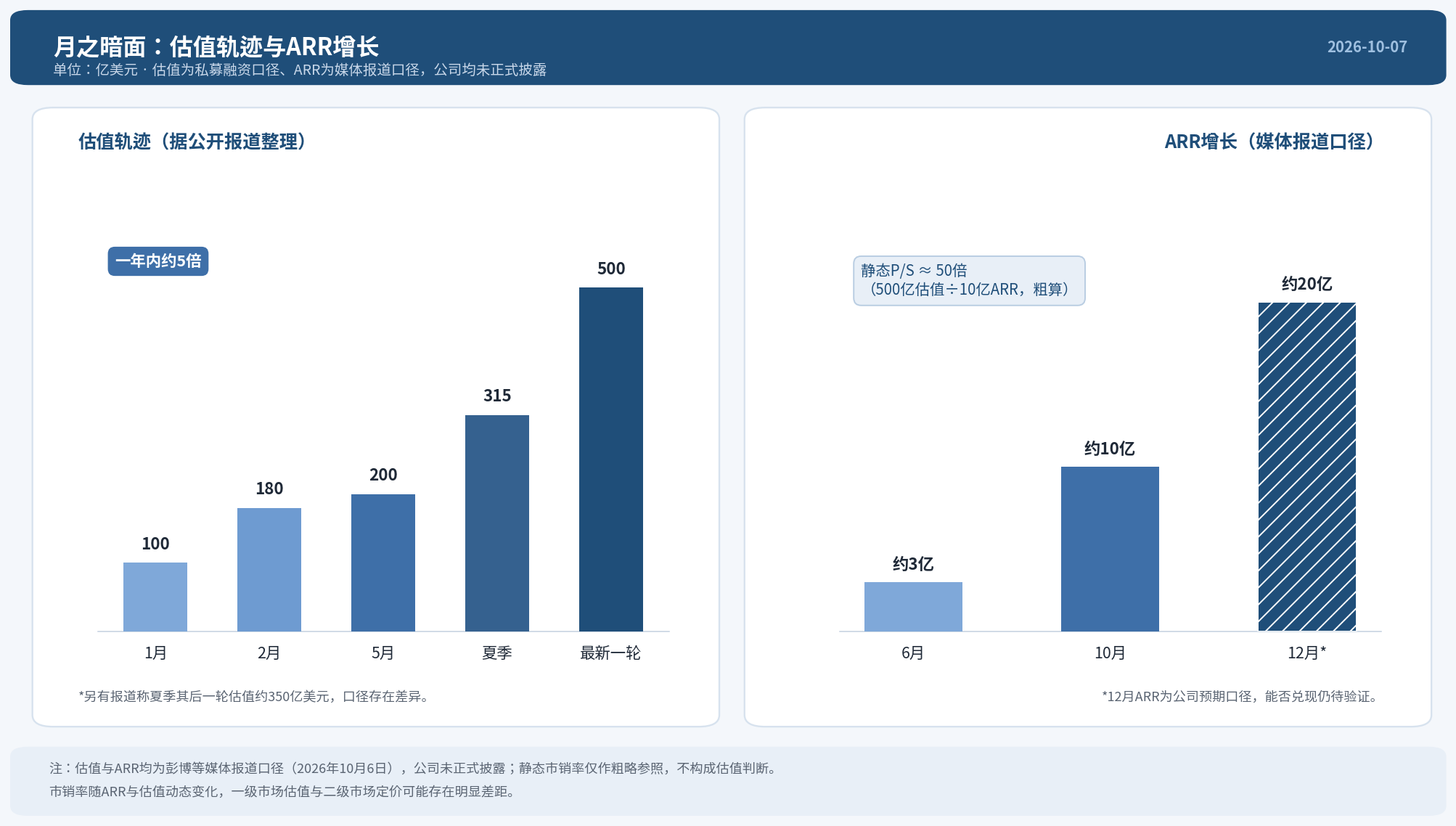
Based on public reports compiled in the piece, Moonshot AI’s valuation moved from $10 billion to $18 billion across three rounds in January and February, reached about $20 billion after its Series D round in May, then rose to about $31.5 billion in a summer round. Another report later put a subsequent round at about $35 billion. The latest round, according to Bloomberg, values the company at about $50 billion. That is roughly a fivefold increase in about a year.
The article says the valuation story is being carried by revenue growth rather than revenue size. Bloomberg reported that Moonshot AI’s annual recurring revenue rose from about $300 million in June to about $1 billion now, and that the company expects the figure could reach $2 billion in December. The piece notes that the December number is the company’s own projection.
On the business side, consumer revenue comes from Kimi’s tiered subscription model, while enterprise revenue comes from selling foundational AI capabilities to businesses. Moonshot AI launched Kimi Work, an agent product, in June. In July, it released the open-source model Kimi K3, which was reported to be close to leading models from OpenAI and Anthropic on some benchmark indicators.
The article then runs a simple valuation check. A $50 billion valuation against $1 billion in ARR implies a static price-to-sales multiple of about 50x. Even if ARR doubles to $2 billion in December, the forward price-to-sales ratio would still be about 25x.
It compares that with Zhipu in the public market. Using an intraday market capitalization of about HK$313.4 billion on Oct. 6 and interim-report ARR of roughly $1.8 billion, the article estimates Zhipu at about 22x static price-to-sales. In that framing, private-market investors are giving Moonshot AI a multiple that is more than double what public investors are assigning to a listed peer. The gap, the article says, can only close in two ways: Moonshot AI keeps expanding ARR at a faster pace, or IPO pricing falls closer to public-market anchors. December ARR is presented as the first major test of that logic.
Hong Kong IPO activity has accelerated, and Chapter 18C usage is rising with it
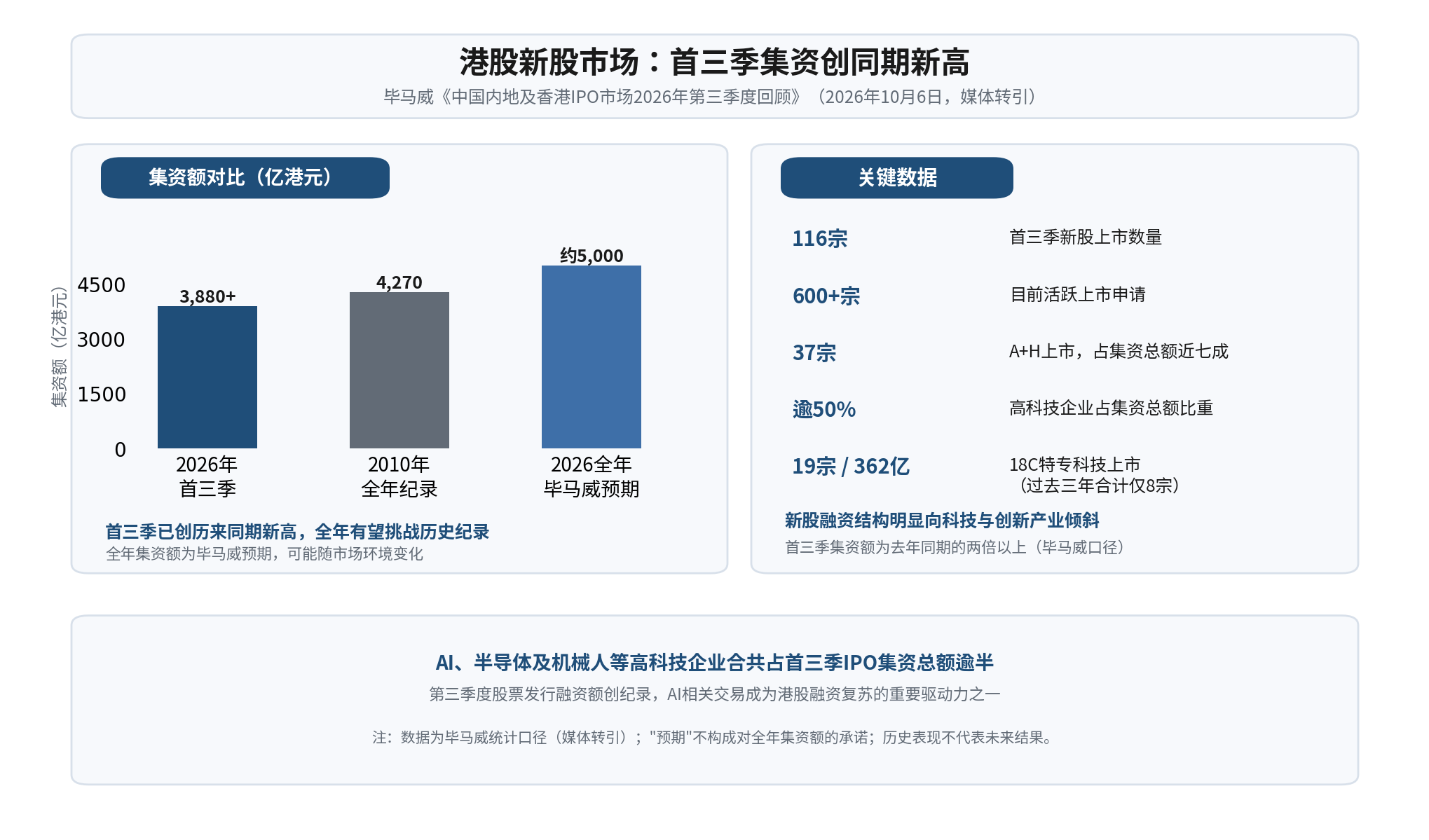
Media-cited figures from KPMG’s third-quarter review, released on Oct. 6, showed 116 IPOs in Hong Kong in the first three quarters, raising more than HK$388 billion. That was more than double the amount from the same period last year and the highest on record for the comparable stretch. Active listing applications exceeded 600, well above the usual level in prior years. KPMG said full-year fundraising could reach HK$500 billion. If that happens, it would break the annual record of HK$427 billion set in 2010.
On sector mix, high-tech companies including AI, semiconductors and robotics accounted for more than half of total fundraising, while third-quarter equity financing hit a record. Chapter 18C specialist technology companies contributed 19 listings and HK$36.2 billion in fundraising during the period. Over the previous three years combined, there had been only eight such listings.
The article notes that Chapter 18C mainly relies on requirements around market value and research and development spending, and does not require profitability as a mandatory condition. That has made it a workable path for companies that are still in heavy investment mode. At the same time, the piece argues that as throughput on that channel rises, scarcity premiums for any single name are likely to thin out.
Kling AI’s IPO plan is presented as financing for competition, not just an exit event
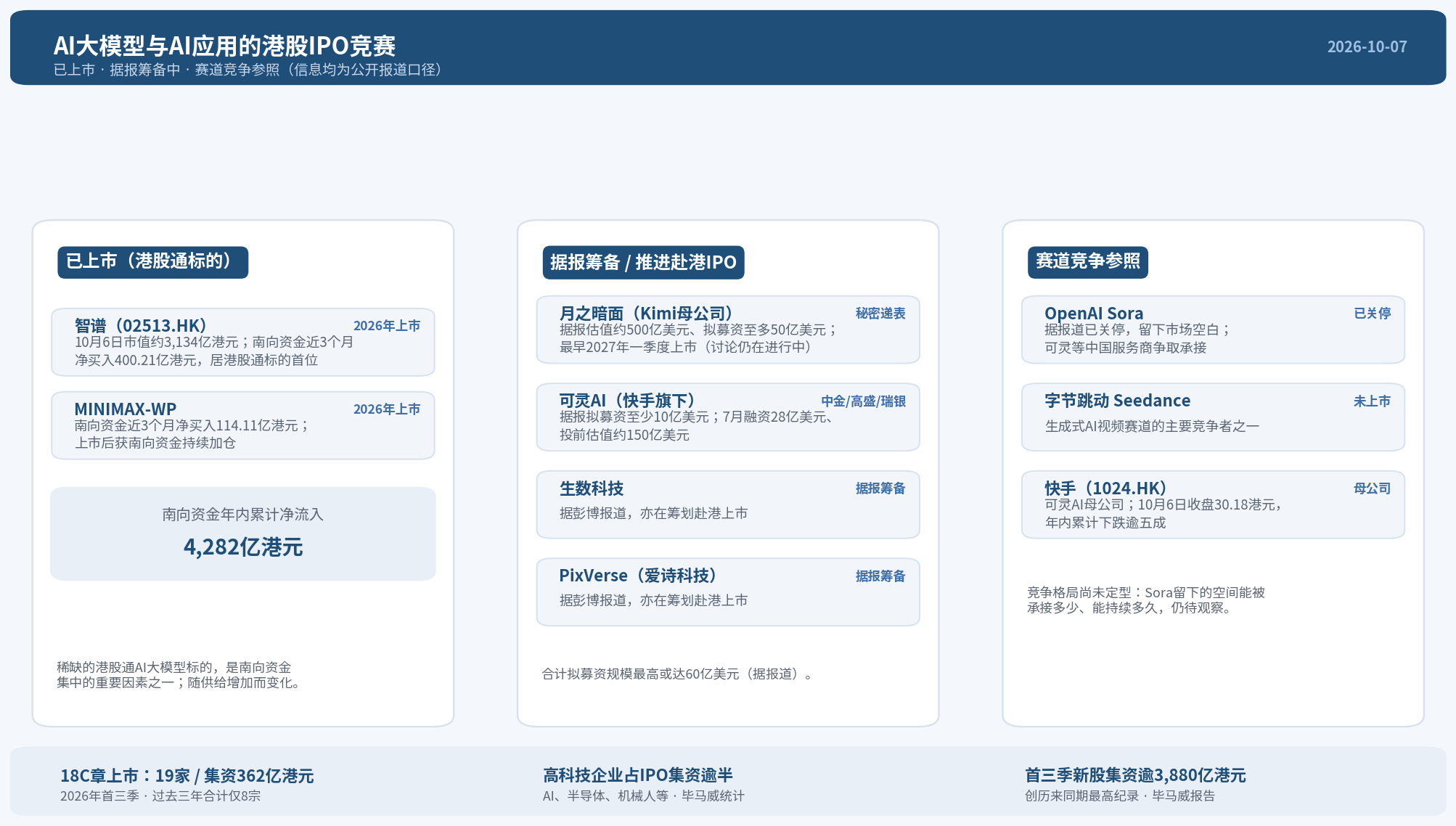
Kling AI launched in 2024 and focuses on generative AI video. Bloomberg said that after OpenAI shut down Sora, Chinese providers including Kling were trying to capture the market space left behind.
According to the article, Kling AI completed a $2.8 billion financing round in July at a pre-money valuation of about $15 billion, with Alibaba, Tencent and Baidu among the investors. By the end of August, based on Kuaishou announcements and related reports, Kling AI had completed another capital increase, and the independent financing quota launched this year had already been fully used.
The article reads the planned IPO as a move to secure more capital for a resource-intensive race rather than a straightforward liquidity event for shareholders. ByteDance’s Seedance, Shengshu Technology, and PixVerse developer Aishi Technology are all cited as companies pushing into the same track. Bloomberg had also reported that Shengshu Technology and Aishi Technology were considering Hong Kong listings.
Its argument is simple. AI video generation carries heavy compute and data costs, so the deciding factor may be balance-sheet endurance more than leaderboard rankings. There is still no public answer on how much of the space left by Sora can be captured, or for how long. The growing list of competitors, though, is already a signal that spending in the category is running ahead of monetization.
Kuaishou’s share-price decline adds another layer to Kling AI’s valuation setup
Bloomberg, together with market data cited in the piece, showed Kuaishou has fallen by more than half this year. The article gives two reference points: HK$66.25 at the close of the first trading day of 2026 and HK$30.18 at the close on Oct. 6, a drop of about 54%.
That creates two possible effects for Kling AI. A weaker parent-company stock could weigh on valuation expectations. At the same time, spinning an AI asset out of Kuaishou’s broader content-platform valuation gives the market a chance to price the AI video business on its own for the first time. Whether that leads to a premium or a discount will only become clear in IPO pricing.
Southbound capital is a key source of demand for upcoming Hong Kong AI listings
Wind data cited in the article showed cumulative net southbound inflows of HK$428.203 billion for the year as of Sept. 28, with holdings valued at about HK$6.02 trillion as of Sept. 29. Over the previous three months, many of the biggest net buys were AI-related names. Zhipu ranked first with HK$40.021 billion, while MINIMAX-W drew HK$11.411 billion.
From that setup, the article argues that if Moonshot AI and Kling AI go public and are later included in the Stock Connect program, the next marginal buyers are likely to come from the same pool of capital. It also says the trading performance of the first wave of large-model listings will shape how southbound investors view the category as a whole.
The scarcity argument appears again here. Hong Kong Stock Connect still has very few large-model names, which helps explain why Zhipu and MINIMAX-W kept attracting southbound buying after listing. But with 19 Chapter 18C companies already listed in the first three quarters and more than 600 applications in line, the market may soon move from scarcity to volume. In that environment, early issuers may hold more pricing power, while later ones face demand that has already been partly absorbed.
What the market is likely to watch next
The article lists several signals to monitor in the coming months:
- Formal application documents on the Hong Kong exchange disclosure platform, especially how ARR is broken down and how subscription revenue is separated from enterprise revenue;
- Feedback from initial investor discussions, which could offer the first direct read on how public-market buyers view a roughly 50x static price-to-sales multiple;
- Whether Moonshot AI can reach the projected ARR of about $2 billion in December;
- Kuaishou’s share performance, the interest-rate environment, and overall IPO market conditions, all of which could feed into final pricing.
The article’s closing framework
The piece ends with three core judgments. First, the gap between Moonshot AI’s roughly 50x static price-to-sales multiple and Zhipu’s roughly 22x is ultimately a debate about whether growth assumptions can be delivered. December ARR is one of the most important checkpoints. Second, with Chapter 18C shifting from a backup route to a main route, scarcity is entering a countdown phase, and the wave of filings is better understood as a race for pricing power. Third, Kling AI’s IPO plan looks more like a capital refill for the AI video race than a clean exit, while Kuaishou’s weak stock can both cap expectations and support the logic for a separate listing.
The article says these judgments are based on currently available public information and may change as conditions shift. It cites Bloomberg, KPMG’s 2026 third-quarter review, Wind, exchange market data and other public reports as data sources. It also notes that information related to Moonshot AI and Kling AI has not been formally disclosed by the companies, so media reports remain the main reference. Differences between media reports and Kuaishou disclosures on Kling AI financing figures were also flagged in the text.