

Moore Threads on Aug. 9 announced two major developments: a plan to seek a Hong Kong listing and a first-half earnings report that showed a sharp rise in revenue.
The update quickly drew attention from investors. One comment cited in the report said, 「Now listed companies are sitting on huge fundraising proceeds, still buying wealth management products, and then heading to Hong Kong for another round of financing.」
Stock has retreated sharply from its post-listing peak
In December 2025, Moore Threads listed on Shanghai’s STAR Market as the "first domestic GPU stock," raising 8 billion yuan.
Its shares jumped 468% on the first trading day. On Dec. 11, the stock reached 941.08 yuan, pushing the company’s market capitalization to a record 442.3 billion yuan.
On Dec. 12, however, the company said it would use idle IPO proceeds to buy principal-protected wealth management products in order to improve the efficiency of fundraising proceeds. That move triggered debate in the market.
Another shareholder quoted in the report said, 「In principle, after a company raises money from investors through a listing, that money should go into the promised projects. Is it appropriate to use it to buy principal-protected wealth management products?」
Share price swings became more visible after that. As of Aug. 10, Moore Threads had fallen to 573.97 yuan per share, with market capitalization at 269.8 billion yuan, about 40% below its peak.
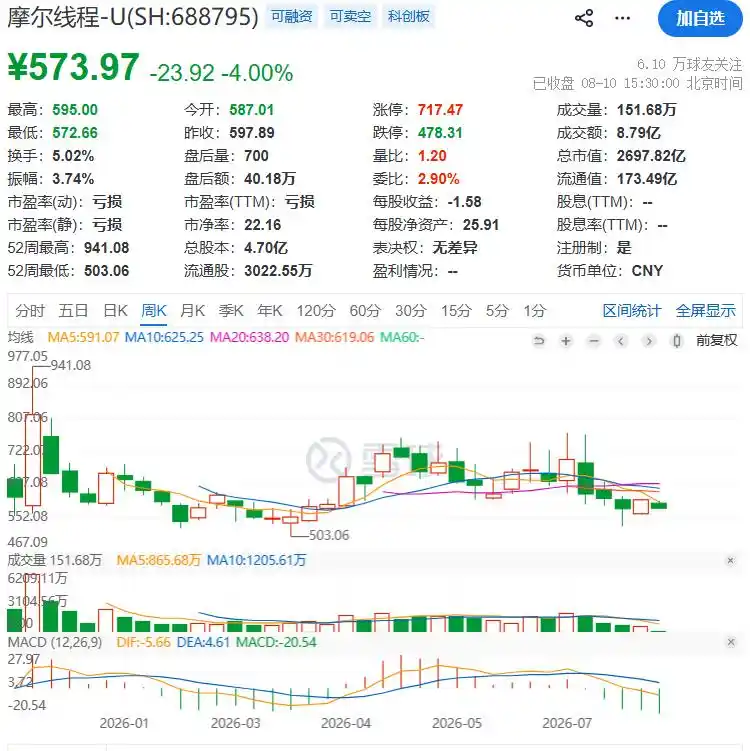
The report said the company’s early valuation had been driven well beyond fundamentals. Its dynamic price-to-sales ratio at one point exceeded 1,000 times, far above an industry static price-to-earnings level of about 60 times. It also said the decision to put fundraising proceeds into wealth management products ran counter to some investor expectations and hurt confidence.
Around July, the AI computing sector as a whole pulled back, with many stocks losing roughly half their value, and Moore Threads did not escape that trend.
Hong Kong listing plan comes while cash remains on hand
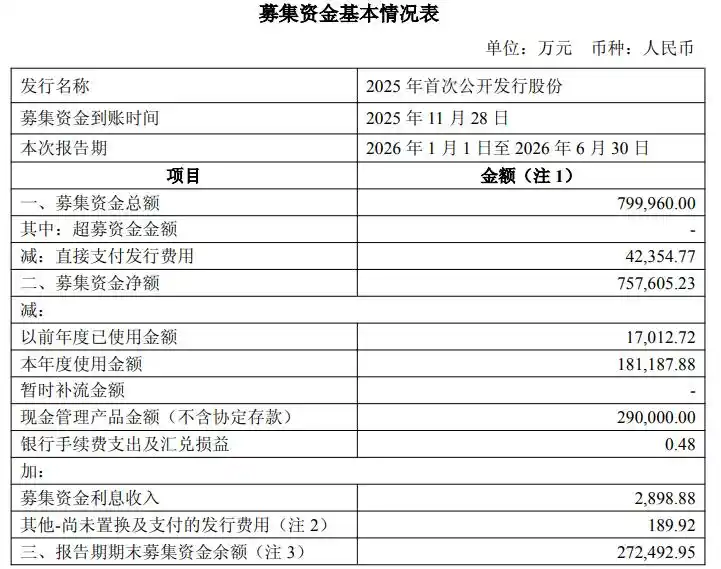
According to the company’s proceeds usage disclosure, Moore Threads still has substantial funds on its balance sheet. It received 7.57 billion yuan from its A-share offering, has spent nearly 2 billion yuan, placed 2.9 billion yuan into wealth management products, and still holds another 2.7 billion yuan in banks.
The company said the purpose of the Hong Kong listing is to "deepen its international strategic layout, continue attracting and gathering outstanding global R&D and management talent, and enhance corporate governance and core competitiveness."
For the GPU industry, where technology cycles move quickly and capital competition is intense, the report said a Hong Kong listing could help open international capital channels and attract top overseas talent.
Industry participants cited in the report said more companies now view the "A+H" platform not as a financing support tool but as a central pillar of globalization strategy.
The report also said that in 2024, the China Securities Regulatory Commission proposed support for mainland industry leaders to list in Hong Kong, while Hong Kong Exchanges and Clearing revised IPO rules and lowered listing thresholds. Since 2024, more than 270 mainland companies have listed in Hong Kong, raising over HK$650 billion. CATL, Zhongji Innolight and Montage Technology were cited as hard-tech leaders that have either completed or are moving along the A+H path.
Among China’s domestic GPU "big four newcomers," Biren Technology has already listed in Hong Kong. MetaX, after going public in the A-share market at the end of last year, announced in June that it would also pursue a Hong Kong listing.
Still, the report said it may be difficult for Moore Threads to price its Hong Kong IPO above the ceiling set by Biren Technology. International investors may use Biren’s Hong Kong valuation as a benchmark and ask Moore Threads to offer a discount.
Revenue surged in the first half, but recurring profit remains negative
On the operating side, Moore Threads posted strong top-line growth in the first half but remained in the red.
The company reported revenue of 1.74 billion yuan for the first half, up 147.4% from a year earlier and already above its full-year revenue from last year.
Moore Threads said in its annual report that the increase was driven by growth in the artificial intelligence industry, strong demand for full-function GPUs, faster commercialization of its Kuayue intelligent computing cluster, and strong customer recognition of product performance.
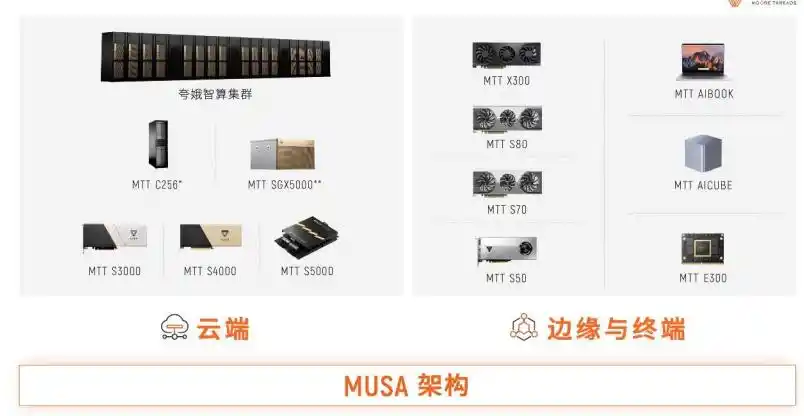
The Kuayue intelligent computing cluster was described as a "super factory" built for large models, providing the computing power needed for training and inference for models with trillions of parameters.
At present, almost all of Moore Threads’ revenue comes from its cloud product line, including cloud intelligent computing accelerator cards, integrated computing systems, and computing clusters. Revenue from that segment was about 1.7 billion yuan in the first half. The edge and terminal product line remains small and has yet to scale.
Net loss narrowed sharply from 271 million yuan in the same period last year to 11.563 million yuan. Even so, net profit attributable to shareholders after non-recurring items still showed a loss of 150 million yuan. The report said non-recurring gains mainly came from government subsidies and investment income.
According to the company’s earlier disclosure, profitability is not expected before 2027 at the earliest.
Total operating costs in the first half also climbed to more than 1.8 billion yuan. Research and development spending reached 770 million yuan, up 38% year on year. Operating costs and selling expenses rose 245% and 121%, respectively, under pressure from higher raw material prices and expansion of the sales team.
The original report was published by the WeChat account Yijian Caijing and written by Feng Jianhong.