
Morgan Stanley has lifted its estimate for the AI scale-up networking opportunity in 2030 to about $70 billion, more than four times its prior estimate from last year, and put copper’s staying power back at the center of the discussion around AI clusters.
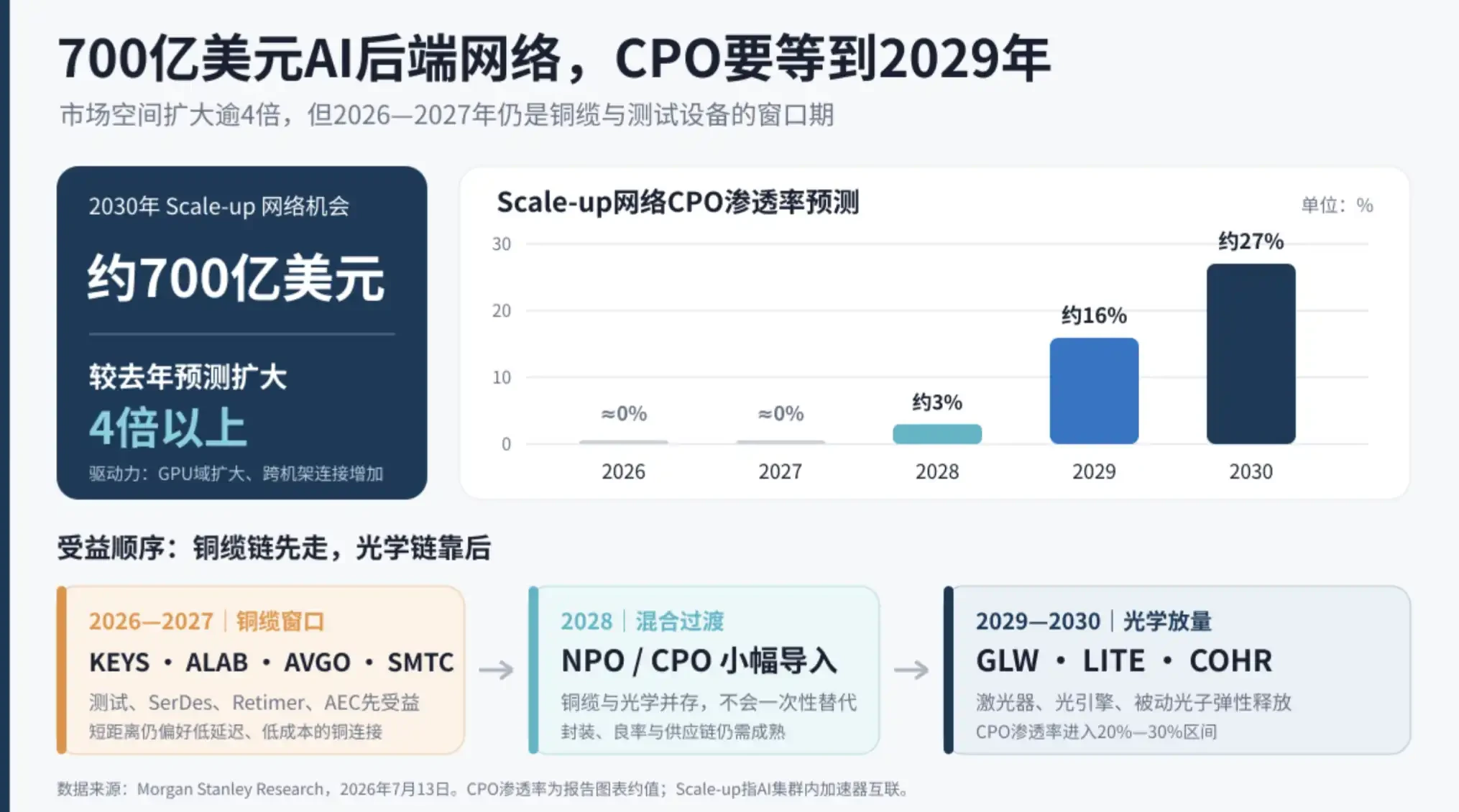
The firm’s latest report is not a case for an immediate CPO surge. Its central argument is that AI systems are moving from single-rack deployments to multi-rack clusters, expanding the total addressable market for back-end networking, but short-reach links still carry strong copper inertia until power, distance and bandwidth-density constraints become harder to manage.
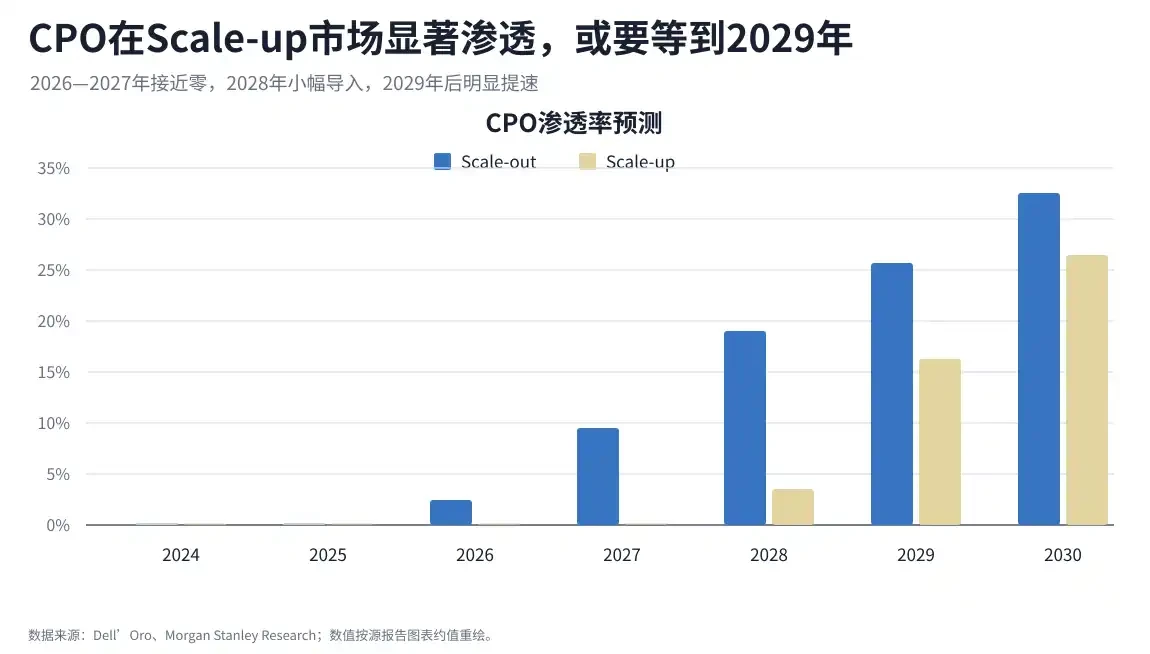
On Morgan Stanley’s timeline, CPO penetration in scale-up networks remains close to zero in 2026 and 2027, begins to appear in 2028, and only reaches a meaningful 20% to 30% by 2029 to 2030. The market opportunity has been revised sharply higher, but optics are still some distance from taking the largest share of scale-up networking revenue.
Multi-rack AI clusters drive the larger market estimate
The upward revision is tied to a clear shift in cluster design. As AI training and inference systems expand, demand rises for links inside servers and across racks. In traditional single-rack setups, GPU-to-GPU distances are short enough that copper still holds advantages in cost, latency and power consumption. For short-reach connections, especially within roughly 7 to 9 meters, copper remains the most direct option.
That position has been supported by advances in SerDes, retimers and PAM4/PAM6, which have repeatedly extended copper’s useful life and delayed the point where optics become necessary. The transition starts to change when clusters scale beyond one rack. Once GPUs need to communicate across multiple racks and signaling rates move from 100G toward 200G and 400G, electrical loss, insertion loss and noise management become much harder to control, pushing copper closer to its limits.
Morgan Stanley’s chart on back-end networking revenue from 2024 to 2030 shows scale-up networking rising quickly, with the 2030 opportunity reaching about $70 billion. That matters for the order in which companies benefit. The first gains may go not to CPO suppliers, but to chip and module makers that allow copper to run faster and over longer distances. Optical engines, passive photonics, lasers and test equipment are likely to show greater operating leverage only after multi-rack clusters become more common.
2026 and 2027 still look like a copper window
CPO is attractive because it places optical components closer to switching or compute silicon, shortening on-board electrical signal paths and improving both power efficiency and bandwidth density. The complication is that this is not just a cable swap. It changes packaging, manufacturing, testing, maintenance and how responsibility is divided across the supply chain.
That is why Morgan Stanley does not expect a broad CPO breakout in 2026. In its model, CPO penetration in scale-up networks stays near zero through 2026 and 2027, begins modestly in 2028, and becomes meaningful only in 2029 to 2030. If multi-rack GPU domains expand as planned, CPO could then reach 20% to 30% penetration in scale-up networking.
This leaves at least a two-year opening for copper-related suppliers. Astera Labs’ Scorpio X-Series has entered initial volume shipments. Broadcom has connectivity exposure tied to AMD MI400, Helios and custom ASIC ecosystems. Semtech is positioned for the transition through its CopperEdge low-power copper-cable products and linear optical offerings.
Importantly, Morgan Stanley does not frame copper and optics as a simple replacement story. Hyperscalers are expected to mix DAC, ACC, AEC, AOC, NPO and CPO depending on reach, power, cost, serviceability and reliability. Copper is still likely to hold a substantial share in short-distance, in-rack and near-rack links, while CPO takes on denser, longer-reach connections with heavier power constraints.
Nvidia’s roadmap raises the optical content question
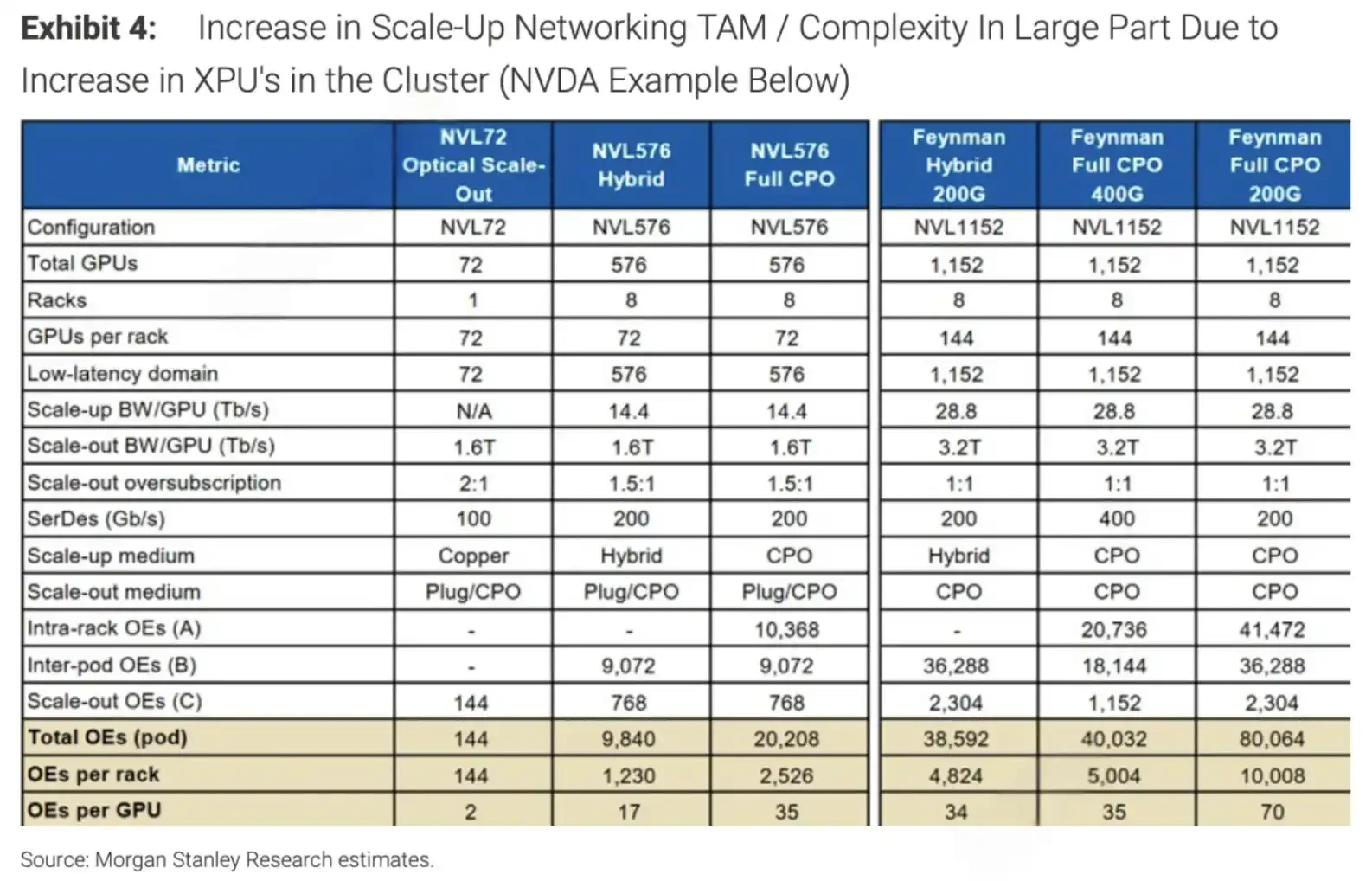
The point at which CPO becomes more important is tied closely to Nvidia’s next AI platform roadmap. According to Nvidia’s official technical blog, Vera Rubin Ultra NVL576 will combine eight 72-GPU racks into a 576-GPU NVLink domain and use both copper and direct optical connections. The later Feynman-era Kyber NVL1152 targets even larger-scale interconnect and uses a similar direct optical approach.
Once GPU domains expand, Morgan Stanley argues that demand for optical engines does not simply rise in a straight line. In the firm’s estimates, the number of optical engines per GPU could increase from about two today to a range of 35 to 70. The accompanying comparison also shows GPU domains growing from 72 to 576 or 1152, while optical engine counts per GPU move from 2 to 17 to 70 depending on architecture.
That is why Corning, Lumentum and Coherent appear in this part of the thesis. Corning is tied to passive photonics and glass-related content. Lumentum and Coherent have exposure to lasers, optical engines and optical components. Once Morgan Stanley adds scale-up CPO adoption into its model, the earnings sensitivity for these companies depends heavily on the pace of adoption.
Still, the bank frames this as upside that appears if adoption happens, not revenue already in hand. The report notes that there is disagreement in the market over Nvidia’s roadmap itself. Some industry analysis has suggested that parts of Kyber or Rubin Ultra configurations could be delayed, while Nvidia has said the roadmap is unchanged. For the optical supply chain, the key issue is less the product name and more whether large GPU domains enter volume production on schedule and whether non-Nvidia XPU ecosystems choose similar connectivity paths.
Keysight stands out as a tools supplier
Within this theme, Keysight Technologies is positioned differently from optical component makers. The argument is that Keysight acts more like a picks-and-shovels supplier. It does not need to commit to copper or CPO as the final winner, because a broader mix of AI networking architectures increases the amount of testing and validation required.
There is still no single standard for AI back-end networks. Nvidia has NVLink and its extension path. Outside Nvidia, the market includes UALink, SUE, PCIe and proprietary interconnect schemes developed by different cloud companies. Each architecture needs work on signal integrity, bit error rate, interoperability, power and reliability.
According to Investing.com’s summary of the report, Morgan Stanley upgraded Keysight to Overweight from Equalweight and raised its price target to $400 from $350. The reasons cited included AI spending, network architecture diversification, and rising test demand for 800G, 1.6T and 3.2T. The note also said AI-related revenue accounts for the mid-teens percentage of Keysight’s total revenue.
Optical component names, by comparison, are more exposed to CPO adoption rates and the exact timing of platform rollouts. If Nvidia’s roadmap advances smoothly, Corning, Lumentum and Coherent would be more direct beneficiaries. If copper continues to extend its life through 2026 and 2027, Astera Labs, Broadcom and Semtech may offer stronger near-term visibility.
CPO may become central later, but not in one step
One of the report’s more striking conclusions is that it treats CPO as important over the long run while also arguing that copper should not be underestimated in the near term. Hyperscalers still have real concerns around vendor lock-in. Once optics are deeply integrated into switch or compute packaging, replacement, repair and multi-supplier procurement become more complicated.
Manufacturing yields, thermal management, serviceability and quality risk can also slow adoption. If the cost premium cannot be offset by power savings and better bandwidth density, deployment is likely to slip.
The architectural picture is not uniform either. Morgan Stanley notes that Nvidia’s roadmap could push a higher share of optical interconnects, while in-house designs such as Google TPU use different topologies that may reduce reliance on traditional CPO approaches. Non-Nvidia XPU ecosystems still create openings for Broadcom, Astera Labs and others, but the absence of a unified standard makes it harder for suppliers to scale quickly around one design.
In that sense, the move to a $70 billion market is better read as an expansion of the total AI back-end networking pool, not as proof that a single technology path has already won. Copper is still expected to dominate inside racks and in short-reach links through 2026 and 2027. Optics begin to take a more central role after 2028. Meaningful CPO penetration in scale-up networking, in Morgan Stanley’s view, does not arrive until 2029 to 2030. The easiest mistake is to read “CPO will come” as “CPO is about to break out now.”