
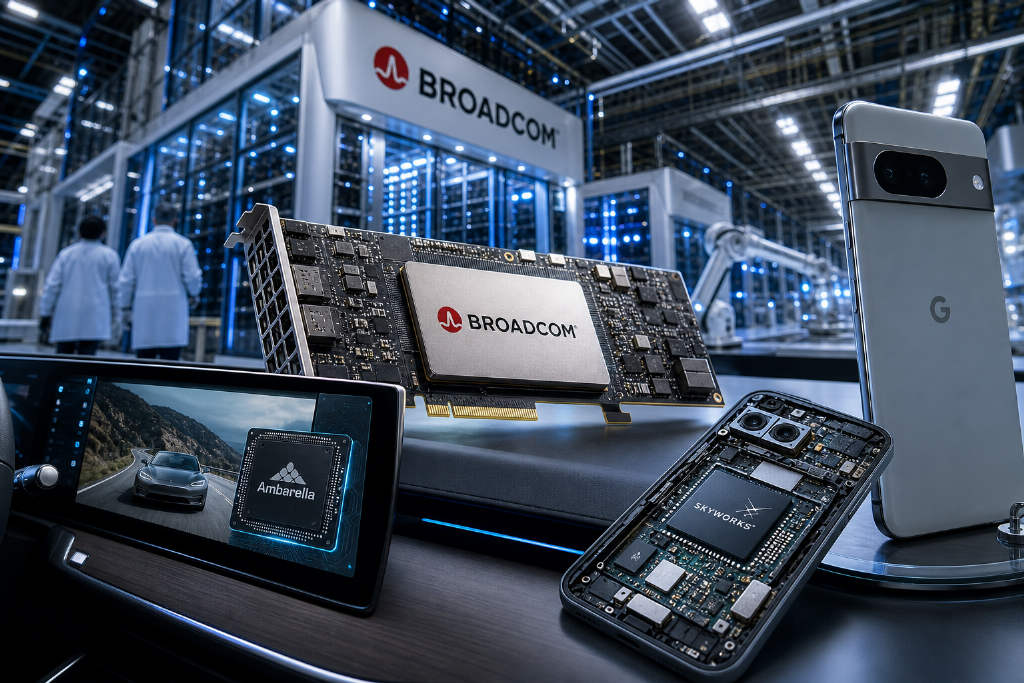
Morgan Stanley on Aug. 31 published a semiconductor weekly report previewing Broadcom, Ambarella and Skyworks. The bank said Broadcom’s AI business is still expanding quickly, Ambarella’s automotive segment remains its main growth driver, and Skyworks has secured nearly all radio frequency front-end content in Google Pixel. Morgan Stanley kept an Overweight rating on Broadcom and Ambarella and maintained an Equal-weight rating on Skyworks.
Broadcom: AI growth stays strong, but expectations are the main risk
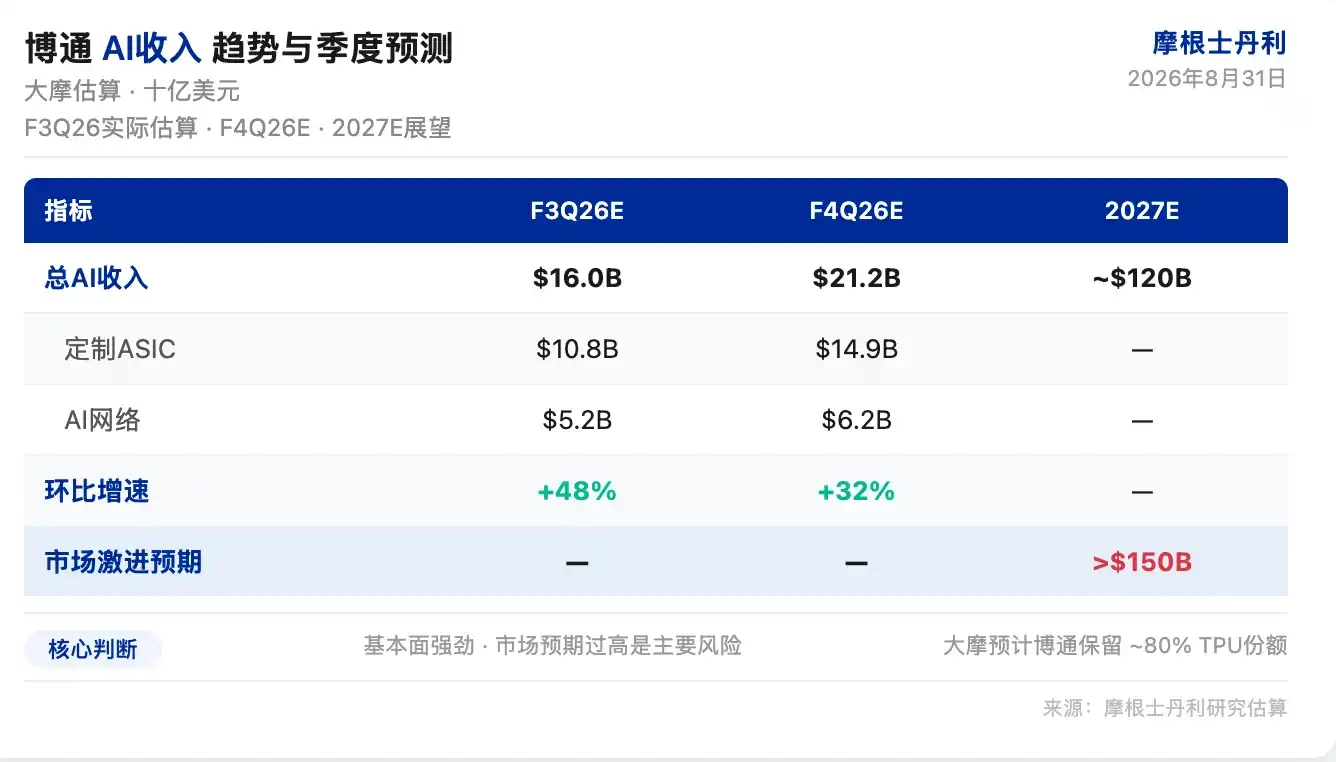
Morgan Stanley expects Broadcom to post about $16 billion in AI revenue in the July quarter, or fiscal third quarter, up 48% from the prior quarter. That figure includes roughly $10.8 billion from custom ASICs and about $5.2 billion from AI networking. For the October quarter, or fiscal fourth quarter, the bank forecasts another 32% increase to $21.2 billion, including about $14.9 billion from custom ASICs and $6.2 billion from AI networking. TPU demand remains strong, the report said, while networking continues to benefit from AI infrastructure expansion.
The larger story, in Morgan Stanley’s view, sits in 2027. The bank projects Broadcom AI revenue at about $120 billion that year, versus the company’s prior guidance of “well above $100 billion.” Management last quarter also hinted that growth could continue into 2028. Morgan Stanley said Broadcom may not formally update its 2027 framework this quarter, but added that the core fundamental story would remain intact even without such an update. TPU is still expected to be the main contributor to Broadcom’s custom ASIC revenue, and the bank said it will be watching several newer custom programs that are expected to ramp gradually in 2027.
The bigger earnings risk, according to the report, is not the business itself but how high market expectations have become. Morgan Stanley said the prior quarter already showed that strong results do not necessarily lift the stock if investors are looking for even more. Some investors are assuming Broadcom can exceed $150 billion in AI revenue in 2027. Morgan Stanley said that outcome is possible, but not certain. It also warned investors not to overread rumors about lower CoWoS capacity forecasts, saying that supply-chain data points carry a lot of noise and that Broadcom’s growth trajectory still looks very strong.
TPU share remains another point of debate. Morgan Stanley said MediaTek’s participation is real, and pointed to reports about AMD’s involvement in TPU v10 as well as Marvell’s warrant agreement with Google as signs that Google is broadening its supplier base. Even so, the bank still expects Broadcom to retain about 80% of the long-term TPU opportunity. It said there is no meaningful risk to Broadcom’s core TPU position and ranked the company as its No. 2 pick in AI compute, behind Nvidia.
For Broadcom’s July quarter, Morgan Stanley forecasts revenue of $29.4 billion versus a market consensus of $29.2 billion, gross margin of 74.0% versus 73.5%, and earnings per share of $3.24 versus $3.22. For the October quarter, it projects revenue of $34.8 billion versus $34.7 billion, gross margin of 72.9% in line with consensus, and earnings per share of $3.85 versus $3.84.
Ambarella: automotive momentum continues, edge AI thesis remains in place
Morgan Stanley expects Ambarella’s July quarter, or fiscal second quarter, revenue to rise 7.9% from the previous quarter, followed by another 12% increase in the October quarter. Automotive remains the main growth engine this year, with revenue growth of about 20%, helped by fleet telematics, AI video and safety applications, and higher AI content per vehicle.
In internet of things markets, the report described a mixed picture. Enterprise security appears relatively healthy, while consumer markets may face pressure in the second half of the year from higher memory and storage costs. Morgan Stanley called that the main near-term risk, though it said the size of the impact is still uncertain.
Over a longer horizon, the bank said Ambarella is well positioned for multiyear expansion in edge AI. Drones are seen as the most attractive near-term opportunity, with both consumer and commercial demand growing. The coming CV7 ramp is also expected to add a new source of growth and support higher average selling prices. Automotive remains an important long-term opportunity as well, though the prior quarter did not bring a major update on large-scale CV3 autonomous driving deployment. Morgan Stanley said Ambarella’s story is shifting from a high-growth product-cycle phase toward a steadier execution phase, while keeping a constructive view on the company’s low-power edge AI inference positioning.

On recent unconfirmed takeover speculation, Morgan Stanley said Ambarella’s strategic value has long been part of its Overweight case, though its conviction is still rooted mainly in the company’s technology. The bank said it cannot verify whether the rumors are true, but added that such a combination could make strategic sense. Ambarella would contribute differentiated edge AI and computer vision capabilities, while NXP’s scale, deep automotive relationships and OEM trust could help speed up commercialization, especially in automotive markets where Ambarella has historically found it harder to compete with larger suppliers.
For Ambarella’s July quarter, Morgan Stanley forecasts revenue of $108.3 million, above the $107.8 million consensus, gross margin of 59.8% in line with consensus, and earnings per share of $0.16 versus a $0.17 consensus. For the October quarter, it expects revenue of $121.2 million versus $119.3 million, gross margin of 59.7% versus 59.6%, and earnings per share of $0.29 versus $0.30.
Skyworks: nearly all Pixel RF front-end share secured
Morgan Stanley also said it attended Skyworks’ technology day in San Jose last week, where the company outlined its capabilities across mobile and broader end markets.
In mobile, the standout point was Google Pixel. Morgan Stanley said Skyworks won the mid-band position for the first time in Google’s roughly two-year rebid cycle and now holds nearly all radio frequency front-end content in Pixel. The agreement has been extended through 2030 and is expected to generate more than $1 billion in cumulative revenue. Skyworks also highlighted its close work with MediaTek and early visibility into next-generation RF demand.
Outside mobile, presentations focused on how Skyworks is applying its RF, timing, isolation, sensing and power capabilities to faster-growing markets. In precision timing, the company highlighted single-chip integrated network synchronization, jitter attenuation, clock generation and software. In data centers, the focus was on higher-voltage power architectures spanning isolation, gate driving and sensing. Morgan Stanley said Skyworks is positioned across every part of the stack touched by 800V, from the grid to the rack. The company also discussed opportunities in automotive, WiFi and broadband, drones, and other edge connectivity applications.
Morgan Stanley said it remains positive on Skyworks’ long-term opportunity set, but added that near-term conditions in broader markets are still mixed. Data center and automotive demand are holding up better, while internet of things markets remain soft. Smartphones have also stayed resilient despite memory-related pressure. Over time, Morgan Stanley expects broad markets to become a larger part of Skyworks’ business, reducing dependence on mobile, especially as share loss at Apple continues. The report said the Qorvo transaction and integration remain key catalysts, but ongoing pressure in the rest of the business is why the bank kept an Equal-weight rating.
Report attribution and disclaimer
The original article said the piece was a整理与解读 of a third-party brokerage report from Morgan Stanley dated Aug. 31, 2026, combined with public market information. It also said that the ratings, target prices, earnings forecasts and related judgments cited in the article reflect the views of the brokerage analyst and the analyst’s institution only, not the views of 潮向研究, and do not constitute investment advice.
The original text also said markets involve risk and investment decisions should be made independently, and that the article should not be used as a basis for buying or selling any security.