
Morgan Stanley said capital expenditure forecasts for hyperscalers still face upward pressure, arguing that the market may be underestimating how long the AI infrastructure buildout can last.

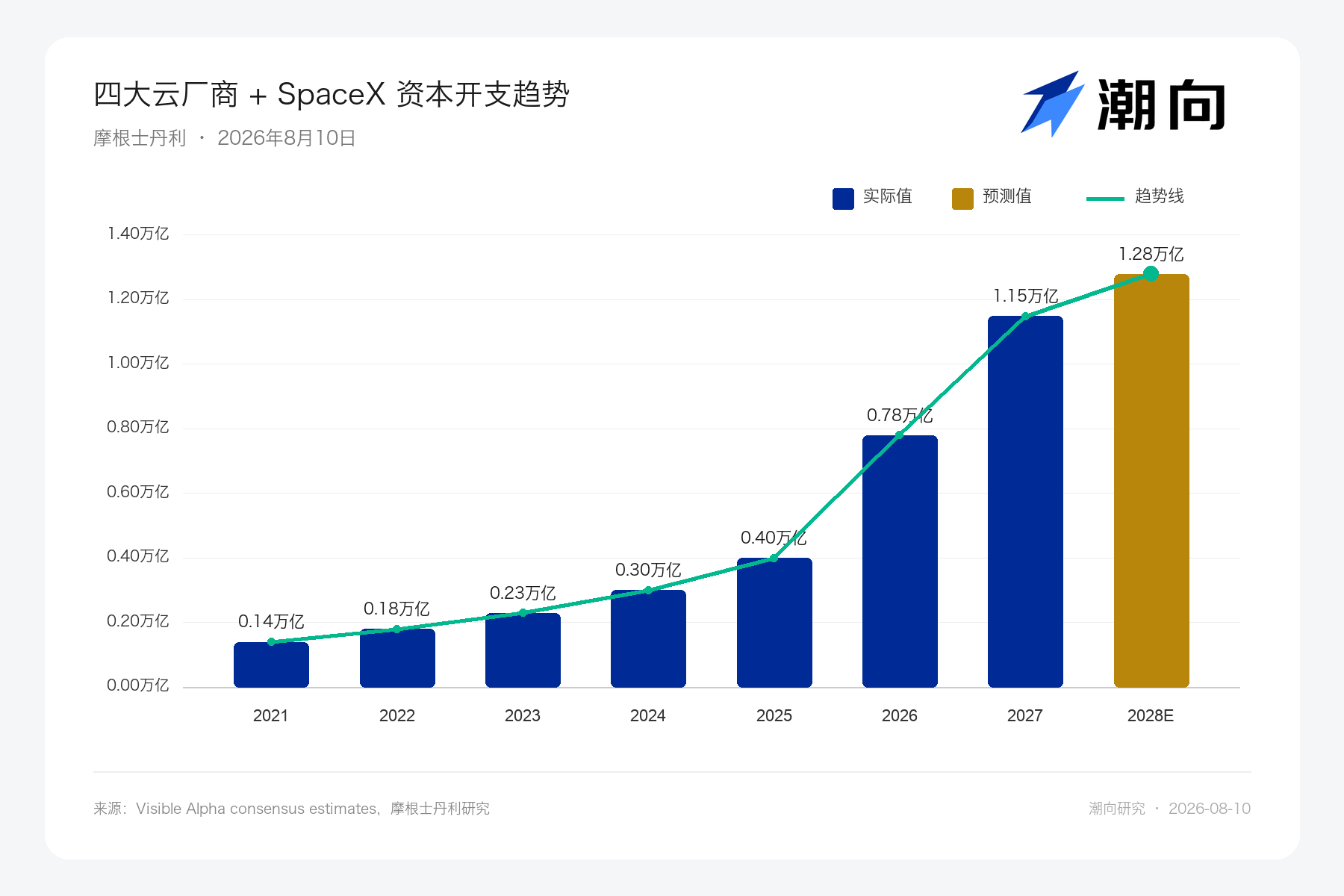
In the bank’s latest report, combined 2027 capex for Microsoft, Google, Amazon, Meta and SpaceX is projected to reach $1.15 trillion. That is 20% above the market’s July expectation and implies 47% year-over-year growth.
The report says the more important question is no longer whether 2027 estimates move up, but whether the market’s current 2028 growth assumption of 11% can hold.
Consensus estimates have already moved higher
Morgan Stanley’s European software and services team said in its weekly report that a broader and more fragmented model ecosystem is reinforcing demand for compute. Closed-source models, open-weight models and hybrid deployment setups all add to the need for computing power and storage, according to the report.
The bank said capex forecasts for hyperscalers will continue to face upward pressure. Since July, consensus 2027 estimates for the four cloud companies alone, excluding SpaceX, have already been raised by 20%.
Brian Nowak, Morgan Stanley’s head of Internet research, said in the report that the number of tokens processed each month is growing exponentially. He tied that to faster cloud revenue growth, larger data center commitments, and suppliers pointing to faster demand growth and longer visibility.
The forecast cited in the note is based on Visible Alpha consensus data as of Aug. 7, 2026. Morgan Stanley said it did not change its own model, but that consensus numbers themselves have been catching up with its view.
Open-weight models are not reducing compute demand
Morgan Stanley rejected the idea that open-source or open-weight models will dilute demand for compute tied to closed-source models.
In a separate report released this week, Stephen Byrd, Morgan Stanley’s head of Global Thematic and Sustainability Research, outlined three possible AI market structures: closed-source leaders win, a hybrid market emerges, or open-source reaches frontier-level performance. The bank said its current view sits between the second and third scenarios.
Its argument is that open-weight models increase competition and speed up AI adoption. The report links that dynamic to Jevons paradox, saying gains in efficiency can stimulate more total demand rather than less.
One data point highlighted in the report is that 60% of enterprises already use open-weight models in their technology stack, mainly in use cases that require speed, security or frequent calls. Those workloads still run on compute infrastructure. Lower inference costs, in Morgan Stanley’s framing, unlock more applications, which leads to more tokens and then more compute demand.
The bank used Wix and Thomson Reuters as examples. Wix’s in-house model sharply reduced AI inference costs, lifting non-GAAP gross margin from close to zero at the start of the year to about 60% in the second half. Thomson Reuters trained a proprietary model on less than 10% of its legal content and, according to the report, achieved performance comparable to frontier models at a much lower cost than third-party alternatives.
Morgan Stanley’s conclusion is that falling costs have not held back demand for compute. They have brought more business processes onto AI systems.
Spending signals are spreading through software and the supply chain
The bank said upward capex revisions are not an isolated event. Its research also covered software and services companies including SAP, IONOS and Legora. The thread running through those names is that AI infrastructure spending is moving from headline capex numbers at cloud providers into revenue guidance and demand signals across the broader ecosystem.
Morgan Stanley said cloud companies are expanding data center commitments while component suppliers are seeing longer demand visibility. That, in its view, is the micro foundation for further upward pressure on capex forecasts.
In Europe, the bank upgraded web hosting company IONOS to overweight this week. It cited customer growth momentum and pricing effects, and said group revenue growth could accelerate to about 8.6% in 2027. AI product innovation, including AI phone receptionist tools, was described as upside not yet fully reflected in current estimates.
The report also referenced an AI survey of SAP resellers. It said 33% of resellers reported that customers had already adopted paid AI products, while 53% said customers were still in pilot mode. Another 87% of resellers expect AI to increase customer spending on SAP over the next 12 months, and 80% said SAP’s AI migration tools would increase customers’ willingness to move to S/4HANA.
In Morgan Stanley’s reading, AI demand is no longer only a long-dated story for cloud providers. It is already showing up in reseller order expectations.
Why Morgan Stanley sees 2028 as the weaker part of the curve
The report’s central message is that even after the latest increase, the $1.15 trillion figure for 2027 may still be too low. Morgan Stanley pointed to faster cloud revenue growth, larger land and power commitments for data centers, and longer order visibility from supply-chain companies as facts that have already been validated rather than hypothetical assumptions.
On that basis, the bank argued that the market has become much more comfortable with 2027 growth, but may still be too conservative on 2028. Current consensus implies capex growth of 11% in 2028. Morgan Stanley said the support for that slowdown assumption does not look solid.
The report said cloud providers’ data center commitments already extend beyond 2028, while supply-chain visibility is lengthening as well. That is why the bank thinks the market may be underestimating 2028 growth.
Morgan Stanley also flagged a longer-term variable: what happens if open-source models reach frontier performance. In that scenario, compute costs would fall further and AI adoption could outpace today’s linear forecasts. If that happens, the $1.15 trillion capex figure projected for 2027 may look more like a midpoint than a ceiling.
Source note
This article is based on a summary and interpretation of a third-party broker research report from Morgan Stanley dated Aug. 10, 2026, alongside publicly available market information. The ratings, price targets, earnings forecasts and related judgments cited in the source material represent the views of Morgan Stanley analysts and their institution, not independent investment advice.
The original source also states that markets involve risk and investment decisions should be made independently. The material should not be used as the basis for buying or selling securities.