

Morgan Stanley said in its August 3, 2026 research report, Weighing In: Open-Weights Models & 3 States of the World, that open-weight AI models lower the cost of a single call and reduce deployment barriers, but do not necessarily reduce total compute demand. The report argues that as AI moves into more enterprises, workflows, and devices, usage growth could outpace efficiency gains and produce a classic Jevons paradox effect.
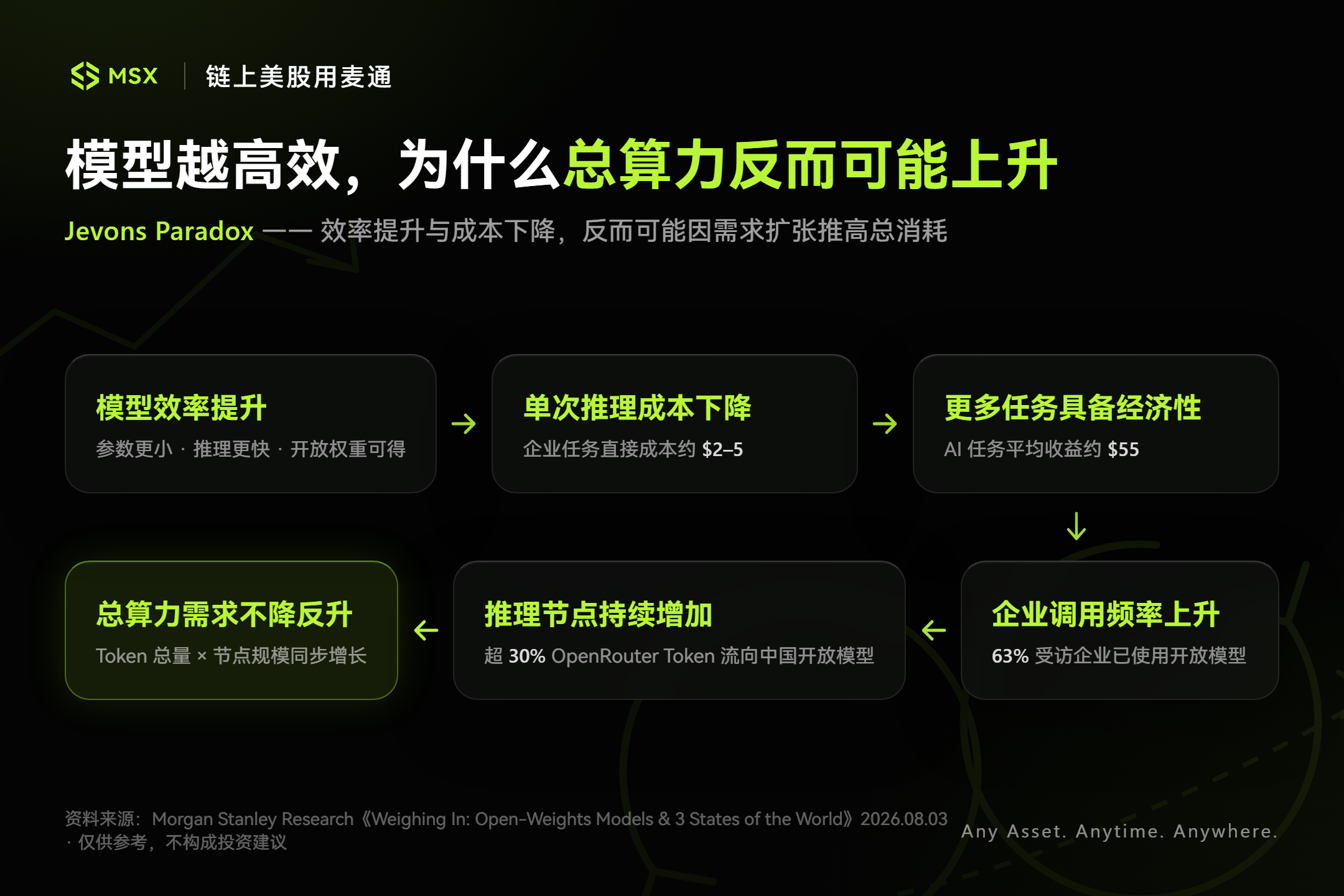
The bank framed the issue against a fresh round of market concern over “efficiency panic.” As model sizes shrink, inference gets cheaper, and some developers approach frontier-level performance with fewer chips, the market tends to jump to a familiar conclusion: if the same task needs less compute, then demand for GPUs, data centers, and power must eventually peak. Morgan Stanley took the opposite view. In its reading, better model efficiency may make AI cheap enough to enter use cases that previously did not justify the cost, lifting total call volume instead of shrinking infrastructure demand.
That discussion has resurfaced with the arrival of newer open-weight models such as Kimi K3 and the official version of DeepSeek V4 Flash. Morgan Stanley said these models are not only trying to narrow the capability gap with frontier closed systems, but also giving enterprises the option to download, modify, and deploy models on their own. In practice, that pushes AI capability beyond a small group of US model labs and into a wider base of developers and enterprise technology stacks.
Why cheaper models can still consume more compute
Morgan Stanley said one of the easiest mistakes in the open-weight debate is to assume that a lower model cost translates directly into lower infrastructure demand. For most enterprises, the adoption decision is not driven only by how much compute a single task consumes. It depends on whether the value created by that task covers the cost of the model, engineering work, and infrastructure around it.
The report cited estimates showing that an enterprise AI task generates about $55 in value on average, while direct cost runs at roughly $2 to $5. Even after accounting for data, engineering, security, and management costs, Morgan Stanley said that spread still suggests many enterprise workflows have not yet been “AI-ified.” In that setting, lower model prices are less likely to make companies spend less on AI than to push more tasks over the line of economic viability.
It listed examples where cheaper inference could widen deployment: customer service record classification, contract review, code testing, product descriptions, enterprise search, marketing materials, data cleaning, and internal approvals. The compute needed for each task may fall, but the number of tasks, frequency of execution, and number of users can all rise at the same time.
That is where the report repeatedly invoked Jevons paradox. When the efficiency of using a resource improves and the unit cost drops, wider adoption can drive total consumption higher. Morgan Stanley compared the pattern to fuel-efficient cars not eliminating global oil demand and cheaper bandwidth not reducing data traffic. By the same logic, more efficient models may not cut GPU usage. They may push AI from a narrow set of high-value tasks into a standard capability spread across the enterprise.
Enterprises are already in a multi-model phase
Morgan Stanley cited a McKinsey survey showing that 63% of respondent companies already use open models somewhere in their stack. Most have not abandoned closed systems. Instead, they mix the two. Open-weight models are used mainly for coding, document parsing, high-frequency calls, and domain-specific jobs, while frontier closed models still handle complex reasoning, work that demands higher reliability, and tasks that are harder to standardize.

The report also said that from February to July 2026, the share of tokens routed by US companies through OpenRouter to Chinese open models topped 30% at one point on a weekly basis. Morgan Stanley noted that the figure may skew toward developers and startups and does not directly represent large-enterprise spending, but said it still shows that open-weight models have moved beyond the lab and into real deployment and usage environments.
Still, “open” does not mean free. Enterprises that self-host may avoid token-based API fees paid to model providers, but they still have to buy or rent GPUs and cover spending on server rooms, cloud services, fine-tuning, engineering teams, security, and ongoing operations. Even when companies use hosted APIs from model vendors or cloud platforms to access open-weight models, they may still pay by token or by compute used.
For Morgan Stanley, the change is not whether compute costs exist. It is how enterprises pay for those costs and whether the value accrues to the model provider, the cloud platform, or the enterprise’s own infrastructure.
The report referenced an MIT study estimating that switching from closed models to open models could lower average prices by about 70% and save consumers about $25 billion per year. Morgan Stanley added an important caveat: the study was completed earlier, the capabilities of different models are not fully comparable, and the work may not have captured hidden costs tied to engineering, fine-tuning, and operations.
It also pointed to a Carnegie Mellon study showing that the payback period for self-building deployments with open models could range from about three months to six years. Smaller models with fixed tasks and high call frequency can amortize hardware costs more quickly. Large models and complex enterprise applications may struggle for a long time to prove they are cheaper than APIs because of low utilization, frequent updates, and high fine-tuning costs.
Morgan Stanley’s conclusion was that there is no single economic answer for open-weight models. It depends on model size, usage frequency, infrastructure utilization, enterprise engineering capacity, and whether data has to remain on premises. The more open the model, the more choices the enterprise has. It also carries more technical responsibility.
Where compute happens next
The report said that if AI remains dominated by a small group of closed models, training and inference will stay concentrated in large cloud platforms and hyperscale data centers. If open-weight models see broader adoption, compute does not disappear. It spreads outward from a few central nodes into private clouds, enterprise server rooms, sovereign data centers, edge servers, and personal devices.
That changes the key question for the market. Instead of asking only how many GPUs are needed, the more important questions become where those GPUs are deployed, who manages them, and how workloads are routed to them.

In the closed-model era, enterprises could outsource much of the complexity to model companies: connect to an API, pay by token, and leave model updates, infrastructure, safety alignment, and part of the legal burden to the provider. Morgan Stanley said that structure starts to break down in a multi-model world. A company may send its hardest tasks to frontier closed models, lower-cost high-frequency jobs to open-weight models, keep sensitive data local, run general workloads in the public cloud, process some requests in a data center, and execute others directly on PCs, smartphones, or other edge devices.
The more models there are and the more distributed deployment becomes, the more complex the enterprise AI stack gets. Morgan Stanley broke that stack into several layers.
- Gateway layer: a unified entry point to manage authentication, access rights, rate limits, logs, and failover across vendors.
- Routing layer: systems that assign each request to the best model based on accuracy, latency, cost, data sensitivity, and task difficulty.
- Orchestration layer: agentic workflows often require multiple models, databases, and external tools working together, with a single user request split into dozens of calls and steps.
- Observability and evaluation layer: enterprises have to keep tracking output quality, response times, token usage, operating cost, failure reasons, and security risk.
That is why Morgan Stanley does not see open-weight diffusion as a benefit only for model vendors. As foundation models become easier to access, enterprises may be more willing to pay for the systems needed to run them reliably in production. Model gateways, task routing, agent orchestration, data governance, observability, and security software could become parts of the value chain that are harder to compress.
Security stands out in the report. When closed models run in centralized environments, part of the responsibility sits with the labs and cloud operators. Once open models move into enterprise environments, private clouds, and edge devices, identity, data, endpoints, model weights, and runtime environments all have to be protected independently.
That means enterprises have to do more than stop staff from sending sensitive data to the wrong model. They also need controls over which databases each model can access, which tools it can call, and whether the system is exposed to prompt injection, model distillation, weight tampering, or abuse of permissions. The more distributed the deployment, the larger the attack surface. The more models involved, the higher the governance cost.
Morgan Stanley’s view is that open weights do not erase infrastructure value. They spread value away from a single foundation-model and API layer into a broader system stack. Future AI spending may show up not only in giant training clusters built by a few tech companies, but also in enterprise server purchases, network and storage upgrades, security deployments, private AI platforms, and stronger on-device compute in phones and PCs.
Three possible AI worlds
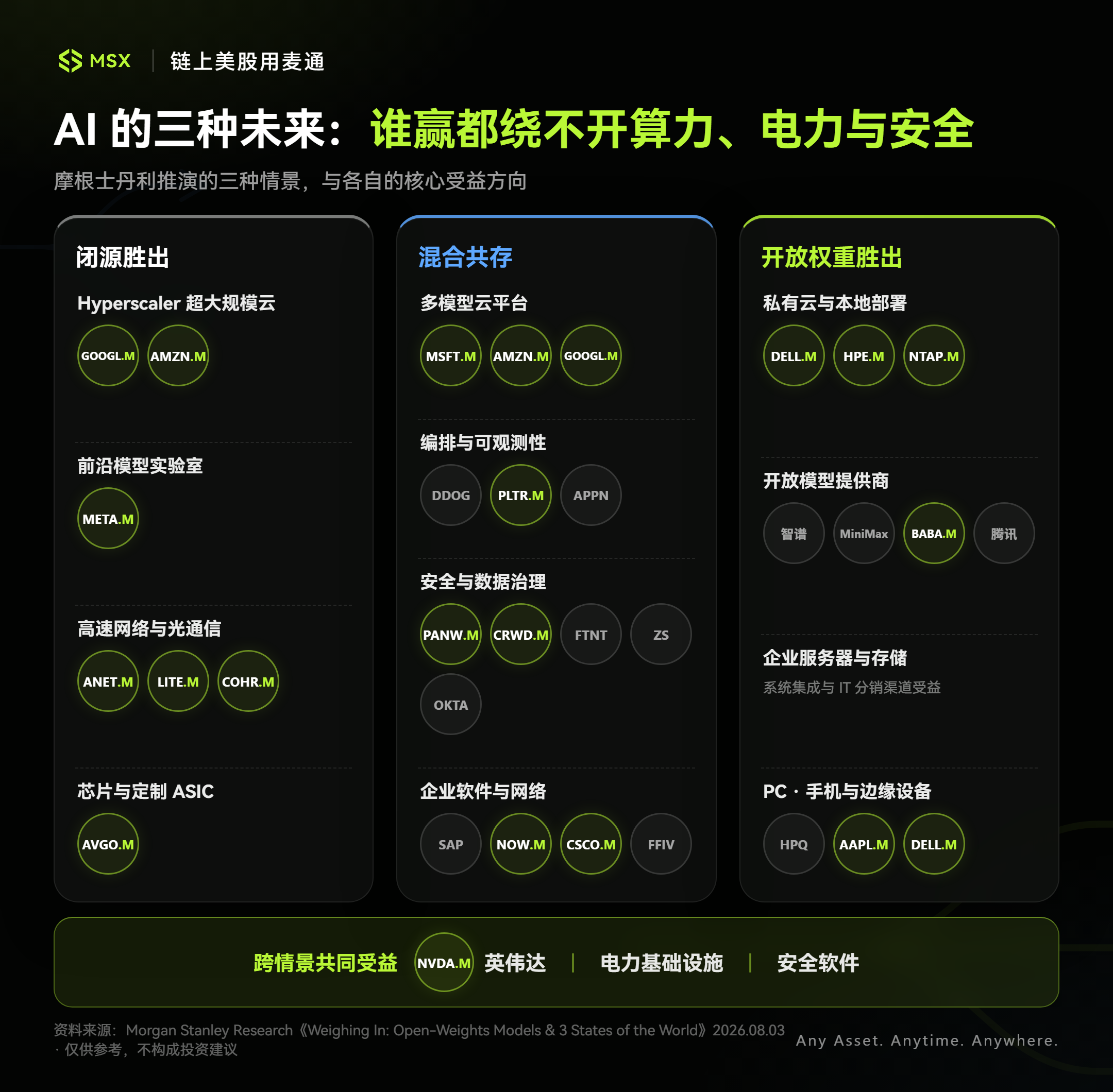
Morgan Stanley did not attach explicit probabilities to the scenarios it outlined. It instead modeled three different end states for the AI market: one where closed models remain dominant, one where open and closed architectures coexist, and one where open-weight models become the mainstream.
Scenario one: closed models keep the frontier
In the first scenario, frontier models remain difficult to replicate on performance, reliability, and safety. A small number of well-capitalized model labs stay ahead. Enterprises continue to pay for closed APIs and enterprise subscriptions because they value accuracy, ease of deployment, intellectual property indemnification, and trusted brands more than full control over model weights.
Under that setup, training and inference become even more concentrated in hyperscaler platforms such as Amazon Web Services and Google Cloud. Large training clusters keep driving demand for GPUs, high-speed networking, optical communications, and custom ASICs. Platforms with both cloud infrastructure and model capability, including Google and Amazon, are in a stronger position, while vendors such as Broadcom, Arista Networks, Lumentum, and Coherent could also benefit.
Morgan Stanley estimated that if Google runs the Gemini API on its own infrastructure with a leading model, illustrative return on invested capital could reach about 45%. Even if the model is not the clear leader and Google acts mainly as an infrastructure provider, the figure could still approach 30%. The point, the report said, is that the key asset in a closed-model world is not only the model itself but the ownership of the compute it runs on. Whoever owns the chips, data centers, and customer entry points has more room to keep the profit generated by model usage.
Scenario two: open and closed coexist for years
Morgan Stanley said this is the scenario that looks closest to how enterprises already operate. Frontier closed models handle complex reasoning, long-chain agent workflows, and jobs with high reliability requirements. Open-weight models and smaller models handle high-frequency, cost-sensitive, low-latency, or highly specialized work. Enterprises do not settle on one model. They switch and route continuously based on the task, which means AI runs across public clouds, private clouds, local infrastructure, and edge devices at the same time.
In that environment, no single model vendor is likely to secure fully monopolistic pricing power, but the overall software and infrastructure market for AI could see the broadest demand. Morgan Stanley listed Microsoft, Amazon, and Google as likely cloud beneficiaries; Datadog, Palantir, and Appian as possible beneficiaries in infrastructure and workflow software; Palo Alto Networks, CrowdStrike, Fortinet, Zscaler, Netskope, and Okta in security; and Cisco, F5, Dell, HPE, and NetApp across networking and enterprise infrastructure.
The investment implication of a hybrid architecture, in the report’s view, is that AI spending does not stay concentrated in training clusters. It diffuses through the enterprise stack layer by layer. And the more competitive the model layer becomes, the more companies need neutral software and infrastructure to help them move across models and deployment environments.
Scenario three: open-weight models become the mainstream
In the third scenario, open-weight models move close to frontier closed systems, foundation-model intelligence becomes widely available, and API prices fall sharply. Enterprises become less willing to pay large premiums for general-purpose model capability. Instead, they use private data for fine-tuning and direct more of their budgets to inference optimization, agents, industry tools, and application deployment.
Morgan Stanley said innovation would shift from pretraining toward post-training and the application layer, while infrastructure becomes more distributed. Governments and large enterprises may deploy more models in sovereign clouds, private data centers, and local environments because of data sovereignty, privacy, latency, and a desire to avoid vendor lock-in. Microsoft could gain a stronger position through Azure, GitHub, enterprise software, and its open-model ecosystem. The strategic value of open-model providers such as MiniMax, Zhipu/Z.ai, Alibaba, and Tencent could rise. Local infrastructure vendors such as Dell, HPE, and NetApp, device companies including HP and Apple, and systems integration and IT distribution channels could also see stronger demand.

Even here, Morgan Stanley did not say cloud platforms lose relevance. Most enterprises still will not build everything themselves, and open models may still run on Azure, AWS, or Google Cloud. In that setup, hyperscalers shift from being the only gatekeepers to serving as hosts for open models, providers of compute resources, data services, and enterprise AI platforms. The issue for cloud providers is not a simple win-or-lose outcome, but a change in profit mix. Foundation-model rents may come down while revenue from compute, storage, databases, security, and enterprise services still grows.
The names that show up across all three scenarios
Morgan Stanley said the most notable part of its asset matrix is not the companies tied to just one scenario, but the names that appear again and again across all three.
The first is NVIDIA. If closed models win, more compute stays concentrated in hyperscale training and inference clusters. If open weights win, inference spreads out across enterprise, local, and edge environments. The chip mix, customer mix, and cluster sizes may differ, but both paths still require more compute capacity. Open models lower the barrier to using a model. They do not remove the computing process itself.
The second is power. In a closed-model world, hyperscale data centers need stable gigawatt-scale electricity. In an open world, demand rises for enterprise data centers, sovereign clouds, and on-site inference facilities. Better model efficiency may lower the power use of a single task while also allowing more tasks and devices to run AI continuously. That is why companies tied to on-site power, natural gas, and energy infrastructure, including Bloom Energy, Williams, and Liberty Energy, appear repeatedly in the report.
The third is security software. Whether enterprises use closed or open models, they still need to protect identities, data, and applications. Once deployment spreads from a few cloud platforms to local and edge environments, security needs get more complex, not less. Morgan Stanley said security software may be one of the market’s underappreciated second-order beneficiaries of open-weight adoption.
What the report says open weights may actually pressure
Morgan Stanley closed with a broader point: what open-weight models may really weaken is not compute demand itself, but the assumption that the foundation-model layer can keep collecting very high rents for a long time. As model capability becomes more widely available, enterprises may spend less simply to access intelligence and more on deploying it, connecting it to data, managing workflows, protecting systems, and making sure it generates returns inside real business operations.
By that logic, compute demand does not simply move from growth into decline. It spreads from a small number of giant training clusters into more inference nodes, enterprise server rooms, sovereign clouds, and edge devices. It also shifts from a one-time race to train ever larger models into a longer cycle of infrastructure spending that touches more enterprise workflows. In Morgan Stanley’s framing, open weights do not signal the end of the AI capex cycle. They signal a new phase with more participants, more distributed deployment, and a longer value chain.