
Morgan Stanley chief U.S. equity strategist Michael Wilson has delivered a clear message to clients in his latest weekly report: reduce exposure to semiconductors and rotate into hyperscalers. Wilson stressed that this is not a bearish call on AI. Instead, he framed it as another internal rotation within the AI investment cycle. Since ChatGPT was released in November 2022, he said, the market has already gone through three similar mid-cycle resets, and the current shift would mark the fourth.
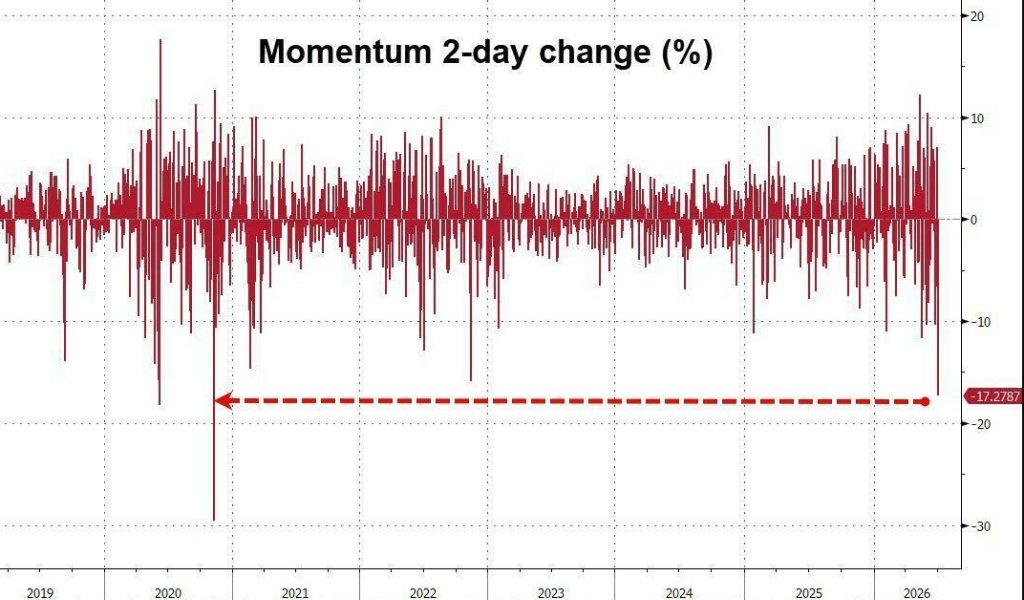
The report said semiconductor stocks have started to cool after a historic run-up since late March. Morgan Stanley’s high-beta momentum basket, which includes memory and chip names, logged its biggest two-day decline since the Covid period. In Wilson’s view, that pullback may still have room to continue. His broader argument is that market leadership should now spread beyond the most direct beneficiaries of AI capital spending and into a wider set of sectors.
Memory is seen as the most exposed pocket of the semiconductor trade
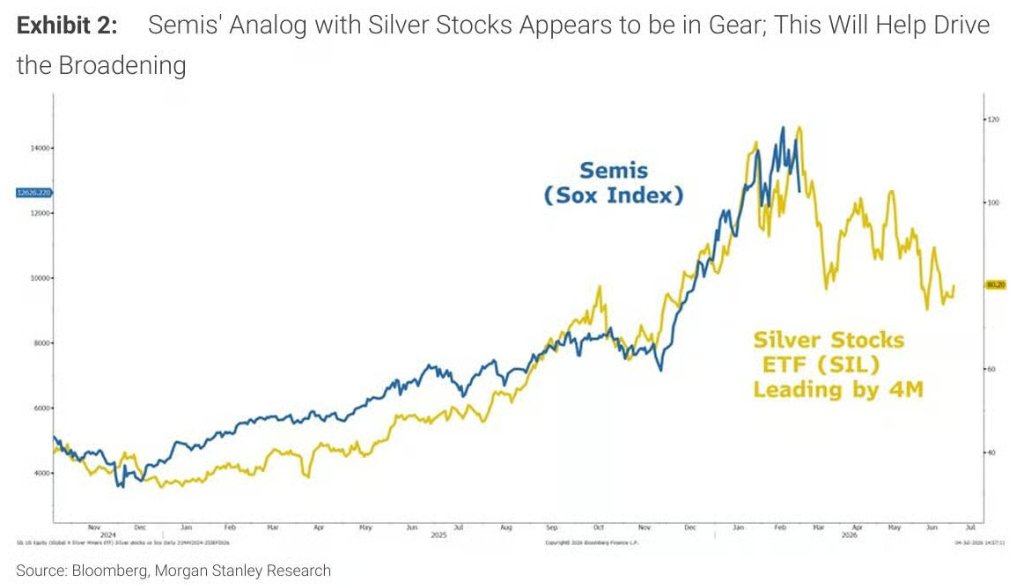
Wilson compared the recent setup in semiconductors to silver. He argued that both assets went through parabolic price appreciation and both have strong ties to commodity-style market behavior, where swings are often sharp and reversals can come quickly. Morgan Stanley first introduced that analogy in early June, and Wilson now says the comparison is increasingly playing out.
Within the semiconductor complex, he identified memory as the most vulnerable area. The reasoning is that memory behaves more like a commodity than other chip segments, making its prices more sensitive on the way up and more fragile when sentiment turns. After Micron reported earnings, semiconductor shares weakened noticeably. Wilson said that reaction suggested investors are now focused on whether the peak rate of earnings revisions has already passed.
Meta’s capacity sale announcement became the immediate catalyst
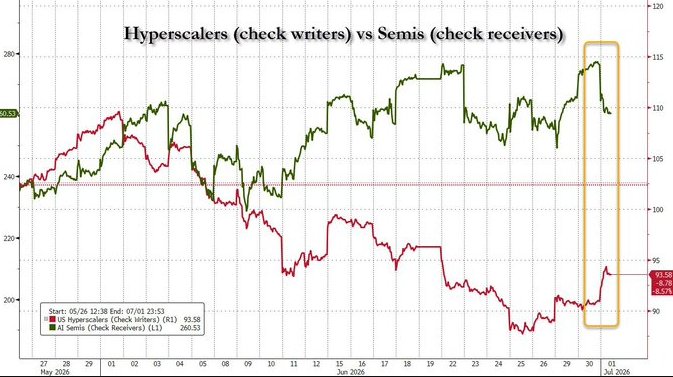
The direct trigger for the latest rotation, according to Wilson, was Meta’s announcement last week that it would begin selling excess computing capacity to outside customers. To Morgan Stanley, that move sent an important signal: the growth rate of hyperscaler capital expenditure may be nearing an interim inflection point.
Wilson wrote that the performance gap between hyperscalers such as Microsoft, Google, Amazon, and Meta, on one side, and semiconductor stocks on the other, had become too wide to be sustainable. Chip demand ultimately depends on cloud companies’ willingness to keep investing. Historically, when that divergence becomes extreme, mean reversion tends to follow. Either hyperscalers temper capex guidance, or the market starts to reprice semiconductor expectations. Meta’s latest action, in his view, provided exactly the kind of justification that can spark such a reset.
At the same time, Wilson was careful to say this does not mean the AI capex cycle is over. What he sees topping out is the rate of change in revisions, not the broader AI spending cycle itself. In other words, AI remains a live theme, but leadership inside the trade is beginning to shift.
Why Morgan Stanley prefers cloud over chips now
Wilson’s case for hyperscalers rests on three main pillars. First, their core businesses remain resilient and are not entirely dependent on the AI capex narrative. Second, he believes they hold an underappreciated strategic advantage in building and commercializing the agentic application layer. Third, he sees meaningful cost-cutting leverage that the market is not fully pricing in.
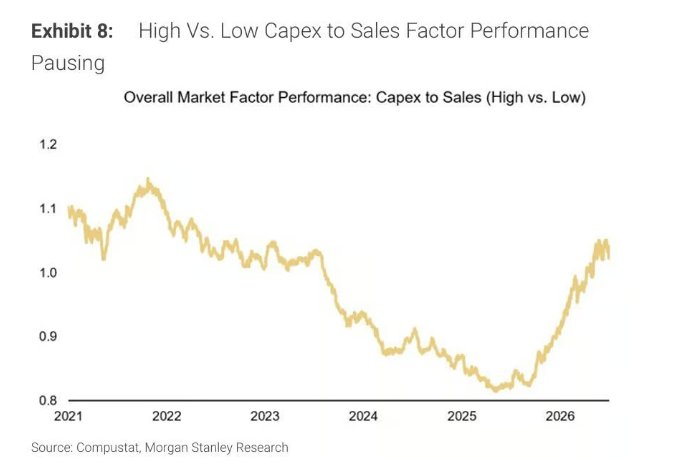
Morgan Stanley also noted that its “high capex-to-sales” factor, which performed strongly over the past year, is now showing signs of peaking. In Wilson’s framework, hyperscalers have already gone through a period of relative underperformance and may have absorbed much of that pressure. Semiconductor names, by contrast, may only be at the beginning of a more difficult repricing process.
The broadening trade extends beyond cloud
Wilson’s call is not limited to hyperscalers. Within his broader market broadening framework, he highlighted several other preferred areas. His top pick is consumer discretionary. The logic is that spending is shifting from services back toward goods, pricing is improving in goods categories, and earnings-per-share revisions remain supportive. He described it as the most compelling expression of the broadening earnings story.
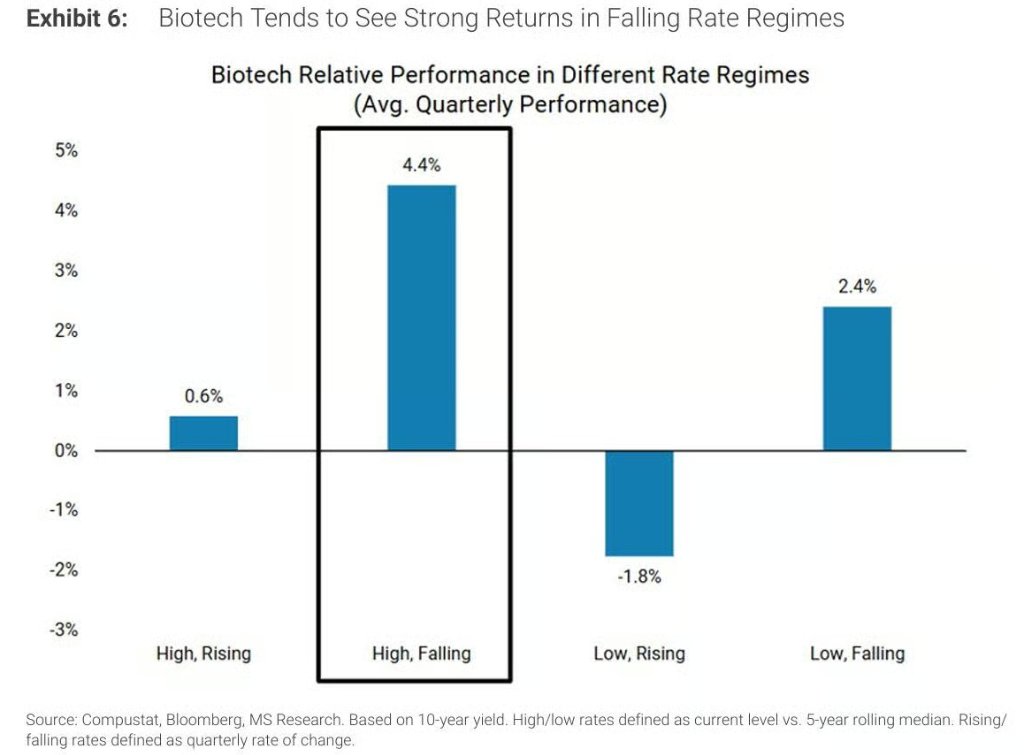
He also pointed to regional banks, transports, and biotech. Transports are seen as direct beneficiaries of a new expansion phase in the economy. Biotech, meanwhile, stands out as a rate-sensitive sector. Wilson cited historical data suggesting biotech has delivered annualized returns near 20% in environments where rates are high but falling. He added that a strengthening M&A cycle could provide another catalyst for the group.
Falling oil and a less hawkish rates backdrop support the rotation
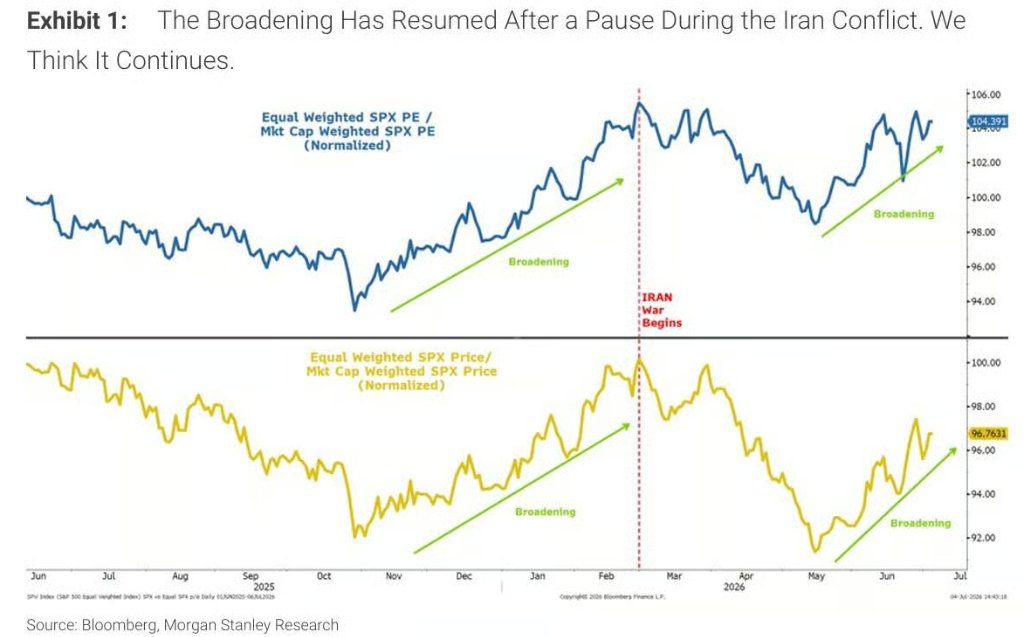
Wilson originally outlined this “broadening trade” in Morgan Stanley’s annual outlook published in November 2025. The core thesis was that the U.S. economy had completed a rolling recession by April 2025 and was entering a new expansion phase, setting up earnings growth to beat expectations. That view was interrupted in February 2026 by the Iran war, which pushed oil prices higher and led markets to reprice the path of Fed tightening. As a result, broadening trades stalled and semiconductor stocks regained leadership through the AI compute narrative.
Now, Wilson argues, the conditions have improved again. Oil prices have fallen, inflation expectations have stabilized, and that combination creates better support for rotation. In his base case, lower energy prices, a peak in tariff-related inflation, and manageable services and housing inflation should allow the Federal Reserve to keep rates unchanged this year rather than hike further.
He also said the bond market is still pricing in around 1.5 rate hikes before the first quarter of next year. In his view, that is too hawkish. If those expectations are revised lower, equities could receive a positive surprise. Wilson further cited comments from Fed Chair Warsh at Sintra that inflation risks have eased, alongside weaker-than-expected nonfarm payrolls data last week, as factors that could help bring down hawkish rate pricing and reinforce the broadening trade.
Morgan Stanley’s conclusion: rotation, not the end of AI leadership
Wilson closed the report by arguing that the market is moving into a period where major indexes consolidate while leadership broadens under the surface. Over the past several years, the winning areas inside the AI trade have already rotated multiple times. He sees the current shift as simply the next step in that process: away from semiconductors and toward hyperscalers, with further participation from consumer discretionary, regional banks, transports, and biotech.
In his reading, the post-Micron underperformance in semiconductor shares made the peak in the rate of revisions a central market issue. Meta’s surprise decision to sell excess capacity then reinforced that view. If the high capex-to-sales factor continues to consolidate, expectations for softer hyperscaler capex guidance could build further, adding momentum to a broader reallocation within U.S. equities.