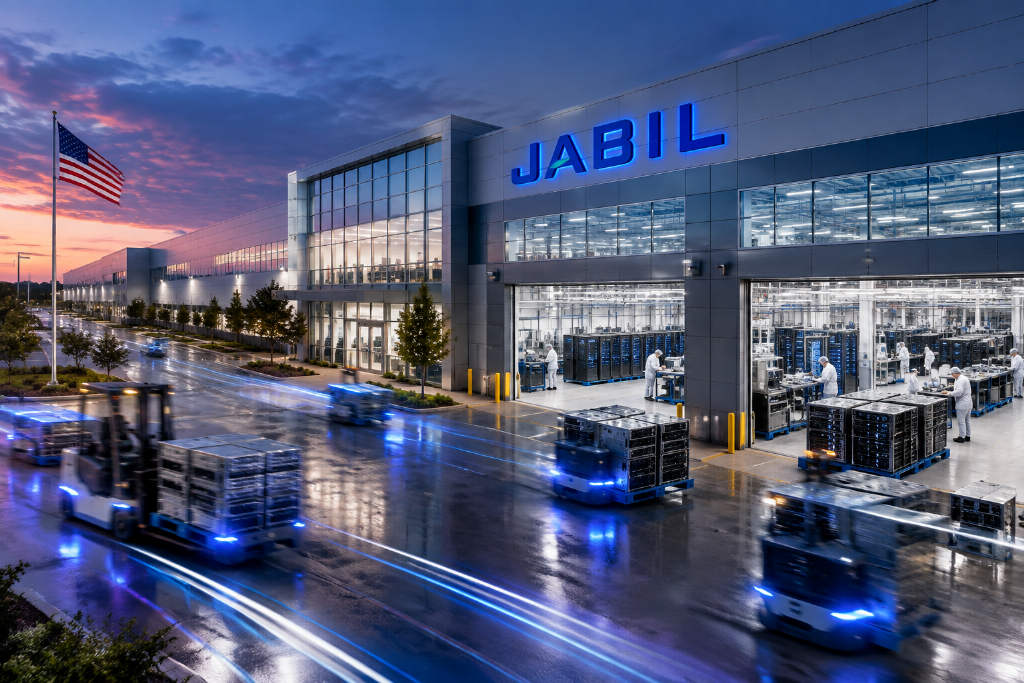
Jabil2026-09-29 09:45:00Jabil earnings preview: 2027 guidance, not Q4 numbers, is the real test for its AI data center storyJabil Inc. is set to report fiscal 2026 fourth-quarter and full-year results before the U.S. market opens on Sept. 30, 2026, followed by what the company has framed as an annual investor briefing. That framing matters. Investors already have a fairly tight range for the quarter, with management guiding for revenue of $9.2 billion to $10.0 billion and core EPS of $3.80 to $4.20, while consensus sits near the upper half of that band. The bigger question is what management says about fiscal 2027. The company has become a key supplier in the AI data center hardware chain, and management said on its June third-quarter call that AI-related revenue for fiscal 2026 should reach about $13.6 billion, up roughly 50% from $9.0 billion in fiscal 2025. That would put AI-related business at close to 40% of Jabil’s expected full-year revenue of about $35 billion. Even so, the stock has pulled back from its June peak. As of Sept. 24, JBL traded at $310.13, within a 52-week range of $189.60 to $428.93. The coming guidance will be judged on three fronts: whether core operating margin can move above 6% in fiscal 2027, how large AI-related revenue can get on a much bigger base, and whether capital spending can stay within the company’s prior 1.5% to 2% of revenue framework while new capacity ramps in North Carolina, Memphis, India, and Mexico.150
Goldman Sachs2026-09-25 22:13:57Goldman Sachs says hyperscalers need unprecedented revenue growth to justify AI spendingGoldman Sachs said in an analysis report that massive capital spending by hyperscale technology companies on artificial intelligence could reshape investment norms across the tech sector. The report said those companies will need to deliver unprecedented revenue growth to justify AI-related capital expenditures that could reach as much as $1.7 trillion. The item was published by Techub, which cited Crypto Briefing as the source. The report centers on whether future business performance can support the scale of spending now being directed toward AI infrastructure and related buildout. No additional financial details were provided in the brief.250
Serenity2026-08-31 10:23:31Serenity says Celestial could have been valued at $6 billion to $10 billion as a standalone U.S.-listed companySerenity said on Aug. 31 that Celestial, which has already been acquired by Marvell, might have commanded a valuation of $6 billion to $10 billion if it had remained independent and listed in the U.S. market. The argument rests on Celestial’s earlier revenue outlook, which projected $500 million in 2028 on a fourth-quarter annualized basis and $1 billion in 2029, as well as its role as a core participant in co-packaged optics, or CPO, projects for hyperscale cloud customers. Serenity contrasted that with Celestial’s reported financial profile in the second quarter of 2026, when revenue was close to zero and quarterly losses were about $12.5 million. Marvell had also said the company’s post-acquisition contribution to revenue and profit was not material. Serenity argued that judging Celestial only by quarterly price-to-sales metrics and near-term losses could lead the market to treat it like a “worthless meme stock,” while a valuation framework centered on qualification cycles and large-scale commercialization opportunities in 2028 would point to a much higher figure.860
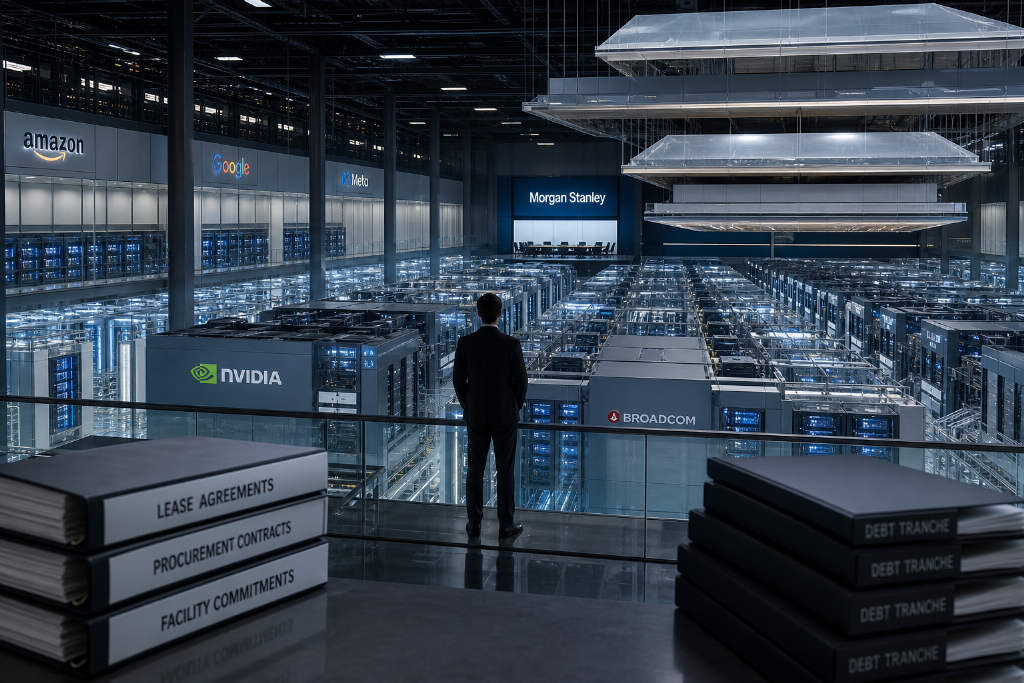
Morgan Stanle2026-08-26 07:34:47Morgan Stanley says off-balance-sheet commitments are becoming central to AI compute financeA Morgan Stanley research note, cited by Chaoxiang Research and reported by ChainCatcher, says disclosed off-balance-sheet commitments from hyperscalers, Nvidia and Broadcom have climbed past $3.1 trillion. The total includes $1.1 trillion in lease commitments and $1.7 trillion in purchase commitments, while on-balance-sheet debt and lease liabilities at hyperscalers stand at a combined $770 billion. The note also points to mounting pressure on cash generation. Amazon and Google had negative free cash flow in the second quarter of 2026, and Meta is expected to follow in the next quarter. Morgan Stanley argues that financing tools are reshaping the capital structure behind AI compute through six channels, including off-balance-sheet leasing and purchase commitments, a rise in debt issuance share from 2% in 2025 to 19% in 2026, and Google freeing up $110 billion by cutting buybacks and issuing equity. The report also highlights Oracle’s $4.6 billion in customer prepayments in the second quarter and chip-leasing SPVs launched by Broadcom and Nvidia to support unrated AI labs. Morgan Stanley’s conclusion is that changes in financing structures and accounting judgments now matter almost as much as chip shipment volumes in tracking the AI supply chain.1630
Nvidia2026-08-19 06:41:30Ben Thompson says Nvidia’s financing tactics cut into profits as easing power constraints weaken its moatBen Thompson, founder of Stratechery, argued in a recent interview that Nvidia’s exceptional profitability may be less durable than it appears as the AI spending cycle enters a more contested phase. His view centers on two pressure points. First, he said Nvidia has supported newer cloud providers, or “Neoclouds,” through equity stakes and roughly 25% backstops tied to commitments to keep buying Nvidia compute through 2030. That may help sustain GPU shipments, but Thompson said the risk does not disappear; it shifts back onto Nvidia if compute demand weakens or those buyers cannot keep purchasing. In his framing, that amounts to a hidden reduction in profit and functions like an indirect price cut. Second, Thompson said Nvidia’s energy-efficiency edge matters most when power is scarce. He argued that unexpectedly resilient U.S. electricity supply over the past two years — including natural gas generation in West Texas, restarted nuclear plants, and grid-related deployments by Elon Musk — gives hyperscalers such as Amazon and Google more time to improve in-house chips like Trainium and TPU. That, in turn, could erode Nvidia’s technical moat. Even if the current AI boom ends in oversupply and a market correction, Thompson said the resulting buildout of power infrastructure may still become the most durable legacy of the cycle.1150
Nvidia2026-08-13 09:57:55VC partner says Nvidia is becoming a “synthetic hyperscaler” in the AI compute stackAltimeter Capital partner Clark Tang argues that Nvidia is no longer just a chip supplier to the AI industry. In his view, the company has been building the two pillars that historically defined hyperscalers: an operating layer that abstracts and manages infrastructure, and a financing layer that funds capacity ahead of demand. Tang says this combination is turning Nvidia into a “synthetic hyperscaler,” one that is starting to displace Amazon, Microsoft, and Google in parts of the AI compute supply chain. His thesis begins with a shift in infrastructure economics. Traditional hyperscalers built strong margins by converting enterprise capex into opex and using software to maximize utilization of shared hardware. Tang says AI workloads break that model. Large-scale training depends on tightly synchronized GPU clusters, while inference is highly sensitive to tokens per watt and time to first token. In that setup, virtualization and networking layers that worked well in the cloud era can become a drag on GPU performance. He also points to the rise of neocloud providers, which offer lower-margin, AI-focused infrastructure but often lack the balance sheet strength to finance aggressive buildouts. Tang says Nvidia has moved to close that gap with software such as DSX OS, Mission Control, Omniverse, and Dynamo, while also standardizing hardware and bringing in third-party capital from firms including Apollo, BlackRock, Blackstone, Goldman Sachs, and KKR.1320
NVIDIA2026-08-12 10:19:04NVIDIA shifts toward a broader customer base as hyperscaler concentration risk comes into focusNVIDIA is moving to reduce its dependence on hyperscalers as large cloud companies push to diversify away from a single AI chip supplier, according to recent analysis from investor and researcher Evergreen Capital. The firm argues that CEO Jensen Huang has been signaling that shift for months, highlighted by his repeated use of the word “diverse” during the company’s earnings call after May results. Evergreen reads that language as a deliberate repositioning: away from being seen mainly as a chip vendor tied to hyperscaler orders, and toward becoming an AI systems platform serving a wider range of customers. In a follow-up note about three months later, Evergreen said NVIDIA’s actions are starting to match that narrative. It pointed to SPCX transactions and a GPU financing program designed to expand access to compute for smaller enterprises and emerging AI companies, while lowering revenue concentration tied to hyperscalers. The analysis also says non-hyperscaler enterprise AI compute already accounts for about half of NVIDIA’s revenue, with analysts expecting that share to exceed 70% in the next few years. If that mix shift holds, Evergreen believes the market could reassess NVIDIA with a different valuation framework.1650
UBS2026-08-02 01:22:42UBS says storage could take 73% of hyperscaler capex by 2027, reaching $761.3 billionUBS said spending on storage is rising quickly as demand from AI GPU vendors and hyperscale cloud providers accelerates and average selling prices for storage products move higher. The bank estimates that the world’s top 11 hyperscale cloud service providers will spend a combined $1.0403 trillion in capital expenditures in 2027, with $761.3 billion of that going to storage, lifting storage’s share to 73%. UBS also outlined a steep climb in overall capex and storage spending over the next two years. Total capex is projected to rise from $504 billion in 2025 to $873.9 billion in 2026 and then to $1.0403 trillion in 2027. Over the same period, storage spending is expected to jump from $72.8 billion to $335.7 billion and then to $761.3 billion, with year-over-year growth of 361% in 2026 and 127% in 2027. By product, UBS expects HBM, DDR and NAND spending all to increase sharply, while average prices per Gb or GB also move up. The bank added that storage makers will need to expand capacity to meet demand, though fab space, equipment delivery times and labor constraints remain major bottlenecks.2090