

NYSE Arca approved Morgan Stanley’s spot Solana and Ethereum exchange-traded funds on July 24, 2026. In the source article’s framing, the decision goes well beyond a routine product launch: it is described as both the first time a top Wall Street investment bank has issued a non-Bitcoin crypto ETF and the first time U.S. regulators have allowed native public-chain staking to be embedded at scale in a tightly regulated spot ETF structure.
The article says Morgan Stanley brought prior operating experience from its spot Bitcoin ETF, MSBT, which it lists at about $392 million in assets under management. Against a U.S. spot Bitcoin ETF market that the article sizes at $80.9 billion, the approval of the two new funds raises a broader question: what happens to crypto ETF pricing once these products stop being purely passive price-tracking vehicles and begin producing base-level cash flow?
Lower fees are only part of the story
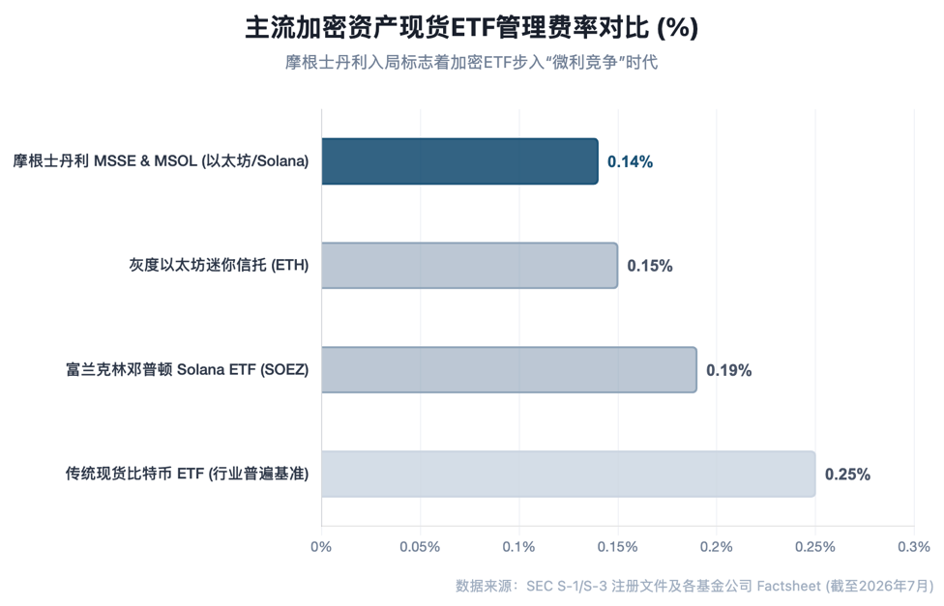
On pricing, Morgan Stanley set the management fee for both new ETFs at 0.14%, a level the article characterizes as clearly below the market average and a sign that crypto ETFs are moving into a low-margin competition phase.
The source compares that fee with Grayscale’s mini Ethereum trust at 0.15%, Franklin Templeton’s Solana ETF SOEZ at 0.19%, and the 0.20% to 0.25% range commonly seen across traditional spot Bitcoin ETFs. As fee bands move lower, the article argues, products built only around passive price tracking will have a harder time sustaining higher margins, pushing issuers to compete for liquidity while searching for more structural forms of differentiation.
In the article’s view, fee compression is a defensive move. The real competitive edge comes from bringing staking into a compliant fund wrapper.
Staking is written directly into the filing
According to the source, Morgan Stanley’s S-1 registration statement with the U.S. Securities and Exchange Commission says the Ethereum trust plans to stake 50% to 80% of its ETH holdings, while the Solana trust may allocate as much as 100% of its SOL holdings to network validation.
For execution, the funds are set to work with node service providers including Figment and Coinbase Canada. The article states that operators will take 5% of staking rewards as a service fee. It describes this arrangement as effectively placing staking rights into a trust structure so institutional capital can access blockchain-native staking income through a regulated channel.
If most of those rewards flow through into fund net asset value, the source argues, the asset class starts to look different. It cites baseline annual staking yields of about 2.7% for Ethereum and roughly 5% to 7% for Solana. After subtracting the 5% node service fee and the 0.14% ETF management fee, the article estimates net annual incremental yield of about 2.4% for ETH and 5% for SOL on the portion of assets that is staked. In that framing, these ETFs combine upside price exposure with a recurring income component.
Fund flows are no longer centered only on Bitcoin
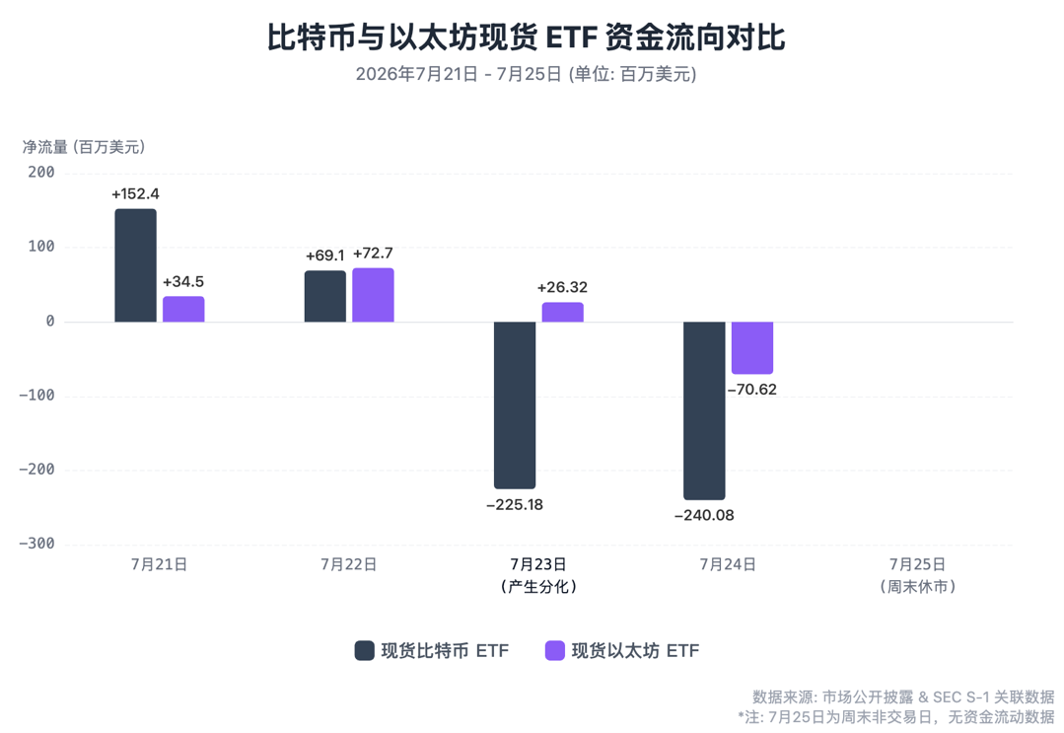
The report presents the market impact as a move from Bitcoin dominance to multi-asset diversification. It points to flow data from July 23, when spot Bitcoin ETFs posted a single-day net outflow of $225 million, while Ethereum ETFs recorded a net inflow of $26.32 million on the same day.
For the author, that split signals a broader change in institutional behavior. As the menu of compliant crypto products expands, professional capital is described as smoothing risk exposure and shifting away from a single Bitcoin position toward more diversified crypto portfolios.
The article also argues that Morgan Stanley’s move into Solana removes a legal and practical barrier for mainstream public-chain assets entering compliant balance-sheet allocation. It notes that Solana had lacked a spot investment vehicle in the U.S. backed by a top-tier traditional financial institution. Bitwise’s BSOL had already tested the market and, according to the article, currently manages about $600 million. But Morgan Stanley’s entry is presented as materially different. In that reading, SEC approval of a spot Solana ETF amounts to a deeper regulatory endorsement of non-Bitcoin crypto assets as eligible compliant investment targets.
Staking may be turning into a standard ETF feature
The article places special emphasis on the regulatory shift. Morgan Stanley openly disclosed a high staking ratio, ranging from 50% to 100% depending on the product, and the SEC still allowed the filings to proceed. The source interprets that as a sign that the policy debate has moved away from whether staking can be allowed at all and toward how it should be disclosed and standardized.
From there, the article argues that staking could move from an optional product feature to a required one in competitive terms. In its view, Ethereum or Solana ETFs without an internal yield layer could become less attractive to institutions focused on capital efficiency.
Three takeaways for institutions and investors
1. Basis trades may need new assumptions
The report says spot ETFs with staking income will reshape the microstructure of Ethereum and Solana markets. In a conventional basis trade, where an investor buys spot or an ETF and shorts futures, staking income now becomes part of the opportunity-cost calculation.
If the ETF can produce a stable 3% to 7% annual return, the futures premium has to widen enough to compensate for that foregone yield before arbitrage capital steps in. The article also says that if the products are rolled out across Morgan Stanley’s brokerage network, including E*TRADE, fresh inflows could tighten bid-ask spreads. Taken together, better liquidity and a changing basis structure would force high-frequency and quantitative desks to recalibrate their models.
2. Allocation shifts from pure exposure to yield enhancement
For high-net-worth clients and institutions looking for crypto exposure, the article says an ETF with built-in staking is no longer just a speculative wrapper. Instead, it offers a combination of beta exposure and internally generated cash flow.
The source argues that, under the same volatility assumptions, an asset that can distribute periodic income may deliver better risk-adjusted returns than a spot Bitcoin ETF that only tracks price. On that basis, some capital focused on efficiency and holding-period absolute return may gradually move out of pure Bitcoin products and into these yield-enhanced crypto ETFs.
3. Tail risks remain at the protocol level
The report also warns that the income feature does not come without trade-offs. Investors still face protocol-level tail risks, including validator failure, slashing that can reduce principal, and delays in unstaking during stressed market conditions.
It highlights Solana in particular, saying the network’s historical volatility and outage frequency have objectively been higher than Ethereum’s. In the article’s analysis, a staking yield near 7% should be viewed as compensation for bearing higher network risk. Before taking concentrated positions, it says those non-systematic risks need to be included in stress testing for extreme market scenarios.
The business logic of crypto ETFs is changing
The article’s closing argument is that Morgan Stanley’s entry with a staking-based income mechanism does more than add two new products to the shelf. It changes the business logic underneath the asset class. Instead of an ETF that mainly offers price exposure, a staked ETH or SOL fund adds a second return layer in the form of native network income.
In the source’s assessment, that “beta exposure plus internal cash flow” model could move institutional crypto investing beyond pure price speculation and closer to an asset-management framework built around operating yield. At the same time, the article says products without income-generating capacity may face stronger competitive pressure, while slashing risk and network outages remain hard limits that investors still have to price in.