
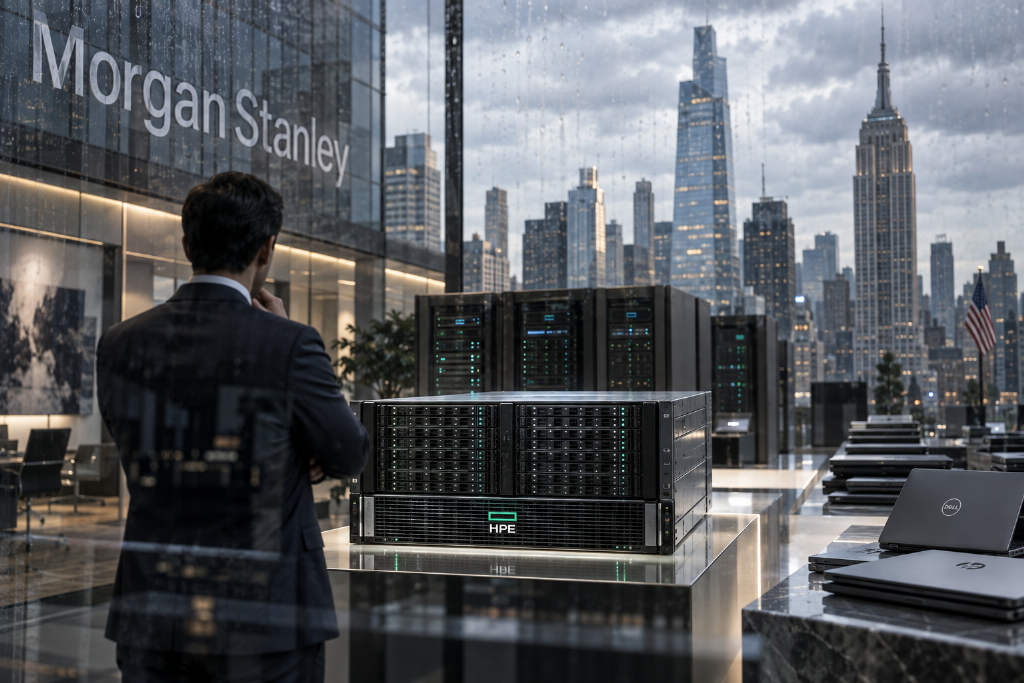
In a Sept. 21, 2026 IT hardware report, Morgan Stanley said enterprise hardware spending was strong across the board in the second quarter. But the argument has changed. It’s not about whether spending is healthy anymore, the bank said. It’s about how much longer this cycle can last.

The core view is simple. Storage is still early in the upcycle. The server cycle is further along. PCs, though, have already weakened fast. On stock picks, Morgan Stanley said it likes P and SNX the most, with HPE next. It kept an Equal-weight rating on Dell and an Underweight rating on HPQ. TechFlowPost said the report was compiled and interpreted by Trend Research, and that every rating, price target, earnings forecast, and related opinion mentioned in the article reflects Morgan Stanley analysts’ views, not investment advice.
Enterprise hardware spending stayed strong in the second quarter
Morgan Stanley said second-quarter spending was broadly strong across enterprise hardware. Traditional server revenue jumped 87% year over year, storage rose 34% after growing 23% in the first quarter, and PC revenue increased 14%. The bank said those growth rates were the strongest seen in more than a decade outside the pandemic window.
Still, the market has already started looking past that near-term strength. Of the eight enterprise OEM, VAR, and distributor stocks Morgan Stanley follows, six were trading at lower valuation multiples after earnings than before earnings, even though consensus EPS for the next fiscal year was revised up by an average 12%. On average, P/E multiples compressed by about one turn.
Morgan Stanley’s AlphaWise survey suggested the current strength is mostly cyclical. Normal refresh activity. Early buying by large enterprises. That’s the main story, while most AI workloads are still staying in the cloud. On-prem AI buildouts are growing, but they are still the minority model, and the share of on-prem AI workloads is expected to fall by 3 percentage points over the next year. Even so, the bank said Dell and HPE can still benefit from ongoing on-prem AI demand, which it called an extra factor behind their continued post-earnings stock outperformance.
Storage is viewed as the longest runway
The report says storage growth is speeding up and is still early in the upcycle. Servers are further along. PCs, by comparison, have already seen much of the opportunity come and go. Of those three areas, Morgan Stanley sees storage as having the longest runway.
It said P recorded the biggest increase in exabyte shipment share in second-quarter external OEM storage data, while its gain in revenue share ranked behind only Dell. Against NTAP, P has gentler pricing and better product efficiency, and enterprises are giving more new storage projects to P.
Morgan Stanley repeated its Overweight rating on P and set a $119 price target. The bank said the stock trades at about 29x earnings, roughly 14% below its three-year average, while enterprise OEM peers are trading more than two standard deviations above their historical average valuations. Morgan Stanley’s view: the market is not giving enough credit to P’s earnings revision potential, especially with record growth and new hyperscale customer orders coming in.
It highlighted the Sept. 23 analyst day as a major catalyst. The number that matters most is long-term operating margin guidance. A low-20% operating margin would disappoint. Mid-20% would be about in line. Mid-to-high-20% would count as a positive surprise, the report said.
Traditional server margin stacking has reached an unprecedented level
Morgan Stanley said margin stacking in traditional servers has climbed to a level never seen before, and both Dell and HPE are cashing in. Dell is the clearest example. Low-margin AI servers rose to 52% of ISG revenue from 49% a year earlier, yet ISG gross margin still expanded 200 basis points year over year to 23.6%.
By Morgan Stanley’s estimates, traditional server gross margin at Dell moved above 30% for the first time, about 9 percentage points higher than a year earlier, even as AI server and storage gross margins also went up. And this happened while NAND and DRAM prices surged 340% to 550% year over year, despite those two components historically making up about 40% of a traditional server bill of materials.
The report said Dell and HPE are repricing hard. Tight supply. Richer configurations. Inelastic demand. Put together, those factors have widened the gap between pricing and cost far beyond old norms. Morgan Stanley estimated that if Dell’s F1Q27 server units, ASP, and revenue stayed flat but traditional server gross margin fell back to the low-20% range, F1H27 EPS would be 13% lower, at about $1.52. It also estimated that around $3.75 of Dell’s FY27 EPS is coming from traditional server margin stacking.
As long as memory prices keep rising and supply stays tight, the bank said, this margin stack probably will not unwind quickly. It raised Dell’s FY27 and FY28 traditional server gross margin forecasts by 50 to 80 basis points and increased its price target to $511 from $499.
Dell is executing best, but Morgan Stanley stays Equal-weight
Morgan Stanley said Dell’s execution has been exceptionally strong and that the market is ready to reward the top performer. Dell delivered 58% year-over-year revenue growth and 189% net profit growth in the second quarter, ahead of Lenovo, HPE, P, NTAP, and HPQ. Dell shares climbed 34% in 2.5 weeks, versus an average 9% gain for other hardware OEMs.
The bank also said Dell’s valuation premium versus its own history is higher than peers. It called Dell an all-weather winner inside the OEM group, pointing to cloud AI, on-prem demand, geopolitics, and supply chain positioning.
Even so, Morgan Stanley kept an Equal-weight rating on Dell and a $511 price target. Why? Because strong execution is already in the stock, valuation premiums are obvious, and the durability of earnings later in the cycle is still unclear. The bank said early purchases of traditional servers and the current margin stacking will normalize at some point. When that happens, earnings support will need to come from AI growth, share gains, storage outperformance, and operating leverage.
Its bottom line was blunt: Dell’s recent execution is not the issue, but at current valuation levels the upside in the risk-reward setup looks pretty limited.
P and SNX are the bank’s preferred names
Morgan Stanley said its top picks in enterprise hardware are P and SNX, with HPE after them.
On P, the bank said the company leads in all-flash arrays, keeps taking share, and is benefiting because all-flash growth is running faster than the wider enterprise storage market. It also said P’s hyperscale business creates long-term upside for both revenue and gross margin, and that the market still has not fully priced that in. On valuation, P trades below its own historical average, while enterprise OEM peers sit more than two standard deviations above theirs.
On SNX, Morgan Stanley said the company benefits from both enterprise infrastructure distribution and hyperscale customer capital spending. It expects SNX’s distribution gross billings to grow at an 11% compound annual rate through FY28, ahead of peers. It also expects Hyve contract manufacturing gross billings to compound at 64% annually. As new hyperscale projects ramp, Hyve is projected to make up about 50% of operating profit, pushing EPS growth above 30% annually. SNX trades at about 10x FY27 EPS and 8x FY28 EPS, and Morgan Stanley said the market is undervaluing the company’s share gains, earnings growth, and Hyve’s option value. Its target price is $334.
HPQ faces pressure from both PC demand and margins
Morgan Stanley said HPQ is getting squeezed on both PC demand and profitability. In the second quarter, personal systems operating margin was 4.6%, or about 4.3% excluding tariff refunds, down roughly 110 basis points from a year earlier. Dell’s CSG operating margin was about 330 basis points higher than HPQ’s and improved about 120 basis points year over year to 7.6%. The bank said the execution gap among PC OEMs is widening.
HPQ management thinks the fourth quarter will be the low point for personal systems margin and expects a rebound in FY27. Morgan Stanley is not buying that confidence. It said component inflation and weak unit demand could keep weighing on any recovery.
HPQ trades at 11x Street FY27 EPS and 12.5x MSE EPS, levels Morgan Stanley said are getting tougher to defend. It is also the only OEM in the bank’s coverage to see P/E expansion ahead of earnings despite posting the smallest earnings revision. The report said HPQ has historically traded at around 7x earnings during periods of falling revenue and profit.
Morgan Stanley kept an Underweight rating on HPQ with a $19 price target, which it said implies more than 40% downside from current levels. The bank expects HPQ FY27 revenue to decline 2% and EPS to drop 16%, both below market consensus.
A dense catalyst calendar is coming over the next few weeks
Morgan Stanley listed several near-term events it is watching closely.
- Sept. 22: Dell COO meeting, with focus on supply allocation, traditional server pricing, AI server economics, and storage attach.
- Sept. 23: P analyst day, with focus on hyperscale economics and long-term operating margin guidance.
- Sept. 24: SNX earnings, with focus on distribution share gains and Hyve details.
- Sept. 30: HPE networking analyst day, with focus on whether Aruba and Juniper integration can turn into durable growth and on the size of the AMD Helios opportunity.
In early October, preliminary third-quarter PC data from IDC will give a first look at how bad the PC deterioration has become. Monthly revenue disclosures from Taiwan ODMs, due before Oct. 10, should add visibility into AI server, traditional server, and notebook shipments.
The report also said supply-chain data points matter a lot, especially DRAM and NAND supply and pricing, for judging OEM pricing power and how long server margin stacking can keep going. Monthly VAR checks and CIO surveys should help show whether server demand intentions have already peaked and whether storage and networking are speeding up.
Morgan Stanley ended the report with an open question: if storage and server demand keep outpacing supply in 2027, will the current valuation compression in enterprise hardware stocks reverse, or will the market keep pricing in a cycle peak too early?
The TechFlowPost piece says the article is a compilation and interpretation of a third-party broker report from Morgan Stanley dated Sept. 21, 2026, combined with public market information. It adds that the cited ratings, price targets, earnings forecasts, and related judgments are solely the views of Morgan Stanley analysts, do not represent Trend Research, and should not be treated as investment advice.
