
Crypto prices extended their rebound over the past 24 hours. Bitcoin was quoted at $80,504, up 3.9% on the day, with an intraday high of $81,196 and a low of $75,736. Ethereum traded at $2,424.61, up 6.6%, after touching $2,450.00 and falling as low as $2,226.44.
The Crypto Fear and Greed Index stood at 35, still in fear territory, up 8 points from the previous reading. In U.S. equities, the S&P 500 closed at 7,688.62 on Nov. 4, up 1.6%. The Nasdaq Composite ended at 25,736.51, up 1.4%, while the Dow Jones Industrial Average closed at 53,356.12, up 3%.
Binance says Oct. 29 security incident began with a fake job offer
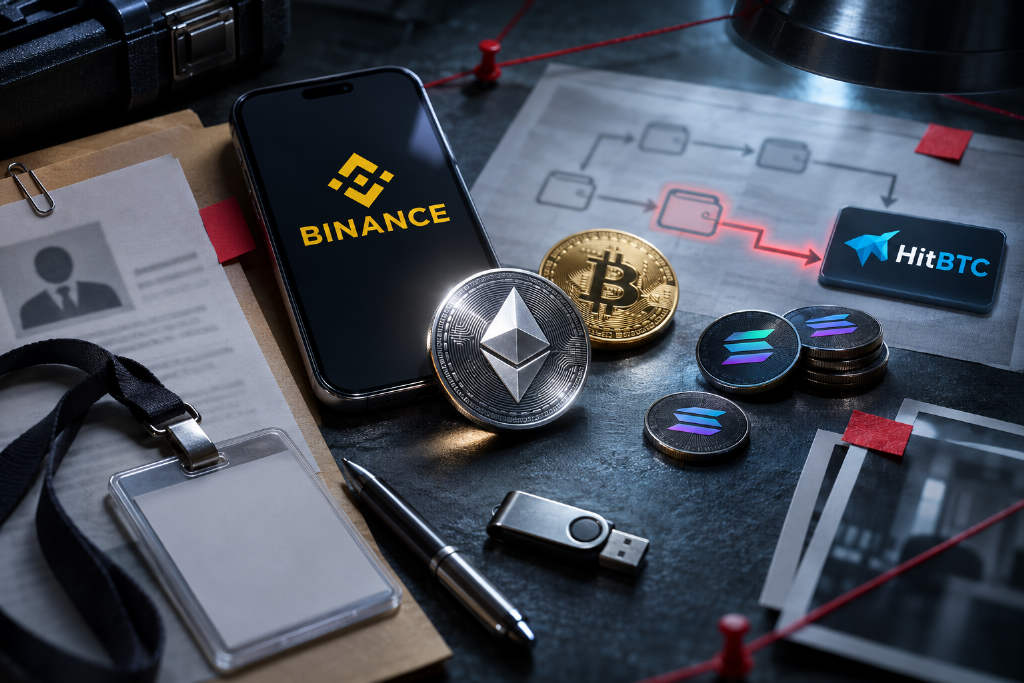
Binance’s preliminary investigation into its Oct. 29 security incident said the breach started with a fake recruitment approach.
According to the exchange, a Binance software engineer was contacted in September through a legitimate job platform by someone posing as a project director. The engineer then went through a fake HR video interview and a fake second-round interview with a supposed CEO. After that, the engineer was asked to download an assignment code repository onto a work computer. Binance said the repository contained a zero-day trojan that bypassed endpoint protection.
The attacker then used the compromised device, along with an internal AI tool, to take control of the computers of two additional wallet engineers, steal deployment credentials, and eventually run a malicious script on Oct. 29 that moved about $6.3 billion, Binance said.
Binance added that it has frozen or intercepted about $2.85 billion and has made up 98% of affected assets. The report also said the method was almost identical to the March 2022 theft involving the Ronin cross-chain bridge on Axie Infinity’s sidechain. Binance said it has detected and blocked 57 suspected North Korea-linked cyberattacks so far this year.
About 3,600 stolen SOL moved into a HitBTC hot wallet
Security firm Salus said about 3,600 SOL stolen from Binance entered a HitBTC hot wallet at 16:51 Beijing time on Nov. 3 after moving through automated scripts and multi-route transfers using a peel-chain pattern.
Salus said HitBTC had also appeared in fund transfer routes tied to major crypto theft cases before. The firm added that hackers often rely on nested services such as instant swap providers, smaller exchanges, and over-the-counter desks to move stolen funds.
Lookonchain says the attacker is still converting SOL into BTC
According to Lookonchain, the Binance hacker continues to swap SOL for BTC.
The route described by Lookonchain starts with splitting SOL across multiple wallets and selling it for USDC. The USDC is then bridged to Ethereum and used to buy ETH. The attacker then swaps ETH for BTC through THORChain.
Meme token rankings
Data from meme token tracking and analytics platform GMGN showed that as of 08:00 on Nov. 5, the top five trending tokens over the past 24 hours were as follows:
- Ethereum: cirBTC, WASTED, GTA6, DacityCoin, CTM
- Solana: BTC, DJT, STONK, AMD, SLOP
- Base: AXIS, AERO, ELSA, BOOTR, XDP
- BSC: BNCB, TAMA, AGENTINE, GANG, 驴来
Notable reads from the past 24 hours
- Tencent Hunyuan releases Hy4: Tencent Hunyuan launched the 770B open-source large model Hy4, adding visual understanding and Computer Use support for the first time. The article said it led evaluations across finance, office work, development, and research, and tested four practical tasks.
- AMD posts record revenue of $13.4 billion: AMD reported third-quarter revenue of $13.377 billion, up 45% year over year. Data center revenue reached $8.546 billion, up 97%. Fourth-quarter guidance was about $17 billion, implying roughly 66% growth. Lisa Su said AI demand had not cooled, while a slight drop in gross margin came from supply-chain costs during the early mass-production stage of rack-scale products.
- Why agent payments are stuck in a loop: The article said consumer AI agents are gaining traction, but card payment systems in B2C scenarios are not ready. Stripe is trying to build a new payment network outside Visa and Mastercard, yet every layer from protocols and wallets to checkout still holds veto power.
- Bitcoin’s “election effect”: The piece noted that in all 19 U.S. midterm elections since 1950, the S&P 500 was higher one year after the vote date. Bitcoin was also higher one year later in each of its three full cycles. IOSG, however, said historical averages should not be applied directly this year because U.S. stocks were near record highs before the election and Bitcoin was still in a recovery phase.
- Anue integrates the RootData API: Taiwan financial media outlet Anue has formally integrated the RootData API and added RootData’s tokenized stock exchange rankings to its platform.



