
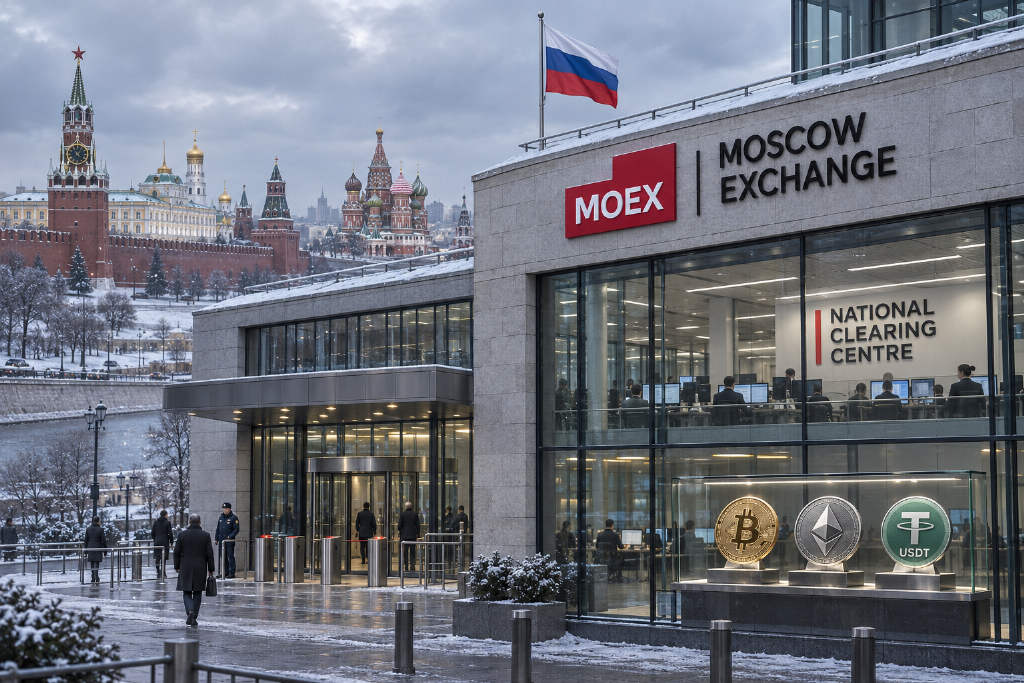
Moscow Exchange plans to launch trading in Bitcoin, Ether and Tether’s USDT on Dec. 1, saying the platform would become Russia’s first organized digital currency market.
How the market will operate
The exchange said pilot trading will begin as participants connect to the platform. The market will use the exchange’s existing stock market infrastructure, while clearing will be handled by the National Clearing Centre, or NCC.
Trading hours will run from 6:50 a.m. to 11:50 p.m. Moscow time. At the initial stage, the venue will support same-day settlement, next-day settlement and swap transactions.
Access rules for investors
Non-qualified investors will have to pass a test before buying cryptocurrencies. Annual purchases will also be capped at 300,000 rubles, about $3,700, per broker.
Legal basis for the rollout
The plan is being advanced under a Russian cryptocurrency law whose main provisions took effect on Sept. 1. The law allows regulated trading, but it still bans the use of cryptocurrencies to pay for goods and services inside Russia.
Sanctions and doubts over demand
Moscow Exchange and NCC have been under U.S. sanctions since June 2024. The U.K. also imposed sanctions on them that year, and the European Union added them to its sanctions list in July 2026.
Sergey Mendeleev, founder of the Russian cross-border payments platform Exved, told Cointelegraph that he doubts the market can attract significant demand and questioned who would trade on a sanctioned exchange.
He said the trading terms are unlikely to be competitive and compared the product to precious metals accounts at Sberbank. He also warned that investors could face 「extremely outrageous spreads」 and said the offering has no appeal at all for ordinary non-qualified investors.
Still, Mendeleev said he sees potential in cross-border payments. A venue where importers and exporters can buy and sell crypto directly with each other could be welcomed, he said, though he added that in a market where dealers negotiate spreads as low as 0.05%, it remains unclear whether adding an intermediary can stay competitive.



