
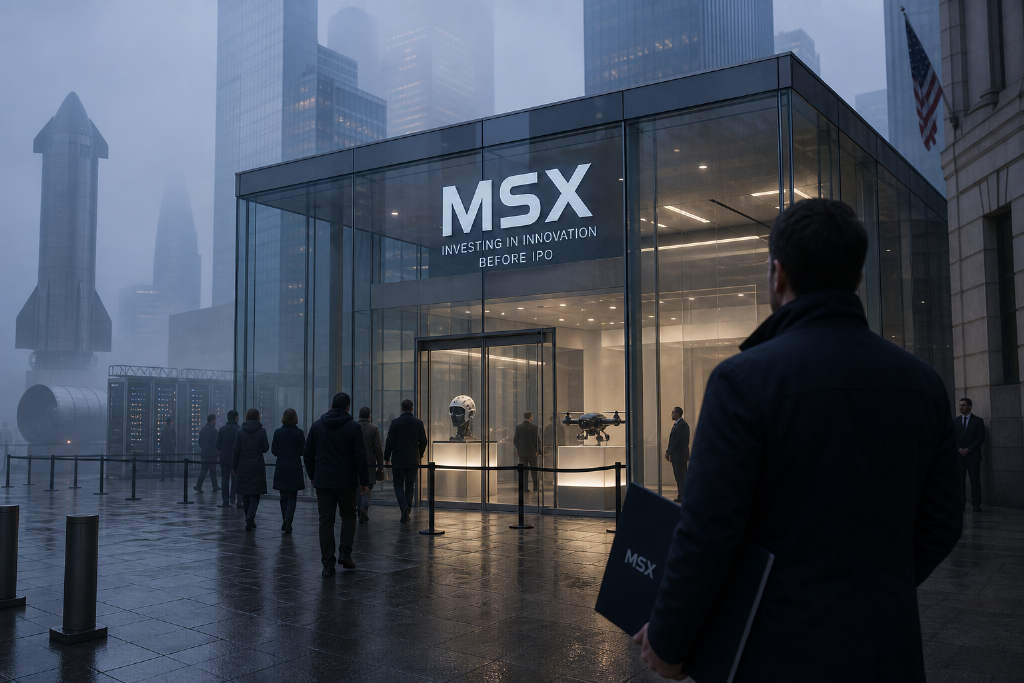
MSX will open subscriptions for the third phase of its Pre-IPO offering on Aug. 31, 2026, with Neuralink and Anduril added as the latest targets. In the PANews article, the timing matters because the platform’s first two phases have already moved beyond launch and into actual holding, listing and buyback events, giving MSX what it describes as an initial closed-loop validation of the product structure.
The piece argues that the appeal of Pre-IPO investing lies in a narrow window: a company’s value is becoming visible, its technology has started to prove itself, its commercial path is getting clearer, yet the public market has not fully priced it. Over the past few years, companies such as SpaceX, OpenAI and Anthropic have completed major fundraising rounds and valuation jumps before IPO, turning access to private-market exposure ahead of listing into a major point of demand.
MSX says the first two phases tested both listing and buyback exits
MSX formally launched its Pre-IPO section on March 2, 2026 and introduced the first batch of products. PANews says demand around private exposure to top unlisted technology companies accelerated in the following months, with more Pre-IPO, private equity and other unlisted-asset products appearing across the market.
The article’s main point is that access alone is not enough. For any Pre-IPO product, the more important question is whether the route after purchase actually works. Over the past five months, according to the report, MSX used two phases of live products to test the two core exit paths: a public-market listing route and a pre-listing buyback route.
In phase one, Cerebras and SpaceX completed what the article describes as a full path from confirmation of private shares to public-market trading.
- Cerebras (CBRS): Users subscribed at 100.35U. After Cerebras listed, MSX opened spot trading for CBRS. Based on the intraday high on the first trading day, the article says early participants at one point saw a staged combined return of more than 300%.
- SpaceX (SPCX): After a stock split adjustment, early subscription cost was about 119U. The after-hours price on the first day of listing reached $166.85, with an intraday high of $176, implying a staged gain close to 50%.
The second route, buyback before listing, has also been tested multiple times, the article says. On Aug. 20, MSX opened buybacks for phase-two names Anthropic and Polymarket. Eligible holders could either exit at the current buyback price and settle in USDT, or continue holding and wait for future valuation changes or an eventual IPO.
- Polymarket: The original Pre-IPO subscription price was 152U per share. The latest buyback price rose to 202.67U per share, for a gain of about 33.3%. PANews says that gave early participants the option to turn paper gains into realized exit proceeds.
- Anthropic: The phase-two subscription price was 855U per share, corresponding to a valuation of about $950 billion. The article says its private-market valuation has moved higher since then, while discussions in the market have mentioned a possible $2 trillion IPO valuation. Investors could also choose to keep holding.
The article adds a cautionary point. Gains of 30%, 40% or more in individual names do not mean every Pre-IPO asset will repeat the same path. What matters more, it says, is that the core product chain has started to take shape: target selection, Pre-IPO subscription, holding, listing or buyback, then liquidity and exit.
Neuralink is presented as a bet on the next human-AI interface
For phase three, PANews places Neuralink and Anduril under a common theme: AI moving out of the digital layer and deeper into the physical world. Neuralink, founded by Elon Musk in 2016, is described as one of the hardest frontier-technology stories to price because reducing it to a medical-device company that implants chips in the brain misses the broader system it is trying to build.
The article says Neuralink has been building an end-to-end brain-computer interface stack from the start, covering implanted devices, flexible electrodes, neural signal decoding, wireless communications and the surgical robot used for precision implantation. The most important change over the past two years, according to PANews, is that the technology has moved from the lab into human use.
Neuralink completed its first human implant in 2024. By early 2026, more than 20 participants worldwide had received implants as the clinical program expanded. The article treats that step as Neuralink’s move from zero to one.
PANews then describes the company’s most aggressive end-state as compressing today’s interaction chain — brain to hand to keyboard to AI to screen to eyes — into a direct brain-to-AI loop. In that scenario, people could control computers, phones, robotic arms and potentially other machines through direct reading of neural signals.
The report says medicine remains the most realistic and most important entry point for now. If brain-computer interfaces can eventually overcome limits tied to long-term safety, bandwidth, implantation efficiency and scale, Neuralink’s addressable market may be far larger than what current medical-device categories can capture. The article frames the opportunity as a Human × AI Interface, a new interface layer between people and AI.
It links that narrative to valuation changes. Neuralink was valued at about $9.65 billion in its 2025 Series E financing, the article says. After entering 2026, some private-market trades and bids implied valuations in the tens of billions of dollars.
PANews also compares Neuralink at its current stage to an earlier SpaceX, arguing that both were difficult to explain through traditional industry valuation models. In Neuralink’s case, part of the story has been proven, but the factors that would define the upper bound of valuation remain unproven.
Anduril is framed as AI moving into defense execution
Anduril, by contrast, is presented as AI entering the battlefield. PANews says the company, founded in 2017, was initially best known for border surveillance and counter-drone systems. Less than a decade later, its product line has expanded into autonomous combat aircraft, cruise missiles, underwater autonomous systems, counter-drone defense, solid rocket motors and Lattice, the AI command-and-control platform at the center of the larger system.
That is why calling Anduril a drone company is no longer accurate, according to the article. The real challenge it poses is to the long-established U.S. defense-industrial model. PANews characterizes that traditional model as one built around long development cycles, high costs, and a relatively fragmented procurement and development structure between software and hardware. Anduril, in contrast, is described as bringing a more Silicon Valley-style approach: software first, AI-driven systems, autonomy, rapid iteration and scaled manufacturing.
The article draws a line from Palantir to Anduril. If Palantir showed that AI could move into the decision layer of defense by processing data, shaping judgment and assisting decisions, Anduril represents the next step into the execution layer. In that role, it connects sensors, drones, fighter aircraft and weapons systems, and takes part in mission execution.
PANews says the capital market’s reassessment of Anduril is one of the main reasons it appears in phase three. The company generated about $2.2 billion in revenue in 2025, according to the article. In 2026, the U.S. Army also established an enterprise procurement framework with a ceiling of $20 billion over 10 years. PANews says that moved Anduril from a defense-tech startup competing for single contracts into a more durable and scaled U.S. defense procurement system.
At the same time, the company has been building its Arsenal manufacturing system. The article presents that effort as an attempt to solve one of the hardest problems for defense startups: large-scale production. In its wording, Anduril is trying to combine AI, autonomy, software, hardware and manufacturing into a new defense-industrial platform.
Valuation data in the article tracks that shift. Anduril was valued at about $8.5 billion in 2022, about $14 billion in 2024 and about $30.5 billion in 2025. Its Series H financing in May 2026 lifted the valuation to $61 billion. By August, Forge reference pricing in the private market implied a valuation above $110 billion.
PANews says that level is not cheap, but argues that Palantir has already shown public investors are willing to pay a premium for a mix of AI, defense and platform capabilities above what traditional defense contractors typically receive. In that framing, Anduril is pursuing a similar re-rating.
Phase three extends MSX’s asset range from compute to brain-computer interfaces and defense tech
The article’s broader conclusion is that Neuralink and Anduril operate in very different industries but share one feature: the market is trading what they may become. Neuralink is portrayed as moving from a brain-computer interface medical company toward a possible Human × AI Interface. Anduril is portrayed as moving from a defense-tech startup toward a possible AI + Defense Platform.
That is the common thread PANews highlights in MSX’s third Pre-IPO phase. The next round of AI value creation may not stay inside models and screens. It may move further into the physical world.
From phase one through phase three, MSX’s target range has expanded from Cerebras and SpaceX to Anthropic and Polymarket, then to Neuralink and Anduril. The sectors now covered span AI compute, commercial space, generative AI, prediction markets, brain-computer interfaces and AI-driven defense technology.
The article says the more important point is not the label on each industry but the selection logic behind them: MSX intends to keep looking for leading unlisted companies that have already completed part of their technical or commercial validation but have not yet been fully priced by public markets. In this framing, the value of Pre-IPO is not simply buying earlier than an IPO. It is identifying moments when a company’s technical capability, commercial scale and market identity are still changing fast enough to alter the valuation model itself.
The report also points to unresolved risks
PANews ends by noting the uncertainty that comes with this type of investment. Neuralink still faces long-cycle questions around clinical progress, safety, regulation and commercialization. Anduril still has to prove that large orders and procurement frameworks can translate into sustained revenue and profit growth, while absorbing a private-market valuation that has already climbed sharply.
The article’s closing argument is that strong Pre-IPO assets rarely appear only after every answer is already known. Once technology is fully mature, the business model is fully proven and the growth path is clear, public markets have often already completed the most important round of price discovery. For MSX, phase three extends a longer-term search for platform-scale companies that are redefining themselves before public markets fully recognize them.