
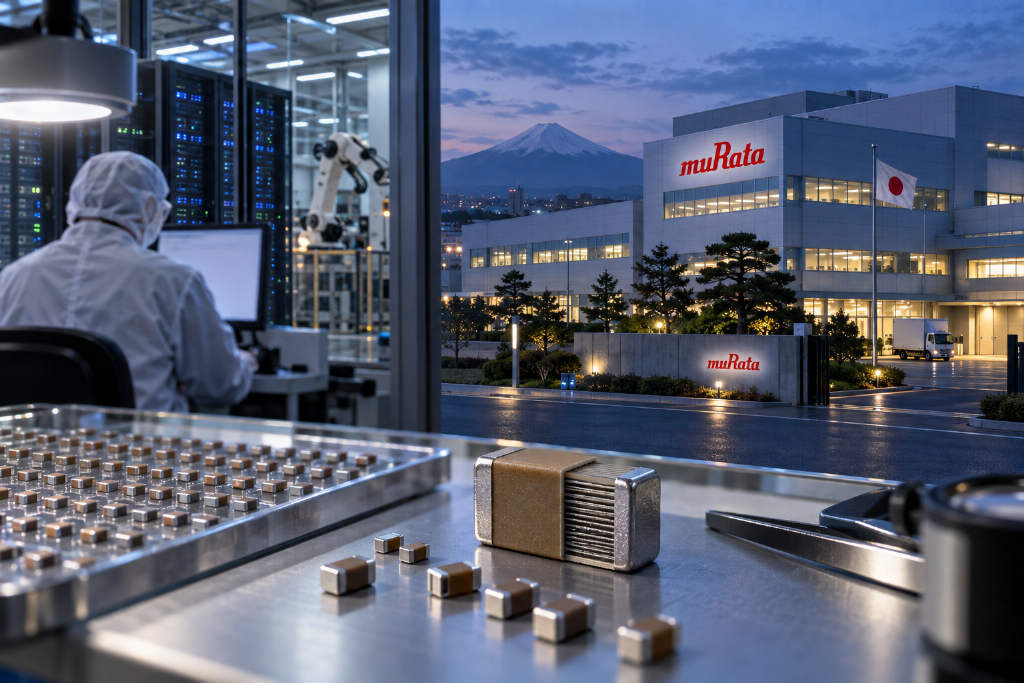
Murata Manufacturing Vice President Masanori Minamide said the company does not plan to adjust MLCC prices in response to short-term supply and demand shifts, keeping its pricing policy centered on long-term customer relationships, according to an interview with Nikkei. On demand, Minamide said growth tied to AI servers should continue at least through 2028. He also identified robots based on physical AI as the next major growth engine.
AI servers are reshaping MLCC demand
Minamide said the rapid buildout of AI infrastructure is changing the structure of MLCC demand. The number of MLCCs installed in each AI server continues to rise, and demand is no longer limited to smaller and higher-capacity parts. The market for heat-resistant MLCCs is also expanding, pushing the overall product mix toward higher value-added offerings.
He said demand growth for AI-related MLCCs is likely to continue at least through 2028. Over a longer horizon, he said that demand base could spread from AI data centers to edge AI devices.
Murata has already moved to position itself inside the AI ecosystem. The company has invested in Noetra, an AI foundation model developer backed by SoftBank and more than 40 Japanese companies. It is also taking part in related industry alliances to better understand how MLCCs are used in AI systems and what technical issues arise during component installation, with the aim of aligning product development with market demand.
Pricing policy stays unchanged
On expectations for higher MLCC prices, Minamide drew a clear line. He said Murata will not change its pricing principle, which is built around long-term trust with customers. In his view, raising or cutting prices too often based on near-term supply and demand could encourage new entrants to come into the market and weaken Murata’s long-term competitive position.
He said, 「Pricing decisions driven by short-term profit are not conducive to improving corporate value over the medium to long term.」
At the same time, Minamide said large price moves by competitors could still affect Murata’s product mix plans and production response. The company is closely watching competitors’ pricing and broader market trends. That stance suggests the market may not need to expect sharp MLCC price increases in the near to medium term.
Murata is studying more capacity over the next three to five years
On supply, Murata is moving ahead with a major capacity expansion. Minamide said the company had anticipated the spread of autonomous driving years ago and positioned itself early, allowing it to secure the factory space it needs through 2028 ahead of competitors. That has helped support its push for AI server-related orders.
Still, Murata believes MLCC demand will keep expanding based on customer needs, and its current plans are no longer enough. The company is now reviewing additional expansion measures with a three- to five-year horizon, including new plant construction. One option is to build larger facilities at existing production bases in Japan and overseas.
Murata had previously announced an extra ¥80 billion investment in MLCC production equipment over the two years through fiscal 2028. Minamide indicated the scale of the next expansion round could go beyond that figure.
Robots, 6G and M&A are part of the next phase
Looking further out, Murata sees physical AI as one of the most important emerging growth areas. As AI extends from digital computing into control and perception in the physical world, the company expects robots’ demand for high-performance, high-reliability electronic components to become the next core driver after AI servers.
Murata is also studying how the adoption of 6G could change demand for communication components and sensors. On strategy, the company has made clear that acquisitions are on the table rather than limiting itself to internal development.
Beyond MLCCs, Murata is targeting power modules and communications parts
Even as its core MLCC business expands, Murata is pushing further into component diversification. Minamide pointed to power modules for AI servers as a major growth opportunity, and said the company plans to direct capital spending and engineering resources toward that area.
In communications components, Murata expects a clear expansion in revenue and profit from fiscal 2028, tied to customer design changes. Taken together, the company is trying to build positions across three growth tracks at the same time: AI computing infrastructure, physical AI robots and 6G communications, while creating a broader long-term growth base outside MLCCs.