
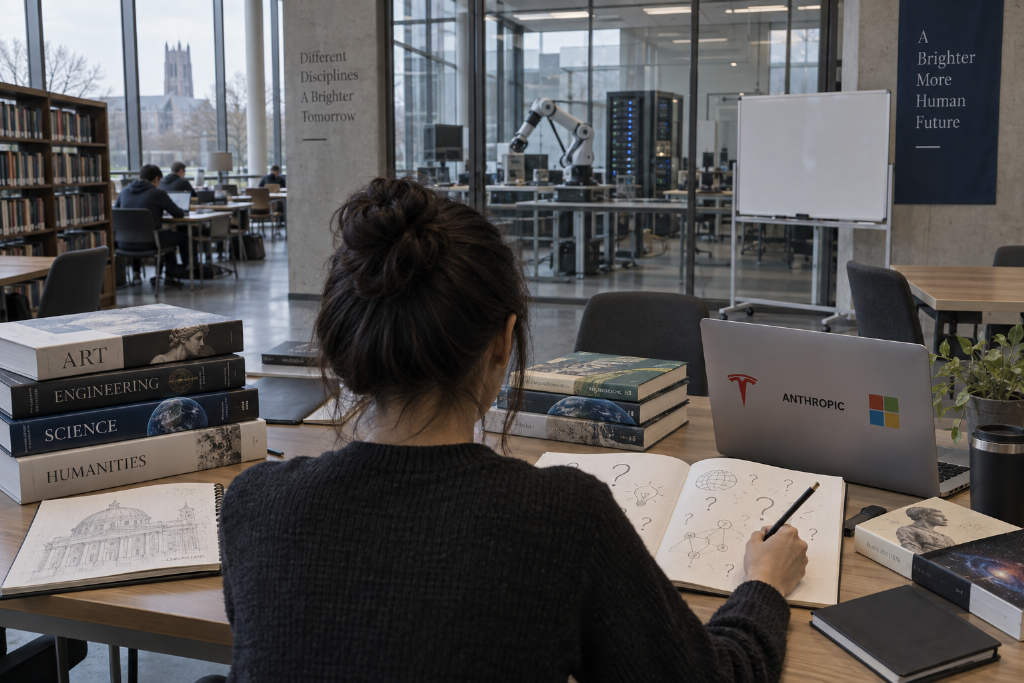
Elon Musk, Anthropic co-founder Jack Clark, and Microsoft chief scientist Jaime Teevan have recently offered young people much the same advice on choosing a college major in the AI era: do not bet everything on one narrow field, and build the widest knowledge base possible.
Three voices, one direction
The report says the three come from very different roles, but their message lines up. Each points to broad education and the ability to ask questions as the more durable advantage.
In a recent interview with China Central Television, Musk was asked how a 20-year-old could find value during the AI transition. He did not respond with a list of majors. Instead, he said young people should get the broadest possible foundational education, covering art, science, engineering, and wide general knowledge.
His reasoning was straightforward: if people want to know what to ask robots to do, they first need the ability to organize the question itself. The broader a person’s general knowledge, the more precisely that person can ask. Musk linked that idea to what people call prompt engineering.
In the same interview, Musk also predicted that there will be at least 1 billion humanoid robots within 10 years, and possibly in less than 10 years. Following that logic, as the number of robots rises, the human role shifts from doing the work by hand to stating what is needed. The quality of that request shapes the result.
What Clark and Teevan emphasized
Clark said at a seminar earlier this year that he graduated with a literature degree, an unusual background for a co-founder of a frontier AI company. What later proved useful, he said, was learning a great deal of history and understanding how people tell themselves stories about the future.
For Clark, the key is knowing what questions to ask and keeping an instinct for what can emerge when ideas from different disciplines collide. He also suggested avoiding degree paths centered on rote programming study and choosing programs that place more weight on interdisciplinary synthesis and analytical thinking.
Teevan, in an interview with The Wall Street Journal, offered a more detailed list: flexibility, adaptability, willingness to experiment, critical thinking, and the courage to question established views. She described these as metacognitive abilities, or the ability to manage how one thinks, and said traditional liberal education is really important.
Prompt skills are losing some of their edge
The report also points to a tension. As models become better at understanding natural language directly, the need to carefully shape wording just to please the model is no longer seen as strong as it once was. The barrier around prompting skills is being gradually absorbed by the models themselves.
On that reading, what Musk is really pointing to may not be sentence-level technique, but an earlier step: whether a person knows what they actually want. The report argues that machines cannot do that part for people, because it depends on understanding the world, which comes from breadth of knowledge.
Clark’s wording is presented as more exact. His focus is on knowing what to ask, not on knowing how to write an instruction.
The distinction matters, the report says. Techniques can be learned quickly, and they can expire quickly too. Judgment takes much longer to build. As machines grow more capable, that kind of judgment becomes more valuable, not less.