
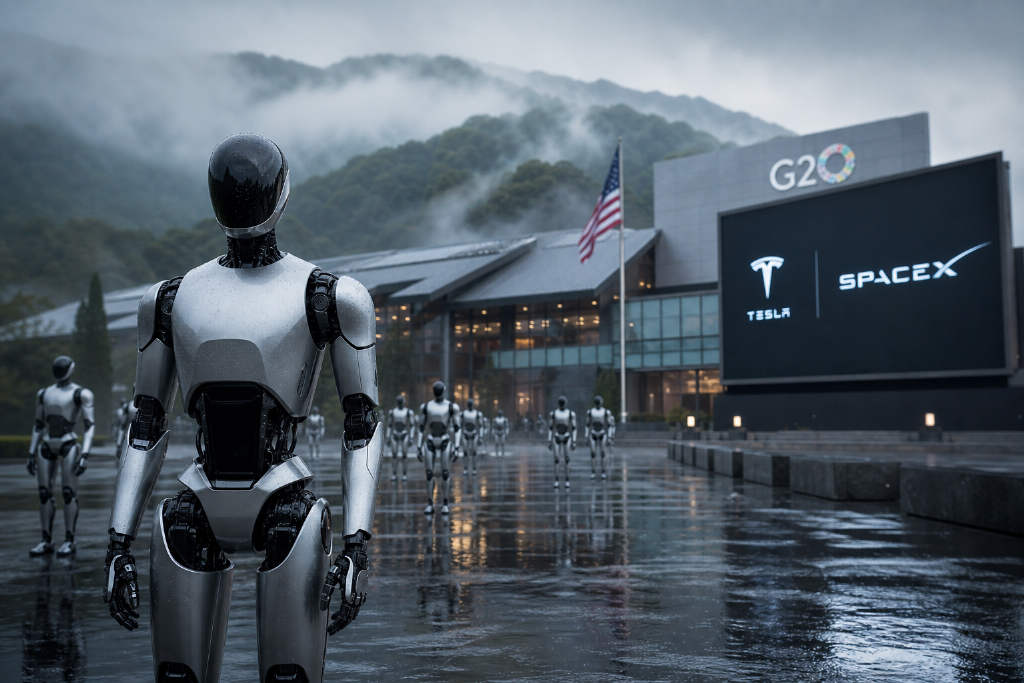
One billion humanoid robots could be walking the planet within a decade, each producing at least five times as much as a person. That was Elon Musk's prediction on Tuesday at the G20 summit in Asheville, North Carolina, delivered over video link.
The Tesla and SpaceX chief executive said the productivity gains from AI are already plain to see, and robotics will carry productivity to a new level. He projected AI could expand the global economy by 20% to 30%, adding $20 trillion to $30 trillion in annual output. Humanoid robots, in his view, are a bigger multiplier: with each unit producing at least five times as much as a human, their widespread adoption could expand the global economy more than tenfold.
Musk also laid out a tighter timeline. By the end of next year, AI will be able to handle nearly all digital tasks that don't require altering the physical world. AI software will reach Stockfish-level strength, and humans will no longer be able to compete with it when writing programs. Within 12 to 18 months, he expects AI to become highly capable across all forms of engineering and digital work.
His remarks come as SpaceX deepens its own AI bet. The company's AI business recorded $2.6 billion in revenue for the second quarter, up 247% year over year. Spending on AI infrastructure hit $15.8 billion in the same period, channeled mainly into the Colossus II data center expansion and representing roughly 86% of total capital expenditure.
SpaceX has also been active on the acquisition front, buying AI coding platform Cursor for $60 billion and rolling out its newest model, Grok 4.6.