
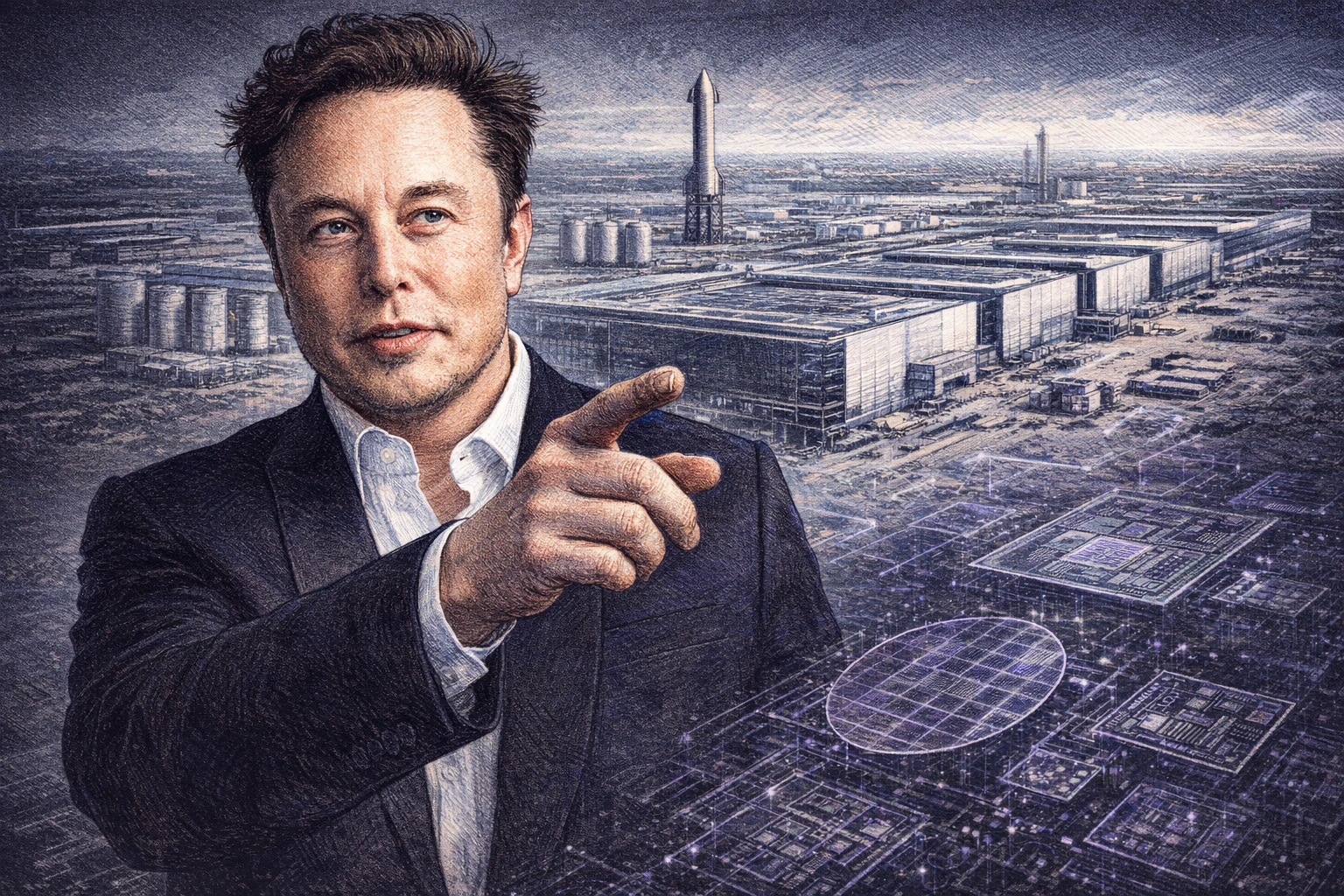
Elon Musk dropped major details on the Terafab project during Tesla's Q1 2026 earnings call on April 22. He warned that logic chips and memory chips will face severe shortages, and without building its own capacity, Tesla will inevitably hit a production bottleneck. The Terafab isn't a bargaining chip with suppliers — Musk sees no path to meet AI compute demand through external sourcing alone.
R&D Fab at Giga Texas: $3B, Intel 14A, Thousands of Wafers Per Month
Musk disclosed the first concrete outlines of the R&D fab: it will be located at the Giga Texas complex, with a budget of approximately $3 billion, a monthly capacity of thousands of wafers, and using Intel 14A process. He explained that Terafab starts as an R&D line and then scales to mass production. By the time the 'initial scale-up phase' begins, Intel 14A is expected to be mature and production-ready. Notably, the scale-up from R&D to volume production will be led by SpaceX, not Tesla. SpaceX's experience in ramping rocket manufacturing and system integration is seen as the key lever to move from lab scale to industrial scale.
World's First: Mask, Logic, Memory, Packaging Under One Roof
The most disruptive design feature is extreme vertical integration: lithography mask creation, logic chips, memory chips, and packaging all inside the same building. Musk said bluntly, 'There is no other place in the world where these four things are under one roof.' The engineering logic is a quick iteration loop. In conventional chip development, mask making, logic design, memory integration, and packaging are split across different suppliers and locations, with turnaround times measured in weeks or months. Terafab compresses the entire chain into one building, aiming to iterate AI chip design several times faster than the industry norm — supporting Optimus robots, Full Self-Driving, and xAI compute needs.
Intel Joins, Taiwan Hiring Spree, and a Nod to TSMC
The earnings call adds the latest chapter to a string of Terafab moves. Earlier, Intel formally joined the Terafab project, working with SpaceX and Tesla to build terawatt-scale AI compute infrastructure. On the talent front, Tesla has been aggressively recruiting in Taiwan, offering triple salaries to lure engineers skilled in 2nm process and CoWoS advanced packaging — directly targeting TSMC's core talent pool. Addressing questions about competition with TSMC, Musk stated, 'Terafab will always be TSMC's biggest customer, not a competitor.' This echoes Terafab's positioning: to fill the absolute gap in AI compute, not to replace existing fabs. He earlier estimated that global AI compute capacity of about 20 GW covers only 2% of his long-term needs — a gap so massive that current supply chains can't even imagine it.
From a financial perspective, the $3 billion R&D fab is just the start. Bernstein analysts estimate the full build-out could cost up to $5 trillion, while Tesla's official budget range is $25–40 billion. Phase one targets production in the second half of 2027, volume ramp in 2028, and full completion by 2030. When the world's most famous tech entrepreneur decides to build a chip fab from scratch, the signal is bigger than any earnings number: the AI compute race is no longer just about software, models, or cloud capacity — who controls the physical infrastructure of chip manufacturing will write the next set of rules.