
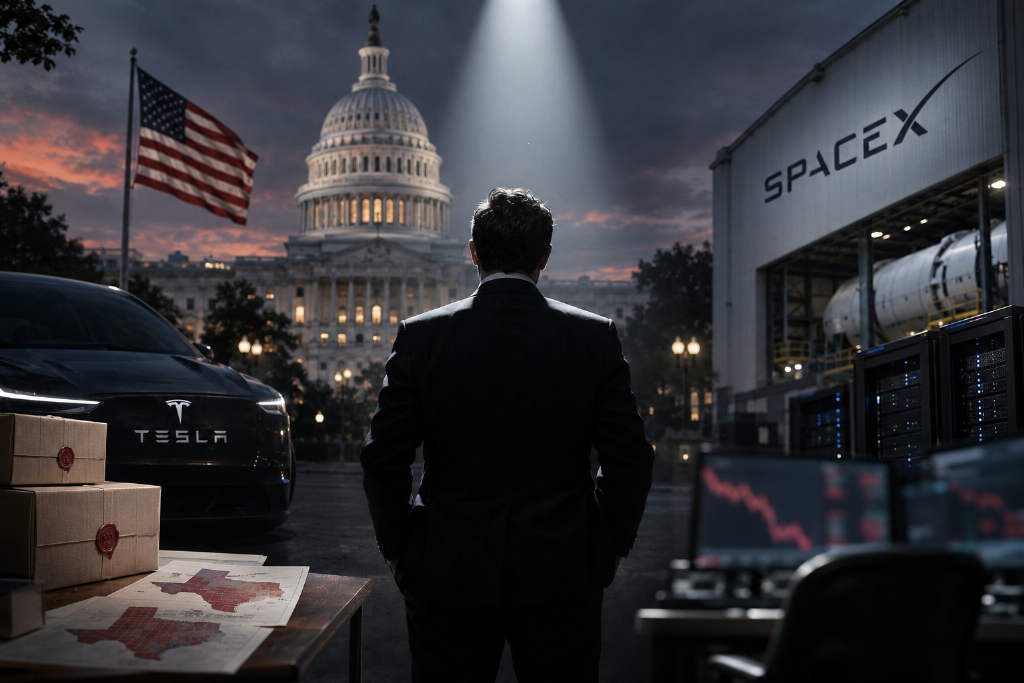
Elon Musk’s political bets and corporate empire came under pressure at the same time after the U.S. midterm election changed the power balance in Washington and delivered key results in Texas. After Democrats won control of both chambers of Congress and prevailed in major Texas races, Tesla and SpaceX shares came under pressure, cutting more than $60 billion from Musk’s paper wealth.
In Wednesday premarket trading, Tesla and SpaceX were down about 5.7% and 7.6%, respectively. Based on Musk’s equity holdings in the two companies, the move erased more than $60 billion from his fortune on paper, though the article noted that valuations could keep shifting with market prices.
Musk spent at least $474 million in the 2026 cycle
Musk was described as one of the Republican Party’s most important individual political donors in this midterm cycle. CNBC, citing filings with the U.S. Federal Election Commission, calculated that he spent at least $474 million in the 2026 election cycle. About $224 million of that total went to Texas-related campaigns, close to half of the overall amount.
The article said Musk strongly backed Republican Senate candidate Ken Paxton and wanted Republicans to keep control of Congress and the Texas state government. That did not happen. Democrat James Talarico won the Texas U.S. Senate race, while Gina Hinojosa defeated Republican incumbent Greg Abbott in the state’s gubernatorial contest.
Texas has long been a Republican stronghold and has also become a core base for Musk’s business operations. Tesla and SpaceX have both established headquarters there and built out major manufacturing and infrastructure investments in the state. Musk had previously moved from California to Texas, in part because of what the article described as a looser business regulatory environment. That made the election outcome more than a political setback. It also introduced new uncertainty into the operating environment for his two key companies.
Texas policy risk centers on data centers and AI expansion
Market concerns in the article focused on three areas: artificial intelligence investment, government contracts and corporate regulation.
At the state level, newly elected Texas Governor Gina Hinojosa was described as taking a more cautious view of large data center projects. She supports pausing approvals for new data center construction until local governments put in place clearer rules on electricity use, water consumption and community protections. She also opposes what the article called overly generous tax treatment for large technology companies.
That could affect Musk’s expansion plans in Texas. Tesla is pushing ahead locally with AI computing, robotics and self-driving operations, while SpaceX plans to expand semiconductor and AI infrastructure investment. Reuters was cited as saying SpaceX is seeking to accelerate the buildout of its AI computing capacity, and that related business has become an important driver of revenue growth. If approvals for data center construction become harder to obtain, some projects could be delayed, costs could rise and expected revenue realization could be pushed back.
Congressional scrutiny may intensify under Democratic control
The article also pointed to Washington. With Democrats controlling both chambers of Congress, Musk and his companies could face tougher scrutiny in their dealings with the U.S. government. Some Democratic lawmakers had already called for investigations into SpaceX government contracts, federal workforce cuts during Musk’s leadership of the Department of Government Efficiency, and national security disputes tied to satellite communications services.
That said, stronger congressional oversight does not mean those contracts would automatically be terminated. The article noted that Trump still controls the executive branch and retains veto power, while SpaceX’s importance in the U.S. launch market could also limit how far policy changes go.
A possible Tesla-SpaceX merger faces added uncertainty
The election result may also complicate a previously discussed merger scenario involving Tesla and SpaceX. Bloomberg was cited as reporting that the two companies have explored a potential combination, though any deal remains at an early stage. Such a transaction could bring together Tesla’s self-driving and robotics technology with SpaceX’s satellite communications and AI computing businesses, creating a larger technology group.
But with Democrats in control of both chambers, any major deal involving a giant technology company could draw more political attention. Market participants cited in the article said Congress might not be able to block a merger directly, but hearings, investigations and policy oversight could add uncertainty to the process.
Investors are reassessing political risk and AI spending
Investors are also rethinking Musk’s heavy capital commitments to AI and whether those projects can deliver the returns that had been expected.
After the election, Musk responded on social media with a joking remark, saying that 「space data centers now seem more attractive」, a reference to SpaceX’s concept of orbital computing facilities as regulation around ground-based data centers tightens. The article added that space data centers still face technical and commercial hurdles, including heat dissipation, maintenance and construction costs, making them difficult to use as a near-term substitute for terrestrial facilities.
In the article’s framing, Musk is dealing with a double hit. Hundreds of millions of dollars in political spending failed to preserve Republican control in Congress and Texas, and declines in Tesla and SpaceX shares amplified the swing in his personal wealth. For investors, the bigger issue is not the size of the one-day paper loss itself, but how Texas regulation, congressional oversight and the outlook for AI capital spending evolve from here. Those factors will determine whether the election impact remains a short-term market move or feeds into the longer-term valuation of Musk’s business empire.



